


As Catholics around the world mourn Pope Francis, many Ukrainians would remember him bitterly for failing to clearly blame Russia for its invasion and calling for Ukraine to raise the “white flag.”
Ukrainian President Volodymyr Zelenskiy would be one of the prominent mourners at today’s funeral for Francis, even though the pope never visited Ukraine and critics said he echoed Kremlin talking points by saying the war was “provoked” and portraying it as part of a wider global confrontation.
A senior Ukrainian official said the Argentine pontiff had been shaped by Marxist-influenced ideas and showed an “absolute ignorance of this part of the world.”
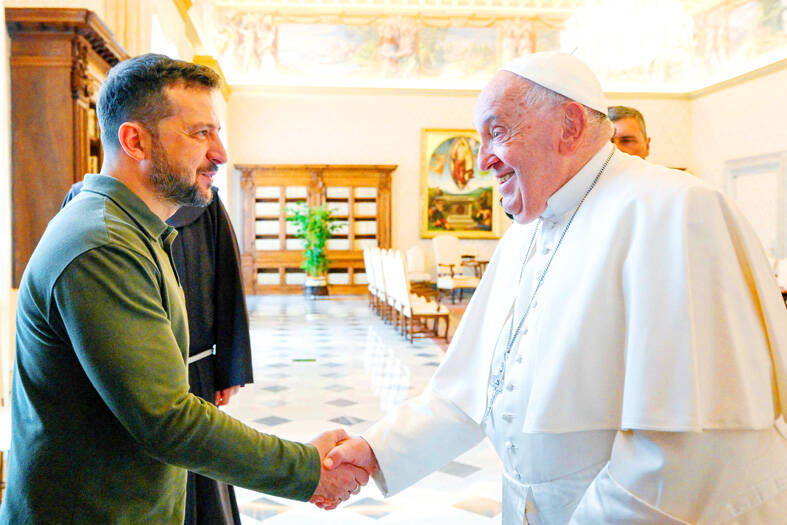
Photo: AFP
“He did not really understand and was not even trying to understand what was happening here,” the official said on condition of anonymity.
At the same time, Ukrainian officials have recognized the Vatican’s efforts in mediating prisoner exchanges and the return of children taken from occupied parts of Ukraine to Russia.
Zelenskiy said Francis had “prayed for peace in Ukraine.”
However, the official said the pope “could have done incomparably more for Ukraine,” for example, by persuading countries of the global south to support Ukraine’s struggle.
Above all, Francis “refused to make a clear distinction” between Russia as the aggressor and Ukraine as the victim of the invasion, the official said.
There was frustration soon after the start of the invasion in February 2022 when the Vatican asked two lifelong friends, a Russian woman and a Ukrainian woman, to carry a cross together during a Good Friday ceremony attended by Francis in Rome.
The initiative, intended as a gesture of reconciliation, was not well received in Ukraine. Ukrainian media boycotted the broadcast of the ceremony.
Bishop Sviatoslav Shevchuk, the head of the Ukrainian Greek Catholic Church, denounced an “inappropriate, premature and ambiguous idea, which does not take into account the context of Russia’s military aggression.”
Over more than three years of war, the pope repeatedly called for peace in Ukraine, but stopped short of a clear condemnation of Russian actions, saying the war was “not a cowboy film with goodies and baddies.”
His comments last month in an interview with Swiss broadcaster RTS proved incendiary in Ukraine.
“I think whoever sees the situation, thinks about the population and has the courage of the white flag is stronger,” the pope said.
“You see that you are defeated, that things are not going well, have the courage to negotiate,” he said.
Then-Ukrainian minister of foreign affairs Dmytro Kuleba slammed the comments.
“Our flag is a yellow and blue one. This is the flag by which we live, die and prevail. We shall never raise any other flags,” Kuleba said.
He also referred to historical accusations of inaction by the Catholic Church against Nazi Germany.
“When it comes to the white flag, we know this Vatican strategy from the first half of the 20th century,” he said, urging the Holy See to “avoid repeating the mistakes of the past.”
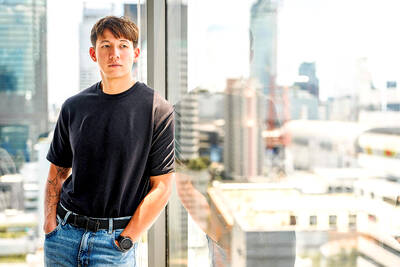
SPEAKING OUT: After Siranudh Scott’s allegations surfaced, celebrities and public figures took to social media to share their own experiences of sexual misconduct and abuse A high-profile alleged sexual abuse case within a wealthy Thai beer brewing family has prompted a wave of painful accounts from survivors of unconnected abuse in the conservative nation. Siranudh Scott, a member of the billionaire Thai family that founded the ubiquitous Singha beer brand, posted an emotional video this month accusing his elder brother Sunit of repeatedly abusing him when he was a teenager. Sunit, who is in his 30s, later denied the allegations in a video posted online, but Singha parent Boonrawd dismissed him from his executive role with the company on Tuesday last week. “I felt I needed to speak
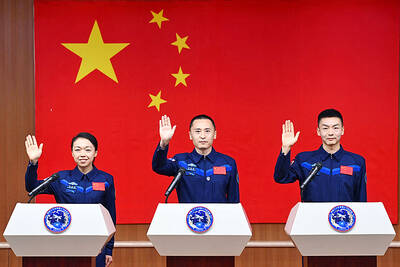
A Hong Kong astronaut is to join a Chinese space mission for the first time as part of a three-person crew launching today, as Beijing edges closer to its goal of landing people on the moon. The Tiangong space station — crewed by teams of three astronauts that are typically rotated every six months — is the crown jewel of China’s space program, boosted by billions in state investment in a bid to catch up with the US and Russia. The Shenzhou-23 mission is to blast off at 11:08pm from the Jiuquan Satellite Launch Center in northwestern China, carrying three astronauts to

SEEKING ORDER: Rodrigo Paz said that ‘anyone who wants to destroy the nation will have to deal with this president and the full force of the constitution’ Bolivian President Rodrigo Paz on Wednesday said that the nation was at a “breaking point” after nearly a month of protests that have caused shortages of food, fuel and medicine. Paz, who took office six months ago amid the worst economic crisis there in four decades, is battling a groundswell of fury over his policies. The political capital, La Paz, has been besieged by low-income workers and members of the indigenous majority calling for his resignation. “The country needs order and is reaching breaking point,” the 58-year-old said at a public event in La Paz, renewing his appeal for dialogue. On Tuesday, the Bolivian
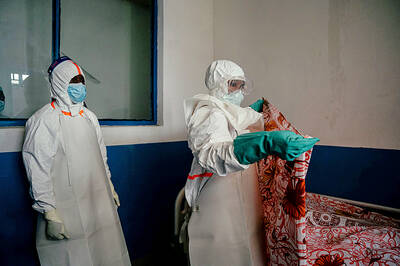
UPGRADED ALERT: The risk inside DR Congo is now considered ‘very high,’ while neighboring countries face a ‘high’ threat as the outbreak continues, the WHO said Ebola is spreading faster than responders can track it in eastern Congo, where health workers managed to follow up with barely one in five identified contacts in a single day. Authorities in the Democratic Republic of the Congo (DR Congo) reported 83 confirmed infections, 746 suspected cases and 1,603 identified contacts as of Thursday, but health workers were able to follow up on only 342 contacts that day — about 21 percent of the total under monitoring — data released by the DR Congo Ministry of Public Health on Friday showed. The figures suggest the response is falling behind the outbreak itself,


 RSS
RSS