


The Vatican yesterday made final preparations for Pope Francis’s funeral as the last of the huge crowds of mourners filed through St Peter’s Basilica to view his open coffin.
Many of the 50 heads of state and 10 monarchs attending today’s ceremony in St Peter’s Square, who include US President Donald Trump and Ukrainian President Volodymyr Zelenskiy, were expected to arrive in Rome yesterday.
Italian and Vatican authorities have placed the area around St Peter’s under tight security ahead of the funeral, with drones blocked, snipers on roofs and fighter jets on standby.
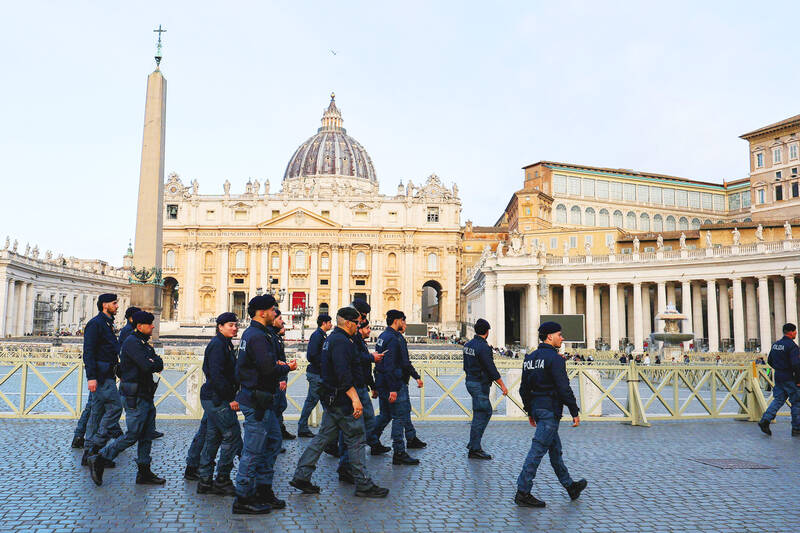
Photo: Reuters
Further checkpoints were to be activated last night, police said.
Tens of thousands of people have already queued for hours to pay their last respects to Francis, whose coffin was to be closed at 8:00pm yesterday in a ceremony attended by senior cardinals.
Cardinal Kevin Farrell, the camerlengo who is running the Vatican’s day-to-day affairs until a new pope is elected, would preside over the so-called “Rite of the Sealing of the Coffin.”
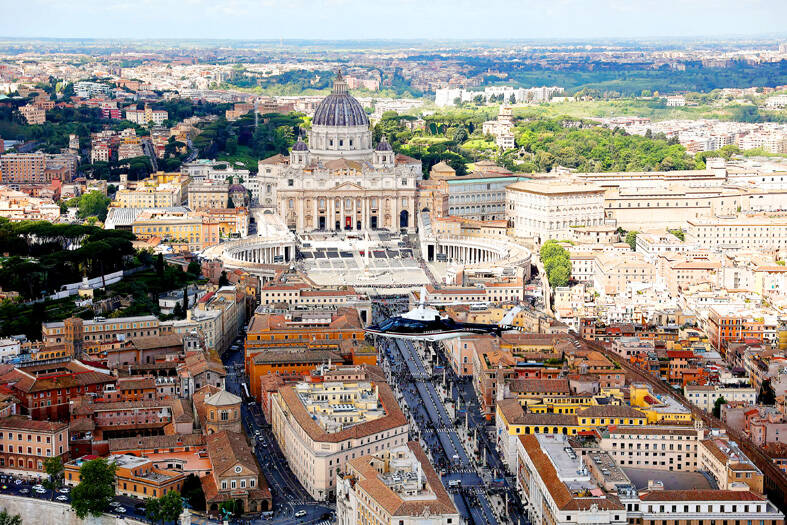
Photo: Reuters
The Catholic Church’s first Latin American pope died on Monday, aged 88, less than a month after spending weeks in hospital with severe pneumonia.
The Argentine pontiff, despite longstanding health issues, defied doctors’ orders by appearing at Easter, the most important moment in the Catholic calendar.
Condolences have flooded in from around the world for the Jesuit, an energetic reformer who championed those on the fringes of society in his 12 years as head of the world’s 1.4 billion Catholics.
He used his last speech to rail against those who stir up “contempt ... towards the vulnerable, the marginalized and migrants.”
At least 130 foreign delegations are expected at his funeral, including Argentine President Javier Milei and Britain’s Prince William, and a no-fly zone would be in force.
The pope’s coffin was set before St Peter’s altar for his three days of lying-in-state, with Francis dressed in his papal vestments — a red chasuble, white mitre and black shoes.
“It was a brief, but intense moment next to his body,” said Italian Massimo Palo, 63, after his visit.
“He was a pope amongst his flock, amongst his people, and I hope the next papacies will be a bit like his,” he added.
Italy’s civil protection agency estimates that “several hundred thousand” people would descend on Rome on what was already set to be a busy weekend due to a public holiday yesterday.
After the funeral, Francis’s coffin would be driven at a walking pace to be buried at his favorite church, Rome’s papal basilica of Santa Maria Maggiore.
The pontiff was a champion of underdogs, and a group of “poor and needy” would be there to welcome the coffin, the Vatican said.
He would be interred in the ground, his simple tomb marked with just one word: Franciscus.
People would be able to visit the tomb from tomorrow morning.
Following that, all eyes would turn to the process to choose Francis’ successor.
Cardinals from around the world have been returning to Rome for the funeral and the conclave, when a new pontiff would be elected.
In the absence of a pope, the cardinals have been meeting every day to agree on the next steps, with another meeting due yesterday.
They have yet to announce a date for the conclave, but it must begin no fewer than 15 days and no more than 20 days after a pope’s death.
Only those younger than 80 — about 135 cardinals — are eligible to vote. Italian Cardinal Pietro Parolin, who was number two to Francis, is the favorite, British bookmakers William Hill said.
They put him ahead of Metropolitan Archbishop emeritus of Manila Luis Antonio Tagle, followed by Ghanaian Cardinal Peter Turkson and Archbishop of Bologna Matteo Zuppi.
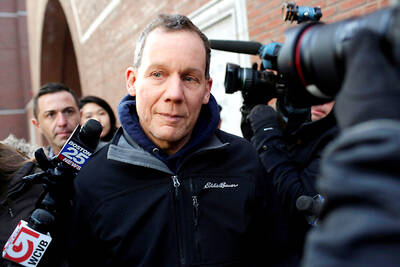
An American scientist convicted of lying to US authorities about payments from China while he was at Harvard University has rebuilt his research lab in Shenzhen, China, to pursue technology the Chinese government has identified as a national priority: embedding electronics into the human brain. Charles Lieber, 67, is among the world’s leading researchers in brain-computer interfaces. The technology has shown promise in treating conditions such as amyotrophic lateral sclerosis and restoring movement in paralyzed people. It also has potential military applications: Scientists at the Chinese People’s Liberation Army have investigated brain interfaces as a way to engineer super soldiers by boosting
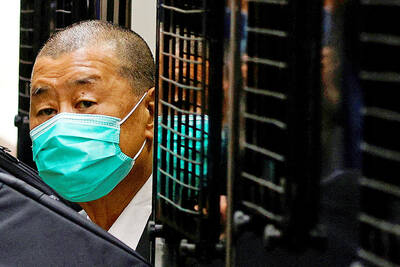
Jailed media entrepreneur Jimmy Lai (黎智英) has been awarded Deutsche Welle’s (DW) freedom of speech award for his contribution to Hong Kong’s pro-democracy movement. The German public broadcaster on Thursday said Lai would be presented in absentia with the 12th iteration of the award on June 23 at the DW Global Media Forum in Bonn. Deutsche Welle director-general Barbara Massing praised the 78-year-old founder of the now-shuttered news outlet Apple Daily for standing “unwaveringly for press freedom in Hong Kong at great personal risk.” “With Apple Daily, he gave journalists a platform for free reporting and a voice to the democracy movement in
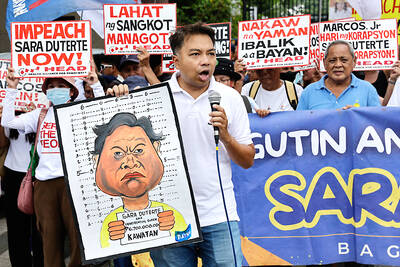
PHILIPPINE COMMITTEE: The head of the committee that made the decision said: ‘If there is nothing to hide, there is no reason to hide, there is no reason to obstruct’ A Philippine congressional committee on Wednesday ruled that there was “probable cause” to impeach Philippine Vice President Sara Duterte after hearing allegations of unexplained wealth, misuse of state funds and threats to have the president assassinated. The unanimous decision of the 53-member committee in the Philippine House of Representatives sends the two impeachment complaints to deliberations and voting by the entire lower chamber, which has more than 300 lawmakers. The complaints centered on Duterte’s alleged illegal use and mishandling of intelligence funds from the vice president’s office, and from her time as education secretary under Philippine President Ferdinand Marcos Jr. Duterte and the
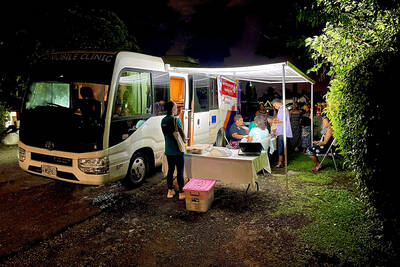
As evening falls in Fiji’s capital, a steady stream of people approaches a makeshift clinic that is a first line of defense against one of the world’s fastest-growing HIV epidemics. In the South Pacific nation — a popular tourist destination of just under a million people — more than 2,000 new HIV cases were recorded last year, a 26 percent increase from 2024. The government has declared an HIV outbreak and described it as a national crisis. “It’s spreading like wildfire,” said Siteri Dinawai, 46, who came to be tested. The Moonlight Clinic, a converted minibus parked in a suburban cul-de-sac in Suva, is


 RSS
RSS