


Envoys from Washington, Kyiv and European nations yesterday gathered for talks in the UK amid a new US push to end Russia’s war in Ukraine, but a planned meeting of foreign ministers was postponed.
The London meeting came as US media reported that US President Donald Trump is ready to accept recognition of annexed land in Crimea as Russian territory, and as fresh airstrikes shattered a brief Easter truce.
The reports said the proposal was first raised at a similar meeting with European nations in Paris last week. Trump has since threatened to “take a pass” on efforts to end the conflict unless progress is made quickly.
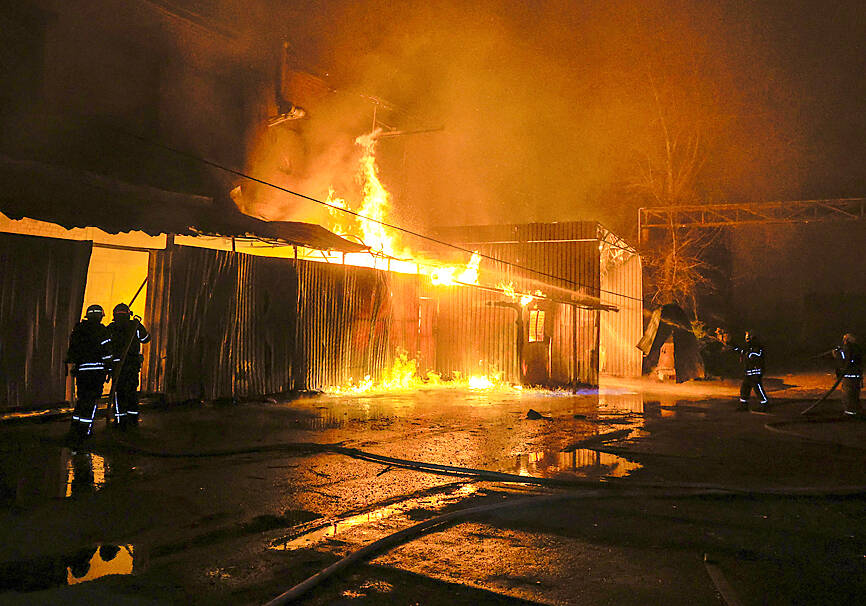
Photo: EPA-EFE
A Russian drone strike on a bus transporting workers in the southeastern city of Marganets killed at least nine people and wounded at least 30 more, the Dnipropetrovsk regional governor said yesterday.
Ukrainian authorities also reported strikes in the regions of Kyiv, Kharkiv, Poltava and Odesa.
In Russia, one person was reported wounded by shelling in the Belgorod region.
British Secretary of State for Foreign, Commonwealth and Development Affairs David Lammy had been due to lead yesterday’s meeting, but his ministry said that the talks had been downgraded in a sign of the difficulties surrounding the negotiations.
“The Ukraine Peace Talks meeting with foreign ministers today is being postponed. Official level talks will continue,” his office said.
Andriy Yermak, a top aide to Ukrainian President Volodymyr Zelenskiy, yesterday said that he had arrived in London with Ukrainian Minister of Defense Rustem Umerov and Ukrainian Minister of Foreign Affairs Andriy Sybiga — who was “likely” to meet Lammy.
“Despite everything, we will work for peace,” Yermak wrote on Telegram.
Meanwhile, Zelenskiy on Tuesday said that Chinese citizens were working at a drone production site in Russia and suggested that Moscow might have “stolen” drone technology from China.
The Ukrainian leader made the comment at a news conference in Kyiv days after he said China was supplying weapons and gunpowder to Russia, the first time he has accused Beijing of direct military aid to Moscow, something China staunchly denies.
The Ukrainian Ministry of Foreign Affairs said it had summoned Chinese Ambassador to Ukraine Ma Shengkun (馬升琨) and expressed Ukraine’s “serious concerns” over Chinese involvement in Russia’s war in Ukraine.
Zelenskiy, in suggesting that Russia might have obtained drone technology from China without Beijing actually knowing, appeared to be softening his tone toward China, which casts itself as neutral on the war.
Zelenskiy earlier this month said that Russia was recruiting Chinese nationals through social media to fight in its armed forces and that Beijing officials were aware of it.
He added that Kyiv was trying to assess whether the recruits were receiving instructions from Beijing.
On Tuesday, Zelenskiy said that he had instructed officials “to transfer information of a broader nature to the Chinese side regarding Chinese citizens who work at the drone factory.”
“We believe that it may be that Russia stole — made an agreement with these citizens outside the agreements with the Chinese leadership — stole these technologies,” he added.
A foreign ministry statement said Ukraine expressed serious concerns about the participation of Chinese citizens in military action against Ukraine and the involvement of Chinese companies in the manufacture in Russia of military goods.
When asked about the latest Ukrainian claims,the Chinese Ministry of Foreign Affairs yesterday reiterated that China is firmly opposed to “groundless accusations and political manipulation.”
Additional reporting by Reuters

SPEAKING OUT: After Siranudh Scott’s allegations surfaced, celebrities and public figures took to social media to share their own experiences of sexual misconduct and abuse A high-profile alleged sexual abuse case within a wealthy Thai beer brewing family has prompted a wave of painful accounts from survivors of unconnected abuse in the conservative nation. Siranudh Scott, a member of the billionaire Thai family that founded the ubiquitous Singha beer brand, posted an emotional video this month accusing his elder brother Sunit of repeatedly abusing him when he was a teenager. Sunit, who is in his 30s, later denied the allegations in a video posted online, but Singha parent Boonrawd dismissed him from his executive role with the company on Tuesday last week. “I felt I needed to speak

SEEKING ORDER: Rodrigo Paz said that ‘anyone who wants to destroy the nation will have to deal with this president and the full force of the constitution’ Bolivian President Rodrigo Paz on Wednesday said that the nation was at a “breaking point” after nearly a month of protests that have caused shortages of food, fuel and medicine. Paz, who took office six months ago amid the worst economic crisis there in four decades, is battling a groundswell of fury over his policies. The political capital, La Paz, has been besieged by low-income workers and members of the indigenous majority calling for his resignation. “The country needs order and is reaching breaking point,” the 58-year-old said at a public event in La Paz, renewing his appeal for dialogue. On Tuesday, the Bolivian

COMMUNITY CONFLICT: Concerns about disease spread from corpses has run up against friends and families’ desire to bury their dead as infection spreads in the area Angry residents of a town at the epicenter of the Ebola outbreak in the Democratic Republic of the Congo (DR Congo) attacked and burned a tent that was part of a health center where people are being treated for the virus, the staff there said Saturday. It was the second such attack in the region in a week. No one was hurt in the attack, according to reports but as patients ran out to escape the fire, 18 people with suspected Ebola infections fled the facility and are unaccounted for, a hospital director said. Angry residents arrived at the clinic in the

Forecasters in Europe yesterday warned of exceptional heat as record temperatures driven by a “heat dome” push temperatures well above seasonal norms across the continent. The surge follows a record-breaking Monday, with France logging its hottest day in the month of May on record, its weather agency said, and the UK also posting unprecedented highs. A so-called “heat dome” of warm air from northern Africa trapped under a high-pressure system over western Europe is behind the high temperatures not usually seen until high summer. Restrictions on outdoor work were imposed in parts of Italy, beaches in southwest France filled earlier than usual and


 RSS
RSS