


US President Donald Trump on Monday resumed his attempts to blame Ukrainian President Volodymyr Zelenskiy for Russia’s invasion, falsely accusing him of responsibility for “millions” of deaths.
Trump — who had a blazing public row in the Oval Office with Zelenskiy six weeks ago — said the Ukranian shared the blame with Russian President Vladimir Putin, who ordered the February 2022 invasion, and then-US president Joe Biden.
Trump told reporters that there were “millions of people dead because of three people.”
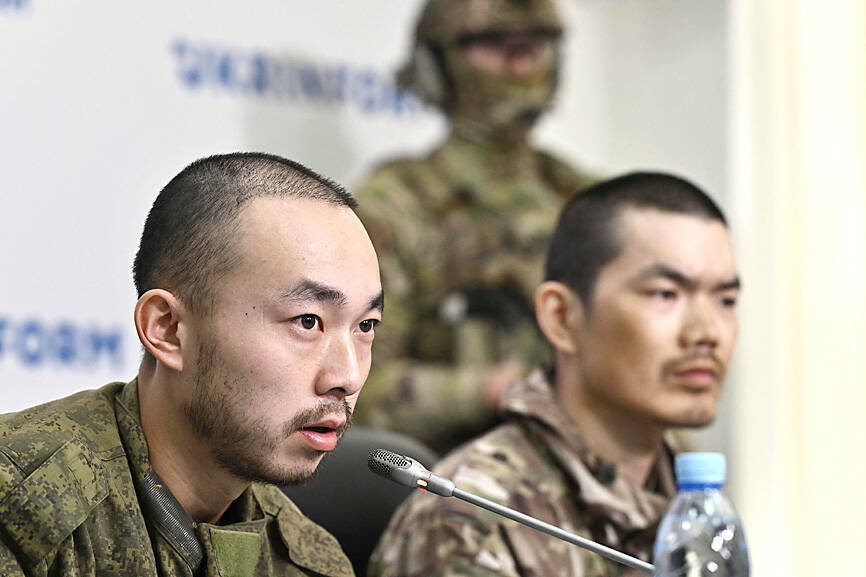
Photo: AFP
“Let’s say Putin No. 1, but let’s say Biden, who had no idea what the hell he was doing, No. 2, and Zelenskiy,” Trump said during a meeting with the president of El Salvador.
Trump then doubled down on his attack on Zelenskiy.
“He’s always looking to purchase missiles,” he said dismissively of the Ukrainian president’s attempts to maintain his nation’s defenses against the Russian invasion.
“When you start a war, you got to know that you can win the war,” Trump said. “You don’t start a war against somebody that’s 20 times your size and then hope that people give you some missiles.”
Relations between Trump and Zelenskiy have been tense ever since the US president stunned the world by opening talks with Russia in February.
In the buildup to their televised row on Feb. 28 Trump repeatedly echoed Moscow’s talking points — blaming Ukraine for the war and calling Zelenskiy a “dictator without elections.”
Zelenskiy has since tried to patch things up, including sending a delegation to Washington last week to discuss a rare earths deal Trump has called for that would give the US preferential access to Ukrainian natural resources, but Trump has stepped up his rhetoric in the past few days.
Trump insisted a deal to end the Ukraine war was possible, despite Ukrainian accusations that Moscow is stalling.
“I want to stop the killing and I think we’re doing well in that regard. I think you’ll have some very good proposals very soon,” Trump said.
Trump’s comments came despite a deadly Russian strike on the Ukrainian city of Sumy on Sunday that killed at least 35 people, one of the deadliest attacks of the war.
The US president on Sunday said that the attack was a “mistake,” but did not elaborate.
Russia on Monday said that its missiles hit a meeting of Ukrainian army commanders.
In related news, Ukraine on Monday held a news conference at which Chinese prisoners of war told journalists they hoped to be swapped and warned other Chinese nationals not to go to fight.
The event came after Zelenskiy accused Moscow of dragging Beijing into its invasion, saying on Friday last week that several hundred Chinese were fighting at the front line.
The Kremlin denied the claim, while Beijing warned parties to the conflict against making “irresponsible remarks.”
Two Chinese men dressed in camouflage uniform were escorted into a Kyiv news conference in handcuffs and sat flanked by armed Ukrainian troops, with no way of telling whether they were expressing themselves of their own free will.
Speaking Chinese, they said they were captured fighting in the eastern Donetsk region after joining the army via online ads.
“I hope China can exchange me with Russia and Ukraine, and bring me back to China,” said one of the men, 26-year-old Zhang Renbo.
The other, 33-year-old Wang Guangjun, said: “To my compatriots who want to join the Ukraine war, I want to say don’t take part in this war.”
The soldier accused Russia of lying about its military strength and Ukraine’s weakness.
“When you really participate in the war, when the moment of the fighting comes, you will find that everything is a lie,” he said.
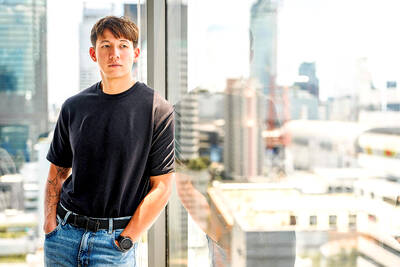
SPEAKING OUT: After Siranudh Scott’s allegations surfaced, celebrities and public figures took to social media to share their own experiences of sexual misconduct and abuse A high-profile alleged sexual abuse case within a wealthy Thai beer brewing family has prompted a wave of painful accounts from survivors of unconnected abuse in the conservative nation. Siranudh Scott, a member of the billionaire Thai family that founded the ubiquitous Singha beer brand, posted an emotional video this month accusing his elder brother Sunit of repeatedly abusing him when he was a teenager. Sunit, who is in his 30s, later denied the allegations in a video posted online, but Singha parent Boonrawd dismissed him from his executive role with the company on Tuesday last week. “I felt I needed to speak

SEEKING ORDER: Rodrigo Paz said that ‘anyone who wants to destroy the nation will have to deal with this president and the full force of the constitution’ Bolivian President Rodrigo Paz on Wednesday said that the nation was at a “breaking point” after nearly a month of protests that have caused shortages of food, fuel and medicine. Paz, who took office six months ago amid the worst economic crisis there in four decades, is battling a groundswell of fury over his policies. The political capital, La Paz, has been besieged by low-income workers and members of the indigenous majority calling for his resignation. “The country needs order and is reaching breaking point,” the 58-year-old said at a public event in La Paz, renewing his appeal for dialogue. On Tuesday, the Bolivian

A Hong Kong astronaut is to join a Chinese space mission for the first time as part of a three-person crew launching today, as Beijing edges closer to its goal of landing people on the moon. The Tiangong space station — crewed by teams of three astronauts that are typically rotated every six months — is the crown jewel of China’s space program, boosted by billions in state investment in a bid to catch up with the US and Russia. The Shenzhou-23 mission is to blast off at 11:08pm from the Jiuquan Satellite Launch Center in northwestern China, carrying three astronauts to
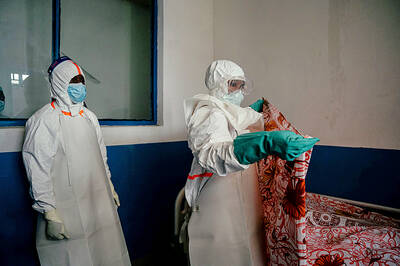
UPGRADED ALERT: The risk inside DR Congo is now considered ‘very high,’ while neighboring countries face a ‘high’ threat as the outbreak continues, the WHO said Ebola is spreading faster than responders can track it in eastern Congo, where health workers managed to follow up with barely one in five identified contacts in a single day. Authorities in the Democratic Republic of the Congo (DR Congo) reported 83 confirmed infections, 746 suspected cases and 1,603 identified contacts as of Thursday, but health workers were able to follow up on only 342 contacts that day — about 21 percent of the total under monitoring — data released by the DR Congo Ministry of Public Health on Friday showed. The figures suggest the response is falling behind the outbreak itself,


 RSS
RSS