


A Los Angeles-based ballet dancer released by Russia as part of a prisoner swap landed safely in the US on Thursday night, the second swap under US President Donald Trump as Moscow and Washington push to rebuild ties.
Ksenia Karelina, a US-Russian dual national convicted in Russia of “treason” over a one-time donation worth about US$50 to a pro-Ukraine charity, landed at Joint Base Andrews just before 11pm.
Karelina descended the stairs of the jet plane where she was greeted by several loved ones — including her boyfriend, South African boxer Chris van Heerden — who applauded and shouted “welcome home” before embracing her.
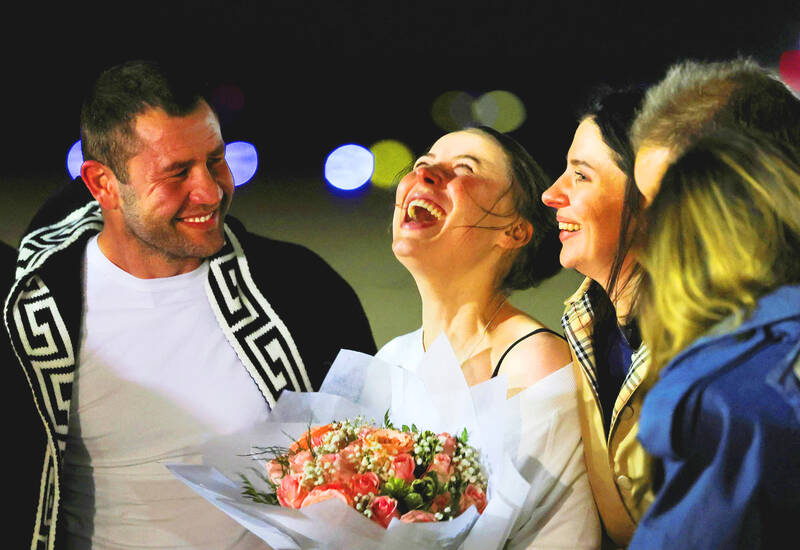
Photo: Reuters
In return, Washington freed Arthur Petrov, a Russian-German national accused of illegally exporting US-made electronics to manufacturers supplying the Russian military.
The exchange took place at an airport in Abu Dhabi, where a dozen people wearing suits were present, video posted by Russia’s Federal Security Service (FSB) showed.
Trump has sought to reset ties with Moscow since taking office, after Russia’s invasion of Ukraine three years ago plunged bilateral relations to their lowest point since the Cold War.
Trump said Karelina’s case was brought to his attention by the president of the UFC mixed martial arts league and that the US then asked Russian President Vladimir Putin to free her.
“She is now out, and that was good. So we appreciate that,” Trump told reporters at a Cabinet meeting.
“We hope that we’re going to be able to make a deal relatively soon with Russia and Ukraine to stop the fighting. It’s so senseless,” Trump said.
The FSB video showed Petrov seated on a plane after he was freed, telling an unseen interviewer that he had not slept for two days, but otherwise had no complaints.
Petrov, arrested in Cyprus in 2023 and extradited to the US, was facing 20 years in a US jail.
CIA Director John Ratcliffe was the key negotiator with Russian intelligence and foreign partners, the CIA said.
Ratcliffe in a statement thanked the UAE “for enabling this exchange.”
“Other Americans remain wrongfully detained in Russia,” a CIA spokesperson said, adding: “We see this exchange as a positive step and will continue to work for their release.”
The Department of State said that the US has raised the particular case of Stephen Hubbard, an English teacher living in eastern Ukraine who was taken away by Russian troops during the invasion and accused of being a mercenary.
“We continue to work to free Mr. Hubbard and all other Americans unjustly detained,” state department spokeswoman Tammy Bruce told reporters.
As the prisoner swap took place, US and Russian delegations were meeting in Istanbul on restoring embassy staffing levels after years of diplomat expulsions.
The State Department said after the meeting that Washington renewed concern about Moscow’s prohibition of its citizens working at US missions in Russia.
The two sides also moved to formalize an agreement on banking access for their diplomats, despite the US sanctions on Russia, the State Department said.
Karelina, 33, was serving a 12-year prison sentence for having donated about US$50 to a pro-Ukraine charity.
She was arrested in the Russian city of Yekaterinburg in January last year while on a trip to visit her family and charged with “treason.”
The FSB accused her of contributing to “equipment, weapons and ammunition” for Ukraine’s army — charges she denied. Her supporters say she donated to a US-based organization that delivers humanitarian aid to Ukraine.
Petrov was accused by US authorities of illegally exporting electronic components to Russia for military use, in violation of Washington’s sanctions against Moscow over the Ukraine war.
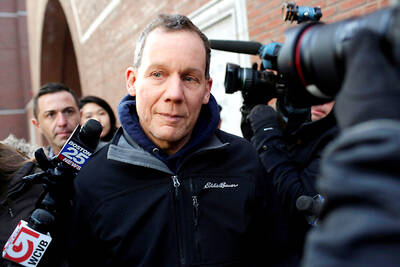
An American scientist convicted of lying to US authorities about payments from China while he was at Harvard University has rebuilt his research lab in Shenzhen, China, to pursue technology the Chinese government has identified as a national priority: embedding electronics into the human brain. Charles Lieber, 67, is among the world’s leading researchers in brain-computer interfaces. The technology has shown promise in treating conditions such as amyotrophic lateral sclerosis and restoring movement in paralyzed people. It also has potential military applications: Scientists at the Chinese People’s Liberation Army have investigated brain interfaces as a way to engineer super soldiers by boosting
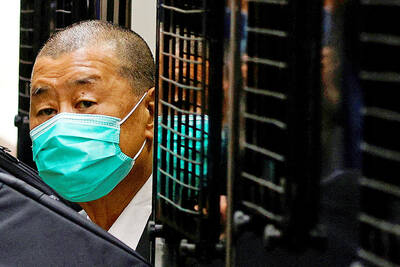
Jailed media entrepreneur Jimmy Lai (黎智英) has been awarded Deutsche Welle’s (DW) freedom of speech award for his contribution to Hong Kong’s pro-democracy movement. The German public broadcaster on Thursday said Lai would be presented in absentia with the 12th iteration of the award on June 23 at the DW Global Media Forum in Bonn. Deutsche Welle director-general Barbara Massing praised the 78-year-old founder of the now-shuttered news outlet Apple Daily for standing “unwaveringly for press freedom in Hong Kong at great personal risk.” “With Apple Daily, he gave journalists a platform for free reporting and a voice to the democracy movement in
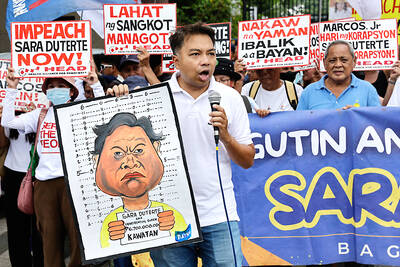
PHILIPPINE COMMITTEE: The head of the committee that made the decision said: ‘If there is nothing to hide, there is no reason to hide, there is no reason to obstruct’ A Philippine congressional committee on Wednesday ruled that there was “probable cause” to impeach Philippine Vice President Sara Duterte after hearing allegations of unexplained wealth, misuse of state funds and threats to have the president assassinated. The unanimous decision of the 53-member committee in the Philippine House of Representatives sends the two impeachment complaints to deliberations and voting by the entire lower chamber, which has more than 300 lawmakers. The complaints centered on Duterte’s alleged illegal use and mishandling of intelligence funds from the vice president’s office, and from her time as education secretary under Philippine President Ferdinand Marcos Jr. Duterte and the
Burmese President Min Aung Hlaing yesterday cut all prisoners’ sentences by one-sixth, a blanket measure that a source close to deposed leader Aung San Suu Kyi said would further shorten her detention. Aung San Suu Kyi has been sequestered since a 2021 military coup, but the senior member of her dissolved National League for Democracy (NLD) party said that while her term had been reduced, her remaining sentence is still unclear. “We also don’t know exactly how many years she has left,” the source told reporters, speaking on condition of anonymity for security reasons. The military toppled Aung San Suu Kyi’s elected government


 RSS
RSS