


Britain’s Prince Andrew sent Chinese President Xi Jinping (習近平) a letter on his birthday every year as part of a “communication channel” to support the British royal’s platform for entrepreneurs, court documents published on Friday showed.
The documents came to light following a legal challenge brought by Chinese businessman Yang Tengbo (楊騰波), who was described as a “close confidant” of Andrew and was banned from Britain on the grounds he was a suspected Chinese spy.
Yang, who has said that “the widespread description of me as a ‘spy’ is entirely untrue,” is appealing against the rejection of his challenge to the decision to ban him from the country.

Photo: Reuters
Documents released by the Special Immigration Appeals Commission included a witness statement provided by Dominic Hampshire, who became Andrew’s senior adviser in 2019.
Hampshire said in the statement that Andrew had regular communication with China’s Xi in relation to the prince’s Pitch@Palace initiative to encourage entrepreneurs.
“The Duke has always had a communication channel with the president, largely to support the success of Pitch@Palace in China, and this was never hidden,” Hampshire said.
“The Duke sends a letter to the president for his birthday each year,” he added. “The Royal Household, including the late queen were fully aware of this communication — it was certainly accepted, and it may be fair to say that perhaps even encouraged — it was an open channel of communication that was useful to have.”
Hampshire’s witness statement also said that in late 2023 and early last year, he had two meetings with Andrew and King Charles about an international financial initiative, after Yang was banned from the UK.
Yang was banned from the UK after the contents of his phone were downloaded when he was stopped under counterterrorism laws at a British border in 2021.
That revealed that Andrew authorized Yang to set up the Eurasia Fund to engage with potential partners and investors in China, a December ruling said.

China on Monday announced its first ever sanctions against an individual Japanese lawmaker, targeting China-born Hei Seki for “spreading fallacies” on issues such as Taiwan, Hong Kong and disputed islands, prompting a protest from Tokyo. Beijing has an ongoing spat with Tokyo over islands in the East China Sea claimed by both countries, and considers foreign criticism on sensitive political topics to be acts of interference. Seki, a naturalised Japanese citizen, “spread false information, colluded with Japanese anti-China forces, and wantonly attacked and smeared China”, foreign ministry spokesman Lin Jian told reporters on Monday. “For his own selfish interests, (Seki)
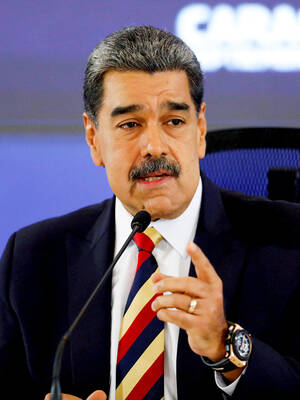
VENEZUELAN ACTION: Marco Rubio said that previous US interdiction efforts have not stemmed the flow of illicit drugs into the US and that ‘blowing them up’ would US President Donald Trump on Wednesday justified a lethal military strike that his administration said was carried out a day earlier against a Venezuelan gang as a necessary effort by the US to send a message to Latin American cartels. Asked why the military did not instead interdict the vessel and capture those on board, Trump said that the operation would cause drug smugglers to think twice about trying to move drugs into the US. “There was massive amounts of drugs coming into our country to kill a lot of people and everybody fully understands that,” Trump said while hosting Polish President

Japan yesterday heralded the coming-of-age of Japanese Prince Hisahito with an elaborate ceremony at the Imperial Palace, where a succession crisis is brewing. The nephew of Japanese Emperor Naruhito, Hisahito received a black silk-and-lacquer crown at the ceremony, which marks the beginning of his royal adult life. “Thank you very much for bestowing the crown today at the coming-of-age ceremony,” Hisahito said. “I will fulfill my duties, being aware of my responsibilities as an adult member of the imperial family.” Although the emperor has a daughter — Princess Aiko — the 23-year-old has been sidelined by the royal family’s male-only

A French couple kept Louise, a playful black panther, in an apartment in northern France, triggering panic when she was spotted roaming nearby rooftops. The pair were were handed suspended jail sentences on Thursday for illegally keeping a wild animal, despite protesting that they saw Louise as their baby. The ruling follows a September 2019 incident when the months-old feline was seen roaming a rooftop in Armentieres after slipping out of the couple’s window. Authorities captured the panther by sedating her with anesthetic darts after she entered a home. No injuries were reported during the animal’s time on the loose. The court in the


 RSS
RSS