


A Chinese construction company is facing questions over the deadly collapse of a Bangkok skyscraper — the only major building in the Thai capital to fall in a catastrophic earthquake that has killed more than 2,000 people in Thailand and neighboring Myanmar.
The 30-story tower, still under construction, was to house government offices, but the shaking reduced the structure to a pile of rubble in seconds, killing at least 13 people and injuring nine.
It was the deadliest single incident in Thailand after Friday last week’s magnitude 7.7 quake, with the majority of the kingdom’s 20 fatalities thought to be workers on the building site and hopes fading for about 70 still trapped. Sprawling Bangkok bristles with countless high-rise blocks, but none have reported major damage, prompting many to ask why the block under construction gave way.
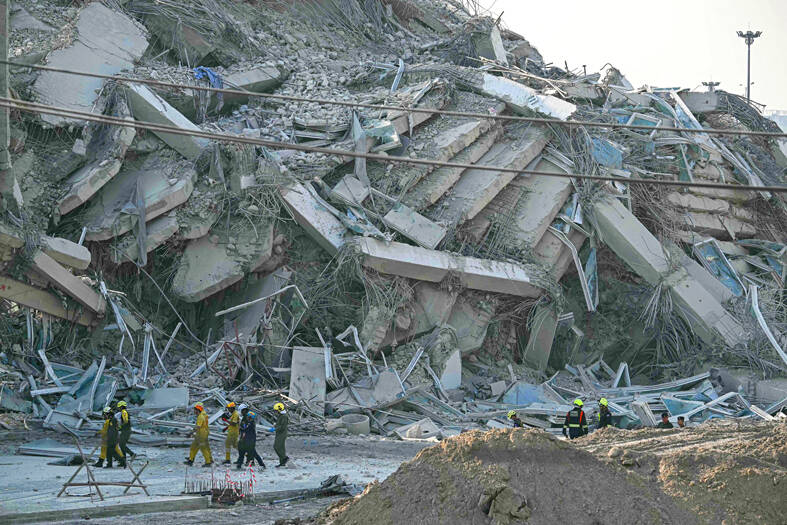
Photo :AFP
“We have to investigate where the mistake happened,” said Thai Prime Minister Paetongtarn Shinawatra, who has ordered a probe into the materials and safety standards at the construction site.
“What happened from the beginning since it was designed? How was this design approved? This was not the first building in the country,” she told reporters on Saturday.
The development near Bangkok’s popular Chatuchak market was a joint project involving China Railway No. 10 Engineering Group (Thailand) — an offshoot of China Railway Group Ltd (CREC), one of the world’s largest construction and engineering contractors.
Testing of steel rebars — struts used to reinforce concrete — from the site has found that some of the metal used was substandard, Thai safety officials said on Monday.
Thai Minister of Industry Akanat Promphan announced that a committee would be set up to investigate the issue, saying one supplier of the steel had failed safety tests in December last year and might have its license withdrawn.
He did not name the supplier.
There were questions to be answered, King Mongkut’s Institute of Technology civil engineering professor Ladkrabang Suchatwee Sunaswat said.
“We have to look at the design. At the beginning, how they calculate, how they design, and in the rescue mission, how they collect evidence at the same time,” he told reporters on Saturday.
The local partner in the project, Italian-Thai Development offered condolences on Monday to quake victims, but said it was “confident” the incident would not impact its other projects.
Beijing-owned building conglomerate CREC is one of the world’s largest construction and engineering contractors, with projects in more than 90 countries and regions, its Web site says.
The Bangkok construction collapse is not the first time CREC and its subsidiaries have come under fire after deadly incidents.
A tide of anger was unleashed at authorities in Serbia following the deaths of 14 people when a roof collapsed in November last year at a train station built by CREC subsidiaries — largely focused on reports of alleged shortcuts made with building projects.
Roisai Wongsuban of the Migrant Working Group advocacy organization said there have been a large number of complaints from migrant workers employed by Chinese companies in Thailand about lax safety standards and poor labor rights.
“For Chinese companies we can’t see the human rights due diligence, to see if labor standards are being met,” she said. “There is always a power imbalance between employer and employee.”
Bangkok’s construction boom is powered by an army of laborers, a large proportion of them migrant workers from Myanmar, toiling on hot building sites for low pay.
The Migrant Working Group has called on Thailand’s labor ministry to hold the employers involved in the construction project criminally liable if they have failed to meet health and safety laws.
China Rail No. 10 Engineering Thailand and CREC did not comment on the issue.
An announcement celebrating the completion of the main structure at the Chatuchak construction site posed on China Rail No. 10’s official WeChat channel was deleted soon after Friday’s quake.
Local media said that four Chinese nationals were apprehended on Saturday for attempting to retrieve documents from the collapse site.
However, China is the largest source of foreign direct investment in Thailand, injecting US$2 billion into the kingdom last year, according to Open Development Thailand. The Thai government typically handles anything linked to Beijing with kid gloves.
An investigation into the collapse launched on Monday would not be “specific to one country,” Paetongtarn said.
“We do not want one particular country to think we are only keeping eyes on [it],” she said on Tuesday.
At a small shelter near the site on Monday, 45-year-old Naruemol Thonglek waited for news of her boyfriend, electrician Kyi Than, who was missing under the enormous mound of concrete and twisted metal being lifted by mechanical diggers.
“I’m devastated,” she said. “I’ve never seen anything like this in my entire life.”
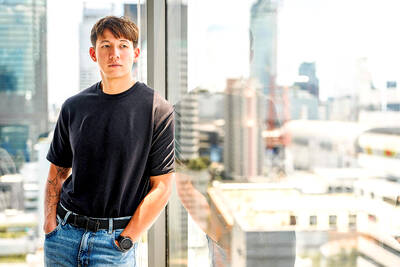
SPEAKING OUT: After Siranudh Scott’s allegations surfaced, celebrities and public figures took to social media to share their own experiences of sexual misconduct and abuse A high-profile alleged sexual abuse case within a wealthy Thai beer brewing family has prompted a wave of painful accounts from survivors of unconnected abuse in the conservative nation. Siranudh Scott, a member of the billionaire Thai family that founded the ubiquitous Singha beer brand, posted an emotional video this month accusing his elder brother Sunit of repeatedly abusing him when he was a teenager. Sunit, who is in his 30s, later denied the allegations in a video posted online, but Singha parent Boonrawd dismissed him from his executive role with the company on Tuesday last week. “I felt I needed to speak

SEEKING ORDER: Rodrigo Paz said that ‘anyone who wants to destroy the nation will have to deal with this president and the full force of the constitution’ Bolivian President Rodrigo Paz on Wednesday said that the nation was at a “breaking point” after nearly a month of protests that have caused shortages of food, fuel and medicine. Paz, who took office six months ago amid the worst economic crisis there in four decades, is battling a groundswell of fury over his policies. The political capital, La Paz, has been besieged by low-income workers and members of the indigenous majority calling for his resignation. “The country needs order and is reaching breaking point,” the 58-year-old said at a public event in La Paz, renewing his appeal for dialogue. On Tuesday, the Bolivian

A Hong Kong astronaut is to join a Chinese space mission for the first time as part of a three-person crew launching today, as Beijing edges closer to its goal of landing people on the moon. The Tiangong space station — crewed by teams of three astronauts that are typically rotated every six months — is the crown jewel of China’s space program, boosted by billions in state investment in a bid to catch up with the US and Russia. The Shenzhou-23 mission is to blast off at 11:08pm from the Jiuquan Satellite Launch Center in northwestern China, carrying three astronauts to
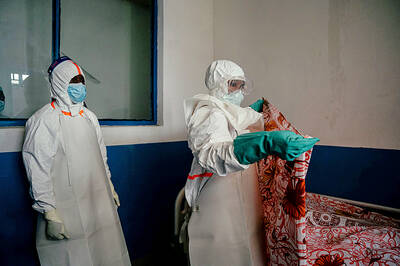
UPGRADED ALERT: The risk inside DR Congo is now considered ‘very high,’ while neighboring countries face a ‘high’ threat as the outbreak continues, the WHO said Ebola is spreading faster than responders can track it in eastern Congo, where health workers managed to follow up with barely one in five identified contacts in a single day. Authorities in the Democratic Republic of the Congo (DR Congo) reported 83 confirmed infections, 746 suspected cases and 1,603 identified contacts as of Thursday, but health workers were able to follow up on only 342 contacts that day — about 21 percent of the total under monitoring — data released by the DR Congo Ministry of Public Health on Friday showed. The figures suggest the response is falling behind the outbreak itself,


 RSS
RSS