


Israel’s military on Sunday pressed ground operations across the Gaza Strip, encircling part of Rafah city near Egypt almost a week into a renewed assault on the Palestinian territory.
The deployment of Israeli troops in parts of Gaza, despite calls to revive a January truce with Hamas militants, comes alongside a deadly flare-up in Lebanon and missiles fired from Yemen.
The health ministry in Hamas-run Gaza on Sunday said that the war triggered by Hamas’ Oct. 7, 2023, attack on Israel had killed at least 50,021 people in the territory.
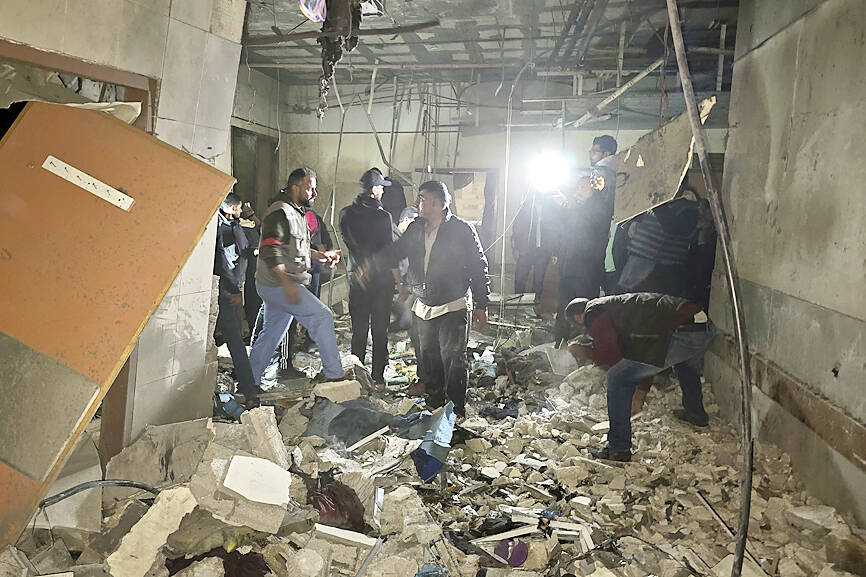
Photo: AP
Gaza’s civil defense agency said separately, citing its own records, that the death toll had topped 50,000 people.
Hamas’ attack on Israel resulted in 1,218 deaths, mostly civilians, according to Israeli figures.
Israeli troops on Sunday encircled Tal al-Sultan in Rafah, the military said in a statement, adding its objective was to “dismantle terrorist infrastructure and eliminate” militants there.
Earlier on Sunday, Israel had warned residents of the area to evacuate.
Rafah, in southern Gaza, had already been the target of a major Israeli offensive about a year ago.
At a charity kitchen in Khan Yunis, southern Gaza’s main city just north of Rafah, 19-year-old Iman al-Bardawil said many displaced Palestinians are struggling to “afford food and drink” during the Muslim holy month of Ramadan.
“I’m here to get rice for the children, but it’s gone,” said Saed Abu al-Jidyan, who like al-Bardawil had fled his home in northern Gaza.
“The crossings are closed and my salary has been suspended since the beginning of the war,” he said. “There is no food in Gaza.”
With fuel unable to enter the territory, images showed Gazans collecting books from the bombed-out Islamic University in Gaza City to use for cooking fires.
Three weeks ago, Israel blocked the entry of humanitarian aid into Gaza and cut electricity in a bid to force Hamas to accept the Israeli terms for an extension of the ceasefire and release the 58 hostages still held. Israel on Tuesday last week also restarted intense airstrikes across the territory.
Israeli Minister of Defense Israel Katz on Friday last week said that he had ordered the army to “seize more territory in Gaza,” warning Israel could annex it if Hamas failed to heed Israel’s demands for the next steps in the truce process.
The comments prompted France to say it opposed “any form of annexation,” while France, Britain and Germany jointly said the resumption of Israeli strikes was “a dramatic step backward.”
EU High Representative for Foreign Affairs and Security Policy Kaja Kallas yesterday was visiting Israel and the occupied West Bank to press for “an immediate return to the full implementation of the ceasefire-hostage release agreement,” her diplomatic service said.
Hamas has accused Israel of sacrificing the hostages with its resumption of bombardments. Many families of the captives have called for a renewed ceasefire, after most of those who returned alive were freed during truce periods.
The Israeli military on Sunday said it was conducting operations in Beit Hanun, northern Gaza, where “fighter jets struck several Hamas targets.”
An Israeli strike on a tent encampment in al-Mawasi, in the Khan Yunis area, killed senior Hamas official Salah al-Bardawil and his wife, the Islamist movement said in a statement.
Israeli air force jets also struck the emergency department at Nasser hospital in Khan Younis, killing another Hamas political bureau official, Ismail Barhoum, as he underwent treatment, the group and Israel said.
Israel has now killed four members of Hamas’ political bureau since the resumption of its airstrikes.
Israel’s military said that al-Bardawil had “directed the strategic and military planning” of Hamas in Gaza, and his “elimination further degrades Hamas’ military and government capabilities.”

Crowds in Bangladesh are flocking to snap photographs with an unlikely social media star — an albino buffalo with flowing blond hair nicknamed “Donald Trump” that is due to be sacrificed within days. Owner Zia Uddin Mridha, 38, said his brother named the 700kg bull over its flowing helmet of hair resembling the signature look of the US president. “My younger brother picked this name because of the buffalo’s extraordinary hair,” he said at his farm in Narayanganj, just outside the capital, Dhaka. Mridha said that a constant stream of curious visitors — social media fans, onlookers and children — have come throughout
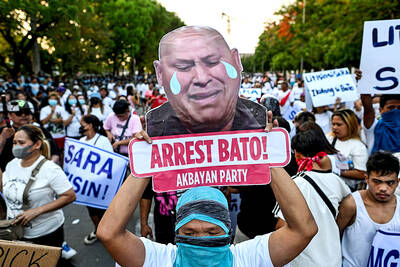
The Philippines said it has asked the country’s Supreme Court to allow it to arrest former Philippine president Rodrigo Duterte’s chief drug war enforcer to stand trial in an international tribunal. The International Criminal Court (ICC) last week unsealed an arrest warrant against Philippine Senator Ronald dela Rosa, accusing him along with Duterte and other “coperpetrators” of the “crime against humanity of murder.” Dela Rosa briefly sought refuge in the Philippine Senate last week while asking the Philippine Supreme Court to stop an ongoing attempt by government agents to arrest him. “By his own conduct, he has placed himself outside the protection of

The researchers in Ireland looked at their computer screen, marveling at a medieval book tracked down in a Roman library. They flipped through its digitized pages and found their sought-after treasure: the oldest surviving English poem. “We were extremely surprised. We were speechless. We couldn’t believe our eyes when we first saw that,” said Elisabetta Magnanti, a visiting research fellow at Trinity College Dublin’s school of English. The poem was also within the main body of Latin text, she said, calling it “extraordinary.” Composed in Old English by a Northumbrian agricultural worker in the 7th century, Caedmon’s Hymn appears within some copies of

BIGGER ROLE: Beijing has said it maintains an impartial stance on the war in Ukraine, but by training Russian troops, China is far more involved than previously known China’s armed forces secretly trained about 200 Russian military personnel in China late last year, and some have since returned to fight in Ukraine, according to three European intelligence agencies and documents seen by Reuters. While China and Russia have held a number of joint military exercises since Moscow’s full-scale invasion of Ukraine in 2022, Beijing has repeatedly said that it is neutral in the conflict and presents itself as a peace mediator. The covert training sessions, which predominantly focused on the use of drones, were outlined in a dual-language Russian-Chinese agreement signed by senior Russian and Chinese officers in Beijing on


 RSS
RSS