


Young fans, some sporting spiky mohawks, slam-danced and stage-dived as the music blasted into the night. One wore a metal-studded jacket with what looked like vintage Sex Pistols buttons.
Several hundred people packed Nine Club early this year for the “Unite Punk Music Festival” in Hangzhou, a technology hub in southeastern China also known for its scenic West Lake.
The mostly young crowd shouted out the lyrics and raised clenched fists under blinking red lights. Some had pierced lips. Others looked like clean-cut college students.
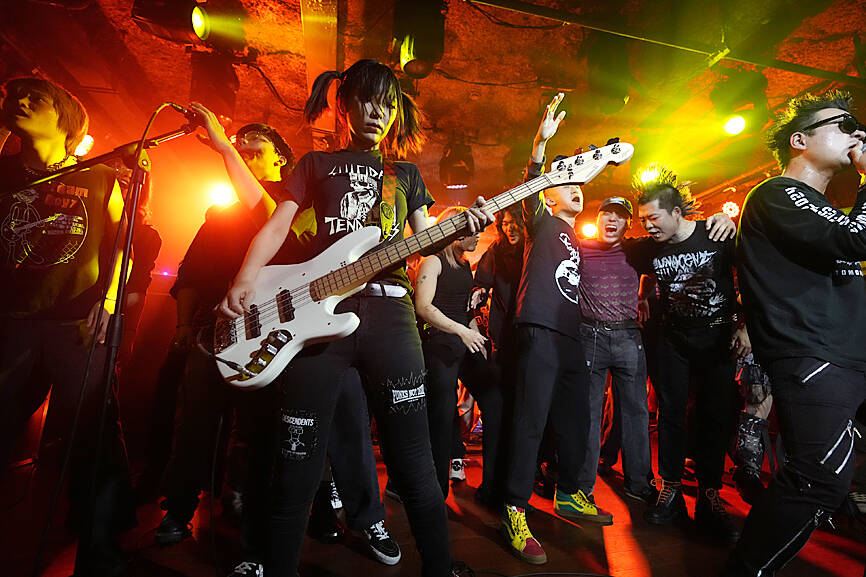
Photo: AP
Then the body slamming began. About a dozen people in front of the stage slammed into each other as if possessed by the thumping beat. There was chaos, but no fights.
Punk rock burst onto the scene globally in the 1970s with groups such as the Ramones and the Sex Pistols. It took longer to reach China, but witnessed explosive growth there in the late 1990s, when influential bands such as SMZB, Brain Failure and Queen Sea Big Shark inspired hip young people to sport mohawks and leather jackets.
It is no longer as trendy as it once was. Many younger people today view punk as their parents’ music and gravitate toward hip-hop and rap, said Liu Fei (劉非), the owner of School Bar in Beijing.
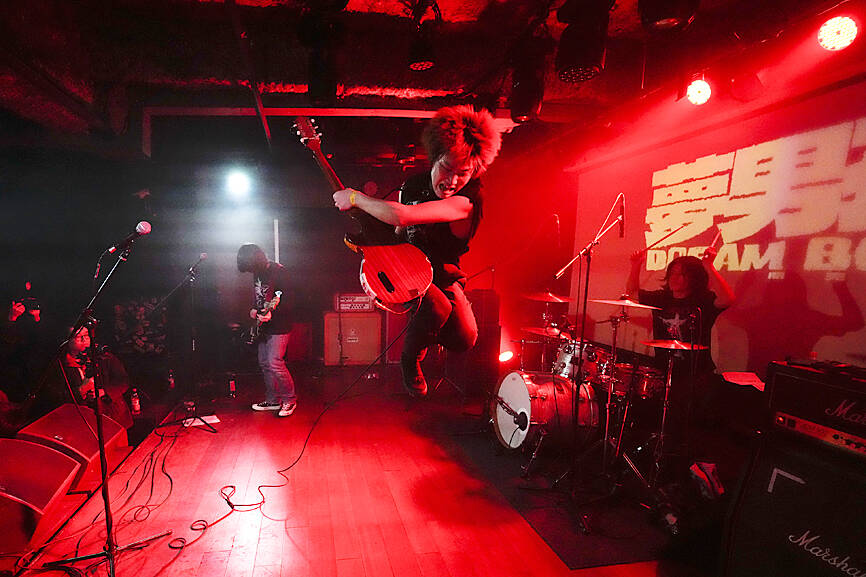
Photo: AP
Others frequent underground raves with pounding techno beats.
However, some are forming new punk bands, and China has skateboard, new school and hardcore punks, Liu said before a recent punk night at his bar for fans of a Beijing soccer team.
The fan club has a fight song written by a Chinese punk rocker who died in 2015.

Photo: AP
“The atmosphere is not as enthusiastic as before, but it is still there,” said one of the performers, Wang Lixing, from the band Labor Glory (勞動光榮).
The lyrics are less rebellious than in the past, said Liu, who remembers the hopping scene in China during a punk revival in the early 2000s.
Today, the songs are more about the “sang” (喪, “mourning”) culture of depression, pessimism and apathy that some young people feel in modern society.
“They need channels to relieve pressure and release negativity to help themselves adjust,” said Zedd, a mechanical engineering student by day who plays guitar by night for the band System Chaos and prefers to be identified by his stage name.
The entertainment industry in China is tightly censored, with regulations over lyrics and portrayals of subcultures and images deemed unsuitable.
“It may be more difficult to do punk rock in China,” Liu said. “But in different environments, it has its own way of survival.”

SPEAKING OUT: After Siranudh Scott’s allegations surfaced, celebrities and public figures took to social media to share their own experiences of sexual misconduct and abuse A high-profile alleged sexual abuse case within a wealthy Thai beer brewing family has prompted a wave of painful accounts from survivors of unconnected abuse in the conservative nation. Siranudh Scott, a member of the billionaire Thai family that founded the ubiquitous Singha beer brand, posted an emotional video this month accusing his elder brother Sunit of repeatedly abusing him when he was a teenager. Sunit, who is in his 30s, later denied the allegations in a video posted online, but Singha parent Boonrawd dismissed him from his executive role with the company on Tuesday last week. “I felt I needed to speak

SEEKING ORDER: Rodrigo Paz said that ‘anyone who wants to destroy the nation will have to deal with this president and the full force of the constitution’ Bolivian President Rodrigo Paz on Wednesday said that the nation was at a “breaking point” after nearly a month of protests that have caused shortages of food, fuel and medicine. Paz, who took office six months ago amid the worst economic crisis there in four decades, is battling a groundswell of fury over his policies. The political capital, La Paz, has been besieged by low-income workers and members of the indigenous majority calling for his resignation. “The country needs order and is reaching breaking point,” the 58-year-old said at a public event in La Paz, renewing his appeal for dialogue. On Tuesday, the Bolivian

A Hong Kong astronaut is to join a Chinese space mission for the first time as part of a three-person crew launching today, as Beijing edges closer to its goal of landing people on the moon. The Tiangong space station — crewed by teams of three astronauts that are typically rotated every six months — is the crown jewel of China’s space program, boosted by billions in state investment in a bid to catch up with the US and Russia. The Shenzhou-23 mission is to blast off at 11:08pm from the Jiuquan Satellite Launch Center in northwestern China, carrying three astronauts to

UPGRADED ALERT: The risk inside DR Congo is now considered ‘very high,’ while neighboring countries face a ‘high’ threat as the outbreak continues, the WHO said Ebola is spreading faster than responders can track it in eastern Congo, where health workers managed to follow up with barely one in five identified contacts in a single day. Authorities in the Democratic Republic of the Congo (DR Congo) reported 83 confirmed infections, 746 suspected cases and 1,603 identified contacts as of Thursday, but health workers were able to follow up on only 342 contacts that day — about 21 percent of the total under monitoring — data released by the DR Congo Ministry of Public Health on Friday showed. The figures suggest the response is falling behind the outbreak itself,


 RSS
RSS