


NASA’s two stuck astronauts yesterday headed back to Earth with SpaceX to close out a dramatic marathon mission that began with a bungled Boeing test flight more than nine months ago.
Butch Wilmore and Suni Williams bade farewell to the International Space Station — their home since last spring — departing aboard a SpaceX capsule alongside two other astronauts. The capsule undocked in the wee hours and aimed for a splashdown off the Florida coast — weather permitting — by early evening yesterday.
The two expected to be gone just a week or so after launching on Boeing’s new Starliner crew capsule on June 5. So many problems cropped up on the way to the space station that NASA eventually sent Starliner back empty and transferred the test pilots to SpaceX, pushing their homecoming into last month. Then SpaceX capsule issues added another month’s delay.

Photo: AFP / NASA
Sunday’s arrival of their relief crew meant Wilmore and Williams could finally leave. NASA cut them loose a little early, given the iffy weather forecast later this week. They checked out with NASA’s Nick Hague and Russia’s Alexander Gorbunov, who arrived in their own SpaceX capsule last fall with two empty seats reserved for the Starliner duo.
“We’ll miss you, but have a great journey home,” NASA’s Anne McClain called out from the space station as the capsule pulled away 148km above the Pacific.
Their plight captured the world’s attention, giving new meaning to the phrase “stuck at work.” While other astronauts had logged longer spaceflights over the decades, none had to deal with so much uncertainty or see the length of their mission expand by so much.
Wilmore and Williams quickly transitioned from guests to full-fledged station crew members, conducting experiments, fixing equipment and even spacewalking together. With 62 hours over nine spacewalks, Williams set a new record: the most time spent spacewalking over a career among female astronauts.
Both had lived on the orbiting lab before and knew the ropes, and brushed up on their station training before rocketing away. Williams became the station’s commander three months into their stay and held the post until earlier this month.
Their mission took an unexpected twist in late January when US President Donald Trump asked SpaceX founder Elon Musk to accelerate the astronauts’ return and blamed the delay on former US president Joe Biden’s administration. The replacement crew’s brand new SpaceX capsule still was not ready to fly, so SpaceX subbed it with a used one, hurrying things along by at least a few weeks.
Even in the middle of the political storm, Wilmore and Williams continued to maintain an even keel at public appearances from orbit, casting no blame and insisting they supported NASA’s decisions from the start.
NASA hired SpaceX and Boeing after the shuttle program ended, in order to have two competing U.S. companies for transporting astronauts to and from the space station until it is abandoned in 2030 and steered to a fiery re-entry. By then, it will have been up there more than three decades; the plan is to replace it with privately run stations so NASA can focus on moon and Mars expeditions.
Both retired navy captains, Wilmore and Williams stressed they did not mind spending more time in space — a prolonged deployment reminiscent of their military days. However, they acknowledged it was tough on their families.
Wilmore, 62, missed most of his younger daughter’s senior year of high school; his older daughter is in college. Williams, 59, had to settle for Internet calls from space to her mother. They will have to wait until they are off the SpaceX recovery ship and flown to Houston before the long-awaited reunion with their loved ones.

SPEAKING OUT: After Siranudh Scott’s allegations surfaced, celebrities and public figures took to social media to share their own experiences of sexual misconduct and abuse A high-profile alleged sexual abuse case within a wealthy Thai beer brewing family has prompted a wave of painful accounts from survivors of unconnected abuse in the conservative nation. Siranudh Scott, a member of the billionaire Thai family that founded the ubiquitous Singha beer brand, posted an emotional video this month accusing his elder brother Sunit of repeatedly abusing him when he was a teenager. Sunit, who is in his 30s, later denied the allegations in a video posted online, but Singha parent Boonrawd dismissed him from his executive role with the company on Tuesday last week. “I felt I needed to speak

SEEKING ORDER: Rodrigo Paz said that ‘anyone who wants to destroy the nation will have to deal with this president and the full force of the constitution’ Bolivian President Rodrigo Paz on Wednesday said that the nation was at a “breaking point” after nearly a month of protests that have caused shortages of food, fuel and medicine. Paz, who took office six months ago amid the worst economic crisis there in four decades, is battling a groundswell of fury over his policies. The political capital, La Paz, has been besieged by low-income workers and members of the indigenous majority calling for his resignation. “The country needs order and is reaching breaking point,” the 58-year-old said at a public event in La Paz, renewing his appeal for dialogue. On Tuesday, the Bolivian

A Hong Kong astronaut is to join a Chinese space mission for the first time as part of a three-person crew launching today, as Beijing edges closer to its goal of landing people on the moon. The Tiangong space station — crewed by teams of three astronauts that are typically rotated every six months — is the crown jewel of China’s space program, boosted by billions in state investment in a bid to catch up with the US and Russia. The Shenzhou-23 mission is to blast off at 11:08pm from the Jiuquan Satellite Launch Center in northwestern China, carrying three astronauts to
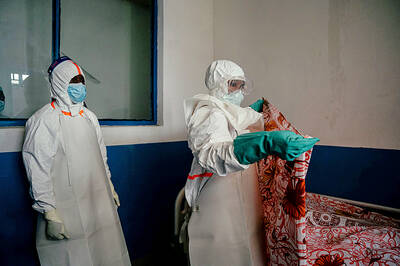
UPGRADED ALERT: The risk inside DR Congo is now considered ‘very high,’ while neighboring countries face a ‘high’ threat as the outbreak continues, the WHO said Ebola is spreading faster than responders can track it in eastern Congo, where health workers managed to follow up with barely one in five identified contacts in a single day. Authorities in the Democratic Republic of the Congo (DR Congo) reported 83 confirmed infections, 746 suspected cases and 1,603 identified contacts as of Thursday, but health workers were able to follow up on only 342 contacts that day — about 21 percent of the total under monitoring — data released by the DR Congo Ministry of Public Health on Friday showed. The figures suggest the response is falling behind the outbreak itself,


 RSS
RSS