


The top diplomats for China, South Korea and Japan are to meet in Tokyo this weekend for talks, Seoul said yesterday, as the neighbors move to bolster regional ties.
South Korean Minister of Foreign Affairs Cho Tae-yul and his Japanese and Chinese counterparts, Iwaya Takeshi and Wang Yi (王毅), are to “exchange comprehensive views ... for the development of trilateral cooperation,” Seoul’s foreign ministry said in a statement.
The meeting in Tokyo on Saturday will be the 11th trilateral ministerial meeting, the statement said, with the last such meeting held in November 2023 in the South Korean port city of Busan.

Photo: AFP
The countries are also to hold bilateral talks on the sidelines of the three-way summit, Seoul added.
Japanese public broadcaster NHK said the meeting was “expected to discuss concrete cooperation in a wide range of areas, such as people-to-people exchanges, economic cooperation and measures to combat the falling birthrate.”
The top diplomats were also set “to agree to coordinate the holding of a summit meeting of the three countries by the end of the year.”
NHK said Tokyo also aims to resolve some outstanding bilateral issues, “ such as China’s measures to suspend imports of Japanese fisheries products.”
In May last year, the leaders of the three countries held a rare summit in Seoul — the first such high level talks in five years — at which they agreed to deepen trade ties.
The three countries also reaffirmed their commitment to the “denuclearization of the Korean Peninsula” — a reference to nuclear-armed North Korea.
Seoul and Tokyo typically take a stronger line against Pyongyang than does China, which remains one of North Korea’s most important allies and economic benefactors, despite leader Kim Jong-un’s recent moves to bolster ties with historic ally Russia.
Beijing has previously resisted condemning Pyongyang for its weapons tests, instead criticizing joint US-South Korea drills for raising tension.
Seoul and Washington accuse Pyongyang of sending thousands of North Korean soldiers to help Russia fight its war against Ukraine, in return for technical assistance from Moscow for its banned weapons programs.
Experts say any moves by Seoul, Tokyo and Beijing to ramp up trilateral cooperation and boost economic ties augers well for future agreements on more difficult topics like Kim’s nuclear weapons.
The announcement comes as South Korea awaits a Constitutional Court’s ruling on whether to remove President Yoon Suk-yeol from office over his botched martial law declaration in December.
While in office, Yoon has pushed for closer ties with Japan, attempting to bury the historical hatchet to present a united trilateral front with the US against North Korea’s growing military provocations.

SPEAKING OUT: After Siranudh Scott’s allegations surfaced, celebrities and public figures took to social media to share their own experiences of sexual misconduct and abuse A high-profile alleged sexual abuse case within a wealthy Thai beer brewing family has prompted a wave of painful accounts from survivors of unconnected abuse in the conservative nation. Siranudh Scott, a member of the billionaire Thai family that founded the ubiquitous Singha beer brand, posted an emotional video this month accusing his elder brother Sunit of repeatedly abusing him when he was a teenager. Sunit, who is in his 30s, later denied the allegations in a video posted online, but Singha parent Boonrawd dismissed him from his executive role with the company on Tuesday last week. “I felt I needed to speak
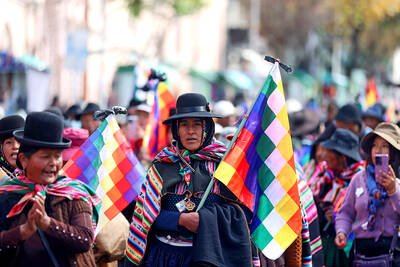
SEEKING ORDER: Rodrigo Paz said that ‘anyone who wants to destroy the nation will have to deal with this president and the full force of the constitution’ Bolivian President Rodrigo Paz on Wednesday said that the nation was at a “breaking point” after nearly a month of protests that have caused shortages of food, fuel and medicine. Paz, who took office six months ago amid the worst economic crisis there in four decades, is battling a groundswell of fury over his policies. The political capital, La Paz, has been besieged by low-income workers and members of the indigenous majority calling for his resignation. “The country needs order and is reaching breaking point,” the 58-year-old said at a public event in La Paz, renewing his appeal for dialogue. On Tuesday, the Bolivian
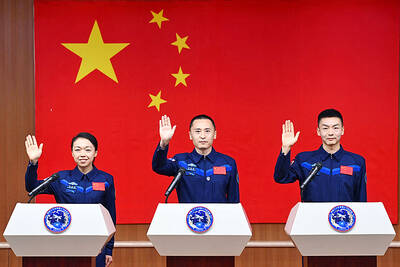
A Hong Kong astronaut is to join a Chinese space mission for the first time as part of a three-person crew launching today, as Beijing edges closer to its goal of landing people on the moon. The Tiangong space station — crewed by teams of three astronauts that are typically rotated every six months — is the crown jewel of China’s space program, boosted by billions in state investment in a bid to catch up with the US and Russia. The Shenzhou-23 mission is to blast off at 11:08pm from the Jiuquan Satellite Launch Center in northwestern China, carrying three astronauts to

UPGRADED ALERT: The risk inside DR Congo is now considered ‘very high,’ while neighboring countries face a ‘high’ threat as the outbreak continues, the WHO said Ebola is spreading faster than responders can track it in eastern Congo, where health workers managed to follow up with barely one in five identified contacts in a single day. Authorities in the Democratic Republic of the Congo (DR Congo) reported 83 confirmed infections, 746 suspected cases and 1,603 identified contacts as of Thursday, but health workers were able to follow up on only 342 contacts that day — about 21 percent of the total under monitoring — data released by the DR Congo Ministry of Public Health on Friday showed. The figures suggest the response is falling behind the outbreak itself,


 RSS
RSS