


Romania’s electoral bureau on Sunday rejected far-right hopeful Calin Georgescu’s candidacy for the rerun of last year’s annulled presidential election, sparking outrage among his supporters in Bucharest.
Georgescu — a past admirer of Russian President Vladimir Putin and an EU and NATO critic — shot to prominence almost overnight to unexpectedly win the first round of a presidential election in November last year, but in a shock move, the Romanian Constitutional Court annulled the ballot shortly before the second round was to be held in December, after claims of Russian meddling and a “massive” social media promotion of Georgescu.
The Romanian Central Electoral Bureau (BEC) in a statement on Sunday said that it had rejected “the independent candidacy” of Georgescu for May’s rerun.
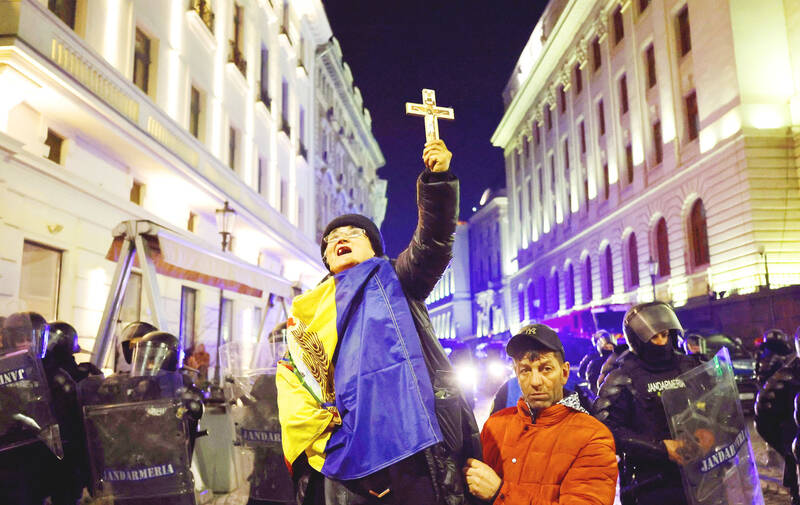
Photo: EPA-EFE
The bureau said its rejection was based on the top court’s annulment of the November ballot.
It had ruled that Georgescu’s candidacy “doesn’t meet the conditions of legality” as it breached “the obligation to ... defend democracy, which is based precisely on fair, honest and impartial” elections.
Georgescu, who is leading opinion polls with about 40 percent of the vote, can challenge the decision at the Constitutional Court.
He denounced the move on social media as “a direct blow to the heart of democracy worldwide.”
“Europe is now a dictatorship, Romania is under tyranny,” the 62-year-old wrote.
The BEC ruling sparked clashes between supporters of Georgescu and police in Bucharest, with authorities trying to disperse violent protesters with tear gas as at least two police officers suffered injuries.
Several hundred people gathered in front of the BEC’s offices on Sunday evening, shouting: “Down with dictatorship” while hurling Romanian flags.
“Following a decision of the Central Electoral Bureau, participants of a public gathering ... broke through the cordon of gendarmes in order to enter the headquarters of the institution,” a police statement said.
As tensions rose again after the BEC published its reasoning, the authorities told journalists to “go to a safe area,” as demonstrators used fireworks and threw objects.
Romania has been plunged into political turmoil since the first round of the presidential election, with Georgescu, who was barely known until then, bagging a surprise win. In a rare move for an EU member nation, its constitutional court annulled the vote following claims of Russian meddling.
Tens of thousands of Georgescu’s supporters have taken to the streets, while Romanian authorities have warned of “hybrid actions carried out by the Russian Federation to undermine democracy in Romania.”
Georgescu — who denies any links to Moscow — has denounced the annulment as a “formalized coup d’etat.”
Opposed to sending aid to Ukraine, he has presented himself as “ultra pro” US President Donald Trump.
Prosecutors last week indicted Georgescu on numerous charges, including making “false statements” over his campaign financing, as well as “instigation to actions against the constitutional order, in attempted form.”
He has been placed under judicial control, meaning he has to regularly report to authorities.
US Vice President J.D. Vance has criticized Romanian authorities for “canceling elections because you don’t like the result,” claiming they are “so afraid of your own people that you silence them.”
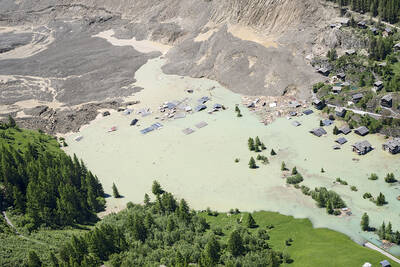
The collapse of the Swiss Birch glacier serves as a chilling warning of the escalating dangers faced by communities worldwide living under the shadow of fragile ice, particularly in Asia, experts said. Footage of the collapse on Wednesday showed a huge cloud of ice and rubble hurtling down the mountainside into the hamlet of Blatten. Swiss Development Cooperation disaster risk reduction adviser Ali Neumann said that while the role of climate change in the case of Blatten “still needs to be investigated,” the wider impacts were clear on the cryosphere — the part of the world covered by frozen water. “Climate change and

Poland is set to hold a presidential runoff election today between two candidates offering starkly different visions for the country’s future. The winner would succeed Polish President Andrzej Duda, a conservative who is finishing his second and final term. The outcome would determine whether Poland embraces a nationalist populist trajectory or pivots more fully toward liberal, pro-European policies. An exit poll by Ipsos would be released when polls close today at 9pm local time, with a margin of error of plus or minus 2 percentage points. Final results are expected tomorrow. Whoever wins can be expected to either help or hinder the
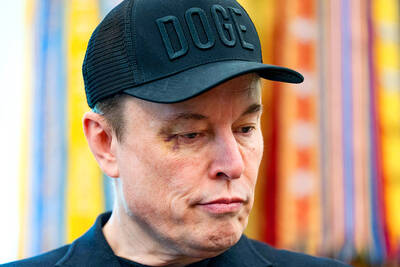
DENIAL: Musk said that the ‘New York Times was lying their ass off,’ after it reported he used so much drugs that he developed bladder problems Elon Musk on Saturday denied a report that he used ketamine and other drugs extensively last year on the US presidential campaign trail. The New York Times on Friday reported that the billionaire adviser to US President Donald Trump used so much ketamine, a powerful anesthetic, that he developed bladder problems. The newspaper said the world’s richest person also took ecstasy and mushrooms, and traveled with a pill box last year, adding that it was not known whether Musk also took drugs while heading the so-called US Department of Government Efficiency (DOGE) after Trump took power in January. In a

It turns out that looming collision between our Milky Way and Andromeda galaxies might not happen after all. Astronomers on Monday said that the probability of the two spiral galaxies colliding is less than previously thought, with a 50-50 chance within the next 10 billion years. That is essentially a coin flip, but still better odds than previous estimates and farther out in time. “As it stands, proclamations of the impending demise of our galaxy seem greatly exaggerated,” the Finnish-led team wrote in a study appearing in Nature Astronomy. While good news for the Milky Way galaxy, the latest forecast might be moot


 RSS
RSS