


Senior Vietnamese official Nguyen Linh believes he has much more to give in the job he has worked his whole life, but would soon retire as part of a radical government cost-cutting drive approved last week.
Across Vietnam, confused public sector workers have been left reeling as ministries are scrapped and merged in a drastic attempt to slash billions of dollars from spending.
The ruling Communist Party of Vietnam aims to cut one in five public sector jobs, many of which were seen as secure positions for life.
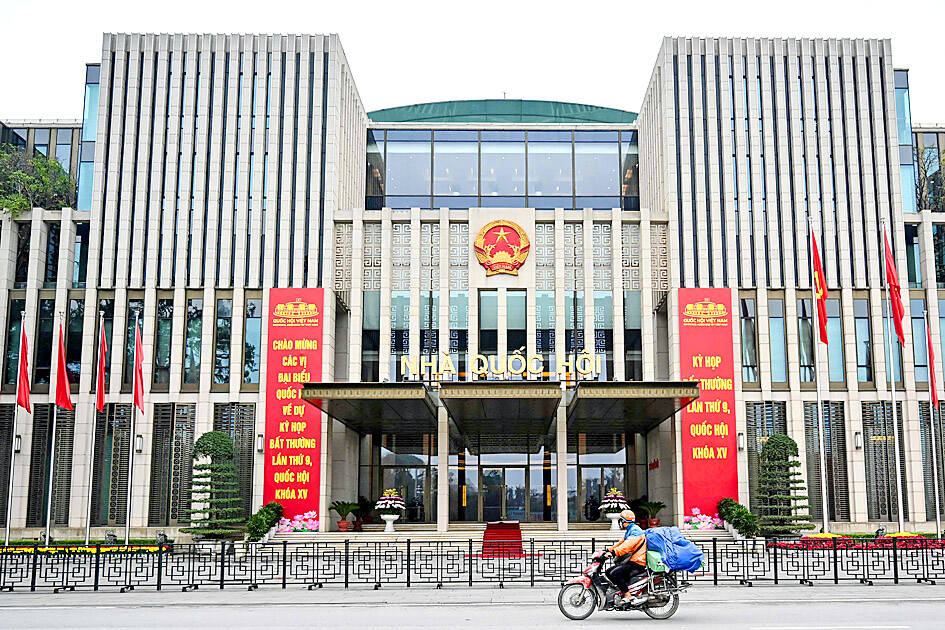
Photo: AFP
Some employees are waiting to hear if their position will go, while others have been given less than 24 hours to decide to fight for their post or take early retirement.
The reforms, which mirror US President Donald Trump’s push to take a hatchet to government spending, are creating unease in a communist country where working for the state is seen as a cradle-to-grave social safety net.
The shake-up has been described as “a revolution” by senior officials, and would see the number of government ministries and agencies slashed from 30 to 22.
The ministries of transport, planning and investment, communications and labor have been abolished, and state media, the civil service, the police and the military all face cuts.
Linh, a pseudonym to protect his identity, works for one of the newly merged ministries and said he had chosen early retirement “to escape the complicated political environment.”
“I think I am fit to continue my work and I still have experience that I can share with other staff,” the 54-year-old said. “But I have made the right decision.”
Linh would receive around US$100,000 when he leaves, but others who have lost their jobs are anxiously awaiting news of compensation.
Several journalists working for state media said they were laid off with little notice, with one saying he had turned to driving a taxi after his 12-year career as a TV producer was suddenly terminated last month.
Almost 2 million people worked in Vietnam’s public sector as of 2022, Vietnamese government data showed, although the International Labour Organization puts the figure much higher.
One in five of these jobs would get the chop over the next five years.
The government has said that 100,000 people would be made redundant or offered early retirement, but it has yet to explain how it would reach the much larger target.
“There are real human costs to these pushes for efficiency,” said Zachary Abuza, a Southeast Asian politics expert and professor at the National War College in Washington, adding that it was not clear if the private sector could absorb them all.
“Think about the state media folks. It’s not like there’s a robust private media for them to move into,” he said, referencing the fact that all media in Vietnam, a one-party state, is government-controlled.
Building on stellar economic growth of 7.1 percent last year, Vietnam — a global manufacturing hub heavily reliant on exports — is aiming for 8 percent this year.
However, a bloated bureaucracy is seen as a brake on growth, as is a high-profile anti-corruption campaign that has slowed everyday transactions.
Authorities have said that savings from the cuts in spending could total US$4.5 billion over the next five years, despite costs of more than US$5 billion for retirement and severance packages.
Abuza said the government could dip into a “sizeable war chest” built up through exports and foreign exchange reserves.
“They can do this without causing too much financial harm,” he said, “and I think they’re assuming that they will be rewarded with further investment down the line.”

A humanoid robot that won a half-marathon race for robots in Beijing on Sunday ran faster than the human world record in a show of China’s technological leaps. The winner from Honor, a Chinese smartphone maker, completed the 21km race in 50 minutes and 26 seconds, said a WeChat post by the Beijing Economic-Technological Development Area, also known as Beijing E-Town, where the race began. That was faster than the human world record holder, Ugandan Jacob Kiplimo, who finished the same distance in about 57 minutes in March at the Lisbon road race. The performance by the robot marked a significant step forward

Four contenders are squaring up to succeed Antonio Guterres as secretary-general of the UN, which faces unprecedented global instability, wars and its own crushing budget crisis. Chile’s Michelle Bachelet, Argentina’s Rafael Grossi, Costa Rica’s Rebeca Grynspan and Senegal’s Macky Sall are each to face grillings by 193 member states and non-governmental organizations for three hours today and tomorrow. It is only the second time the UN has held a public question-and-answer, a format created in 2016 to boost transparency. Ultimately the five permanent members of the UN’s top body, the Security Council, hold the power, wielding vetoes over who leads the

South Korea’s air force yesterday apologized for a 2021 midair collision involving two fighter jets, a day after auditors said the pilots were taking selfies and filming during the flight and held them responsible for the accident. “We sincerely apologize to the public for the concern caused by the accident that occurred in 2021,” an air force spokesman told a news conference, adding that one of the pilots involved had been suspended from flying duties, received severe disciplinary action and has since left the military. The apology followed a report released on Wednesday by the South Korean Board of Audit and Inspection,

An earthquake registering a preliminary magnitude of 7.7 off northern Japan on Monday prompted a short-lived tsunami alert and the advisory of a higher risk of a possible mega-quake for coastal areas there. The Cabinet Office and the Japan Meteorological Agency said there was a 1% chance for a mega-quake, compared to a 0.1% chance during normal times, in the next week or so following the powerful quake near the Chishima and Japan trenches. Officials said the advisory was not a quake prediction but urged residents in 182 towns along the northeastern coasts to raise their preparedness while continuing their daily lives. Prime


 RSS
RSS