

Asian perspectives of the US have shifted from a country once perceived as a force of “moral legitimacy” to something akin to “a landlord seeking rent,” Singaporean Minister for Defence Ng Eng Hen (黃永宏) said on the sidelines of an international security meeting.
Ng said in a round-table discussion at the Munich Security Conference in Germany that assumptions undertaken in the years after the end of World War II have fundamentally changed.
One example is that from the time of former US president John F. Kennedy’s inaugural address more than 60 years ago, the image of the US was of a country that would not allow tyranny such as colonial control to be replaced by another form of tyranny.

Photo: Bloomberg
Now “the image has changed from liberator to great disruptor to a landlord seeking rent,” according to a prepared text of his remarks posted on a government Web site over the weekend.
The remarks came after US President Donald Trump’s administration blindsided historic NATO allies with plans to directly negotiate with Russian President Vladimir Putin over the future of the Kremlin’s war on Ukraine.
The fear for many officials gathered for the conference in Germany is that by dialing back support for Ukraine, Trump is inviting Putin to probe NATO’s willingness to defend the alliance’s eastern borders.
Meanwhile, US National Security Adviser Mike Waltz said the US deserves “payback” from Ukraine for its support against the Russian invasion and Ukrainian President Volodomyr Zelenskiy would be “very wise” to accept a minerals deal offered by the Trump team.
Zelenskiy has rejected a US draft agreement that would give Washington access to critical minerals in the war-battered nation, because it did not offer investments and sufficient protections.
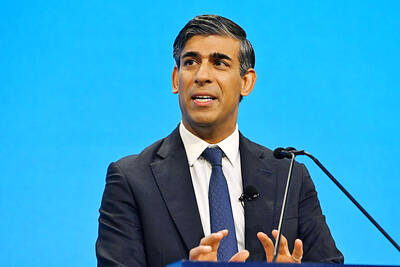
Former British prime minister Rishi Sunak on Wednesday urged so-called middle powers to become a “poisonous shrimp” to carve out strategic economic leverage in a more turbulent global environment. Sunak drew from a metaphor by former Singaporean prime minister Lee Kuan Yew (李光耀): A big fish will eat a smaller fish, and the smaller fish will eat the shrimp. Lee made the point a year after the Asian nation’s independence in 1966 that the city-state needed to build up its defense mechanisms — like a shrimp that stings — so it would be left alone by predators. “He was thinking about what Singapore’s

POLL POSITION: Democrats criticized the timing of the raid, saying that the US justice department historically avoids public investigations within 60 days of an election Federal agents on Monday searched the home of Democratic US Representative Ilhan Omar, a startling escalation in a criminal investigation that brings renewed focus to the frequent target of White House derision in the final weeks of her re-election bid. The search of the Minnesota congresswoman’s home so close to next month’s midterm contests that would determine control of the US House and the Senate was swiftly condemned by top Democrats in Congress, who raised questions about the timing given longstanding US Department of Justice (DOJ) protocol to avoid overt investigative steps involving political candidates in the direct run-up to an

A Rhode Island pumpkin grower appears to have broken the world record for the heaviest pumpkin, with his giant squash topping the record by nearly 136kg. Ron Wallace of Greene, Rhode Island, weighed his pumpkin on Saturday at a contest in New England and is waiting for the Guinness World Records to confirm he smashed the record, set about a week earlier by a grower in England. Wallace said he has been in contact with Guinness officials who say his record is on track to be verified. “It’s truly massive, it was a pleasure to grow,” Wallace said on Monday. Guinness World Records lists

BUILDUP: The report comes as Japanese Prime Minister Sanae Takaichi boosts defense spending in the face of China’s military expansion and the North Korean threat French defence contractor Thales will establish a maintenance and operational support base in Japan in what is seen as the first such move by a foreign firm in the country, a report said yesterday. Thales chairman and CEO Patrice Caine told the Nikkei business daily that the base “will mark a milestone toward Thales’ long-term engagement in Japan.” It is believed to be the first time a foreign defense company has established a dedicated base in Japan for the maintenance and operation of Japanese defense equipment, the Nikkei said. It added that Thales might also expand its Japan-based business to


 RSS
RSS