


The US on Wednesday said that its government vessels would sail for free through the Panama Canal following heavy pressure from US President Donald Trump, but authorities at the waterway swiftly issued a denial.
“US government vessels can now transit the Panama Canal without charge fees, saving the US government millions of dollars a year,” the US Department of State wrote on social media.
It was the first public announcement of promises hinted at by US Secretary of State Marco Rubio, who said that Panama offered concessions during his talks on Sunday.
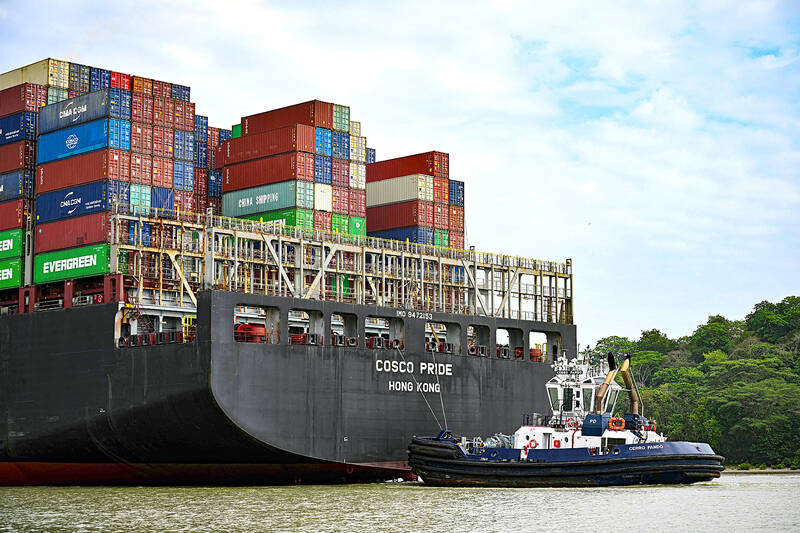
Photo: AFP
The Panama Canal Authority, the agency that runs the vital link between the Atlantic and Pacific oceans, said no agreement had been reached.
“The Panama Canal Authority, which is empowered to set tolls and other fees for transiting the canal, reports that it has not made any adjustments to them,” the agency said in a statement.
It said it was still ready to hold a dialogue with US authorities.
Rubio said he had told Panama that it was unfair for the US to be in a position to defend the vital waterway and also to be charged for its use. US government vessels — which would be primarily from the navy — make up a small portion of the ships that go through the canal.
Aircraft carriers are too large to sail through the canal and must make the far longer journey around South America through the Strait of Magellan.
The US and Panama are scheduled to hold new talks today to discuss the canal.
Since winning the US election in November last year, Trump has refused to rule out the use of force to seize the canal, through which 40 percent of US container traffic passes.
Trump and Rubio have complained about Chinese investment — including ports on both sides of the canal — and warned that Beijing could close the waterway to the US in a crisis.
Panama has forcefully denied Trump’s repeated allegations that China has been given a role in operating the canal.
However, it has also moved to address US concerns. Panamanian President Jose Raul Mulino after his talks with Rubio said that Panama would not renew membership in the Belt and Road Initiative, Beijing’s signature infrastructure-building program.
Rubio told reporters on Monday that his talks with Mulino were “respectful” and that the visit was “going to achieve potentially good things that assuage concerns we have.”
However, Trump said that he was still “not happy,” although he acknowledged that Panama had “agreed to certain things.”
Trump in his inaugural address said the US would be “taking back” the canal — built more than a century ago by Washington with Afro-Caribbean labor and handed back to Panama at the end of 1999.
Mulino has also ordered an audit of Panama Ports Co, a subsidiary of Hong Kong-based conglomerate CK Hutchison Holdings, which runs the two major ports around the canal.
The company was granted a concession in 1997 that was extended for 25 years in 2021, despite rising concern in Washington as China has tightened its grip on Hong Kong, a former British colony that had been promised autonomy.
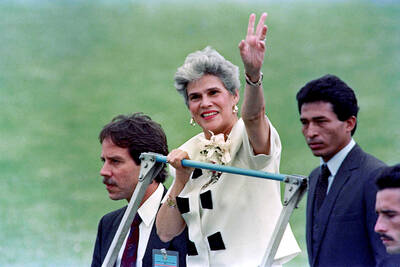
Former Nicaraguan president Violeta Chamorro, who brought peace to Nicaragua after years of war and was the first woman elected president in the Americas, died on Saturday at the age of 95, her family said. Chamorro, who ruled the poor Central American country from 1990 to 1997, “died in peace, surrounded by the affection and love of her children,” said a statement issued by her four children. As president, Chamorro ended a civil war that had raged for much of the 1980s as US-backed rebels known as the “Contras” fought the leftist Sandinista government. That conflict made Nicaragua one of
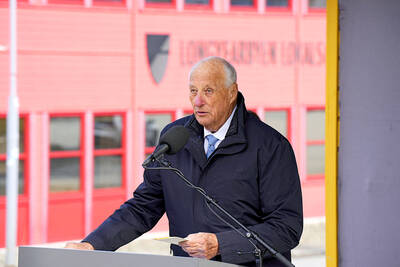
COMPETITION: The US and Russia make up about 90 percent of the world stockpile and are adding new versions, while China’s nuclear force is steadily rising, SIPRI said Most of the world’s nuclear-armed states continued to modernize their arsenals last year, setting the stage for a new nuclear arms race, the Stockholm International Peace Research Institute (SIPRI) said yesterday. Nuclear powers including the US and Russia — which account for about 90 percent of the world’s stockpile — had spent time last year “upgrading existing weapons and adding newer versions,” researchers said. Since the end of the Cold War, old warheads have generally been dismantled quicker than new ones have been deployed, resulting in a decrease in the overall number of warheads. However, SIPRI said that the trend was likely
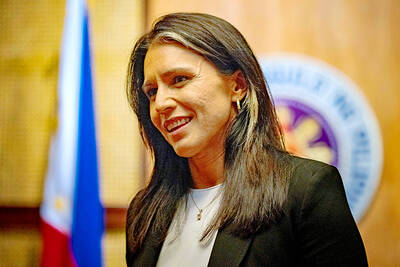
NUCLEAR WARNING: Elites are carelessly fomenting fear and tensions between nuclear powers, perhaps because they have access to shelters, Tulsi Gabbard said After a trip to Hiroshima, US Director of National Intelligence Tulsi Gabbard on Tuesday warned that “warmongers” were pushing the world to the brink of nuclear war. Gabbard did not specify her concerns. Gabbard posted on social media a video of grisly footage from the world’s first nuclear attack and of her staring reflectively at the Hiroshima Peace Memorial. On Aug. 6, 1945, the US obliterated Hiroshima, killing 140,000 people in the explosion and by the end of the year from the uranium bomb’s effects. Three days later, a US plane dropped a plutonium bomb on Nagasaki, leaving abut 74,000 people dead by the
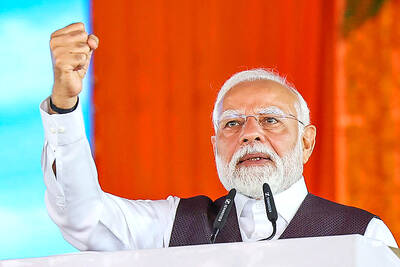
Indian Prime Minister Narendra Modi is to visit Canada next week, his first since relations plummeted after the assassination of a Canadian Sikh separatist in Vancouver, triggering diplomatic expulsions and hitting trade. Analysts hope it is a step toward repairing ties that soured in 2023, after then-Canadian prime minister Justin Trudeau pointed the finger at New Delhi’s involvement in murdering Hardeep Singh Nijjar, claims India furiously denied. An invitation extended by new Canadian Prime Minister Mark Carney to Modi to attend the G7 leaders summit in Canada offers a chance to “reset” relations, former Indian diplomat Harsh Vardhan Shringla said. “This is a


 RSS
RSS