


Ancient Greece produced the earliest records of democracy, Western philosophy — and, it turns out, lead pollution.
Researchers studying sediment cores recovered from mainland Greece and the Aegean Sea have found the oldest known evidence of lead pollution in the environment dating to about 5,200 years ago.
That is 1,200 years older than the previous earliest recorded lead pollution, which was found in a peatbog in Serbia.
In antiquity, lead was released into the atmosphere as a byproduct of smelting ore for copper and silver. The toxic metal later condensed as dust and settled onto the soil.
“Silver was used for jewelry, for special objects — but it wasn’t found in a pure state,” but mined in ore combined with lead, said Heidelberg University archeologist Joseph Maran, coauthor of a new study published on Thursday in Communications Earth and Environment.
The site with the earliest signs of lead contamination is in northeastern Greece, near the island of Thasos. Prior archeological evidence suggests Thasos was one of the region’s most significant sites for silver mining and metalwork, Maran said.
“Lead released from smelting is the world’s first form of toxic or industrial pollution,” said Yale historian Joseph Manning, who was not involved in the study.
The researchers found that levels of lead contamination remained fairly low and localized in ancient Greece, considered the cradle of European civilization, throughout the Bronze Age, the Classical period and the Hellenistic period.
However, about 2,150 years ago, the researchers detected “a very strong and abrupt increase” in lead emissions caused by human activities across Greece, said coauthor Andreas Koutsodendris at Heidelberg University.
Around that time, in 146 BC, the Roman army conquered the Greek peninsula, transforming the region’s society and economy. As Roman trade, colonies and shipping expanded across the Mediterranean Sea and Black Sea, demand for silver coins grew rapidly, requiring smelting that released lead, Koutsodendris said.
Later the Roman Empire used lead for tableware and for construction, including pipes.
Previous research —including an analysis of ice cores from Greenland — had detected high levels of lead across much of the Northern Hemisphere during Roman times.
However, the new study adds a more “specific and local picture to how lead levels changed,” said Nathan Chellman, an environmental scientist at the University of Nevada, Reno, who was not involved in the research.

A US YouTuber who caused outrage for filming himself kissing a statue commemorating Korean wartime sex slaves has been sentenced to six months in prison, a court in Seoul said yesterday. Johnny Somali, 25, gained notoriety several years ago for recording himself doing a series of provocative stunts in South Korea and Japan, and streaming them on platforms such as YouTube and Twitch. South Korean authorities indicted Somali — whose real name is Ramsey Khalid Ismael — in 2024 on public order violations and obstruction of business, and banned him from leaving the country. “The court has sentenced him to six months in

Former Lima mayor Rafael Lopez Aliaga, a Peruvian presidential hopeful, gathered hundreds of supporters in Lima on Tuesday and gave authorities 24 hours to annul the first round of the country’s election over allegations of fraud. Lopez Aliaga is locked in a tight three-way race with two other candidates for second place in Sunday’s vote. The election runner-up wins a ticket to June’s presidential run-off against front-runner Keiko Fujimori. “I am giving them 24 hours to declare this electoral fraud null and void,” said Lopez Aliaga, surrounded by a crowd of several hundred supporters. “If it is not declared null and void tomorrow,
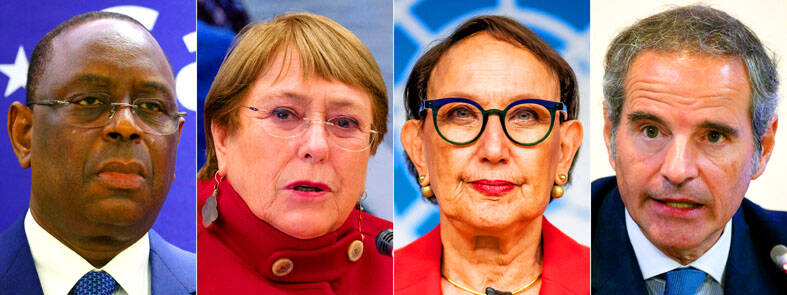
Four contenders are squaring up to succeed Antonio Guterres as secretary-general of the UN, which faces unprecedented global instability, wars and its own crushing budget crisis. Chile’s Michelle Bachelet, Argentina’s Rafael Grossi, Costa Rica’s Rebeca Grynspan and Senegal’s Macky Sall are each to face grillings by 193 member states and non-governmental organizations for three hours today and tomorrow. It is only the second time the UN has held a public question-and-answer, a format created in 2016 to boost transparency. Ultimately the five permanent members of the UN’s top body, the Security Council, hold the power, wielding vetoes over who leads the

A humanoid robot that won a half-marathon race for robots in Beijing on Sunday ran faster than the human world record in a show of China’s technological leaps. The winner from Honor, a Chinese smartphone maker, completed the 21km race in 50 minutes and 26 seconds, said a WeChat post by the Beijing Economic-Technological Development Area, also known as Beijing E-Town, where the race began. That was faster than the human world record holder, Ugandan Jacob Kiplimo, who finished the same distance in about 57 minutes in March at the Lisbon road race. The performance by the robot marked a significant step forward


 RSS
RSS