


A wizened farmer leads a buffalo through a misty copse of gnarled trees in eastern China, closely followed by a woman in a straw hat heaving pails of water.
It is a tranquil image of rural Chinese life — except for the overhead whir of a drone, the hiss of a smoke machine and the excited chatter of smartphone-wielding day-trippers.
Residents in Xiapu County, in China’s Fujian Province, have achieved viral online fame by staging picturesque country scenes and charging tourists up to 300 yuan (US$41.75) to photograph them.
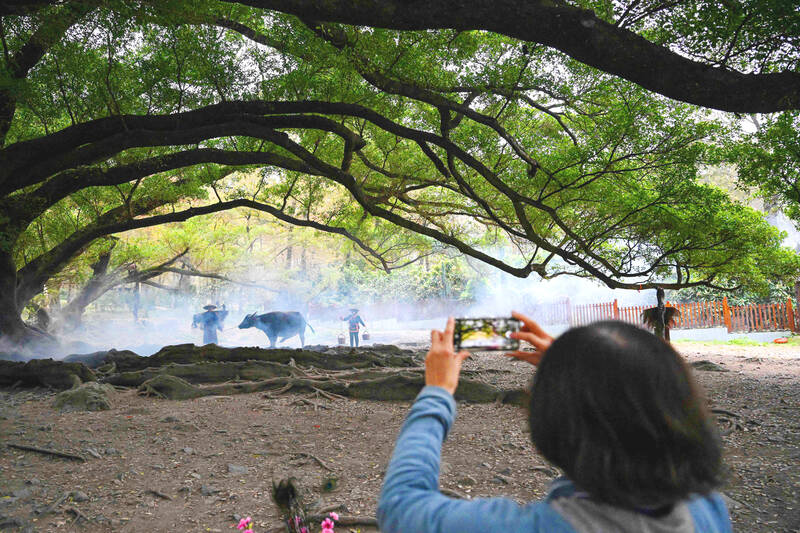
Photo: AFP
The scheme indulges visitors’ nostalgia for a pastoral idyll that perhaps never truly existed and has been swept away by rampant urbanization and industrial development.
“Back in the day, when we were sent down to the countryside, we used buffalo for ploughing,” said Liang Liuling, 72, on holiday from the southwestern Guangxi region.
In the 1960s and 1970s, her generation toiled for years in rural backwaters during Mao Zedong’s (毛澤東) Cultural Revolution — although many remember their hardships fondly.
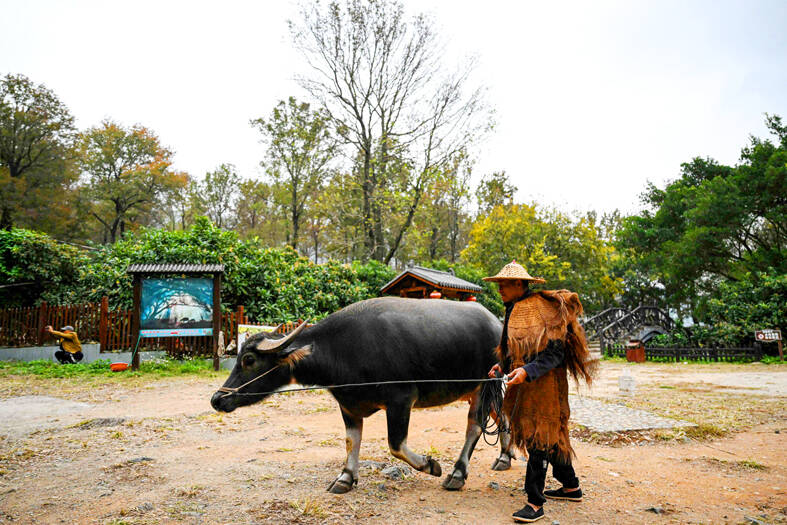
Photo: AFP
“Now, they’ve become props for us elderly to enjoy,” Liang said, smiling after posing for shots with the animals. “Seeing them here is just wonderful.”
About 20 percent of Chinese people lived in cities in 1980, compared to about two-thirds today — a result of the country’s rapid development.
The jarring shift in living styles feeds a trend for reminiscing about economically leaner, but arguably simpler times.
A search for Xiapu — population 480,000, small by Chinese standards — returns hundreds of thousands of posts on Douyin, the country’s version of TikTok, and on Xiaohongshu, known as Red Note in English.
Many users flaunt stunning photographs of supposedly timeless scenes and offer guides on how to create the best shots.
That the vista is manufactured does not seem to have dampened the enthusiasm of the coachloads of daily visitors.
“We saw this scenic spot online and changed our plans at the last minute to come,” tour guide Huang Jumei said, as she led a group of people mainly over 60, adding that they were “reluctant to leave.”
“It brings back childhood memories for many of us who come from farming families ... but as life has improved, most families stopped keeping cattle,” she said.
Visitors must thrash out a price with buffalo-owner Chen Weizuo before he steps in front of the cameras.
The 62-year-old poses several times a day and rents costumes for extra income.
Originally a farmer, a decade ago he borrowed a fellow villager’s buffalo and began charging a trickle of mostly local tourists for photos.
Larger groups began arriving a few years back, and he imported his own bovine from Vietnam as “no one in China sells buffaloes anymore.”
While his customers revel in nostalgia, Chen is glad to have shaken off his former life working the fields.
“Now, I spend my days under the banyan trees. In the summer, it’s cool, and when guests come I chat and joke with them,” he said.
“It’s much more relaxed,” he said, adding: “I’m not into taking photos myself.”

A ship that appears to be taking on the identity of a scrapped gas carrier exited the Strait of Hormuz on Friday, showing how strategies to get through the waterway are evolving as the Middle East war progresses. The vessel identifying as liquefied natural gas (LNG) carrier Jamal left the Strait on Friday morning, ship-tracking data show. However, the same tanker was also recorded as having beached at an Indian demolition yard in October last year, where it is being broken up, according to market participants and port agent’s reports. The ship claiming to be Jamal is likely a zombie vessel that

Cannabis-based medicines have shown little evidence of effectiveness for treating most mental health and substance-use disorders, according to a large review of past studies published in a major medical journal on Monday. Medical use of cannabinoids has been expanding, including in the US, Canada and Australia, where many patients report using cannabis products to manage conditions such as anxiety, post-traumatic stress disorder and sleep problems. Researchers reviewed data from 54 randomized clinical trials conducted between 1980 and May last year involving 2,477 participants for their analysis published in The Lancet. The studies assessed cannabinoids as a primary treatment for mental disorders or substance-use

NATIONWIDE BLACKOUT: US President Donald Trump cut off Venezuelan oil shipments to Cuba, strangling the Caribbean island’s already antiquated grid Cuba’s national electric grid collapsed on Monday, the nation’s grid operator said, leaving about 10 million people without power amid a US-imposed oil blockade that has crippled the already obsolete generation system. Grid operator UNE on social media said that it is investigating the causes of the blackout, the latest in a series of widespread outages that last for hours or days and that this weekend sparked a rare violent protest in the communist-run nation. Officials ruled out a major power plant failure, but had still not pinpointed the root cause of the grid collapse, suggesting a problem with transmission. Officials said that

CONSERVING FUEL: State institutions are to operate only four days a week starting tomorrow, with the measures also applying to schools and universities Sri Lanka on Monday announced a shorter working week to conserve its scarce fuel reserves as it prepares for a prolonged war in the Middle East. The Strait of Hormuz, a key waterway through which about 20 percent of global exports pass in peacetime, has been effectively closed by Iran in retaliation over the US and Israeli war against it, now in its third week. Sri Lankan Commissioner-General of Essential Services Prabath Chandrakeerthi said state institutions would operate only four days a week starting tomorrow. The new austerity measures would also apply to schools and universities, and would remain in place indefinitely. “We are


 RSS
RSS