


Filming in dirty, bug-infested rooms with scant breaks and shared sex toys: Colombia’s “webcam models” are speaking out about abuse in one of the world’s top providers of adult webcam content.
Despite their clients being thousands of kilometers away — mainly in the US and Europe — many webcam sex workers said they have suffered physical and emotional mistreatment.
Some studio bosses in Colombia prey on cis and transgender women from poor backgrounds, with low education levels, or single mothers trying to make ends meet, they said.

Photo: AFP
“They forced us to do 12 hours [of broadcasts] a day. If not, they took a percentage of my money,” 25-year-old Paula Osorio said at an upmarket webcam studio in Bogota, recounting her start in the industry at another, lower-end adult platform five years ago. “I started working there to earn enough to eat, and they took advantage of that because I had nowhere else to go.”
Sex work is legal in the South American country, which has a high rate of informal employment — about 55 percent — and a low minimum wage of about US$320 per month.
In December last year, Human Rights Watch (HRW) documented claims of “abusive, unhygienic working conditions and coercion to perform nonconsensual sex acts” in a report focusing on the plight of “webcam models” in Colombia.
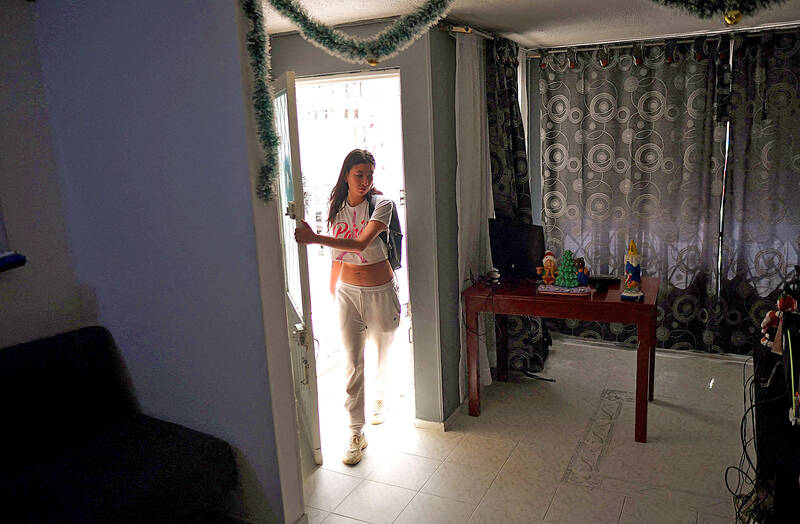
Photo: AFP
Tens of thousands of Colombians are estimated to be employed in the sector, broadcasting adult content to clients around the globe.
In 2021, the industry was worth about US$40 million in Colombia, the report said.
In general, platforms keep 50 to 65 percent of what viewers pay, but in Colombia many sex workers claimed to get as little as 30 percent of the earnings, HRW said.
Sometimes models are fined for taking breaks to eat or go to the bathroom.
Tania Rios, a mother of two small children, said that she has had many bad experiences that she preferred not to recount.
“But yes, there are studios that want to control women and cheat them of their wages,” said the 27-year-old, who has no formal education beyond elementary school. “There are many things one will do out of necessity.”
In its report based on interviews with sex workers in the cities of Bogota, Cali, Medellin and Palmira, HRW said it was alerted to models working 18-hour shifts without breaks and coerced into degrading, traumatizing or painful sex acts at some studios.
Investigators contacted four platforms named in the report, three of which said they had measures in place to combat human trafficking and child sex abuse, but denied responsibility for abuses at studios where the content is filmed.
One platform did not reply at all.
Sergio Rueda, a manager at Gold Line Studios, said that it was true that many low-budget “garage studios” treated women poorly, but not his.
The studio employs a psychologist, Katherine Arroyave, who said that seven out of 10 women who joined Gold Line have had “bad experiences” with other employers in the past.
The Colombian government has been working since last year on regulating the sector to protect workers’ rights and combat tax evasion by employers.
However, the demand for workers — including men — has only continued to grow.
Ex-webcam model Darling Leon, 28, created a service to help others better navigate the system — teaching them what to look for in a work contract, for example.
She gives classes in-person and online.
“Most of them got into it thinking only about the money and not the fine print,” she said. “Providing them with this information helps prevent their rights being violated.”

‘CROSSING THE LINE’: China’s embassy in Seoul criticized US Forces Korea Commander General Xavier Brunson, asking if his ‘hostile’ remarks were authorized by Washington South Korea and the US are in talks over recent public remarks by the commander of US Forces Korea, Seoul’s presidential office said yesterday, after the comments drew sharp criticism from China. In a recent podcast interview, US Forces Korea Commander General Xavier Brunson described South Korea as “the dagger in the heart of Asia” from China’s east coast, prompting the Chinese embassy in Seoul to say that he had “truly crossed the line.” The interview came amid growing speculation that Washington might seek to expand the role of US Forces Korea in countering the growing regional influence of China, a key

SEEKING ORDER: Rodrigo Paz said that ‘anyone who wants to destroy the nation will have to deal with this president and the full force of the constitution’ Bolivian President Rodrigo Paz on Wednesday said that the nation was at a “breaking point” after nearly a month of protests that have caused shortages of food, fuel and medicine. Paz, who took office six months ago amid the worst economic crisis there in four decades, is battling a groundswell of fury over his policies. The political capital, La Paz, has been besieged by low-income workers and members of the indigenous majority calling for his resignation. “The country needs order and is reaching breaking point,” the 58-year-old said at a public event in La Paz, renewing his appeal for dialogue. On Tuesday, the Bolivian

Australian researchers have trained lab-grown brain cells on a silicon computer chip to play the 1990s shooter game Doom and said they are just scratching the surface of what the neurons could be capable of doing. It is the science-fiction work of biotech boffins at Cortical Labs, who researched and developed the technology that harnesses the workings of the brain’s networking system. Each so-called “biological computer” contains about 200,000 living human brain cells, grown from stem cells that were harvested from blood donations. Having mastered the simple computer game Pong, where a paddle is moved up and down to send a ball

Through the noise of rushing papers and whirring belts at a print factory in Kyoto, two creators watch their photo essay come to life in broadsheet form — part of an effort to win new audiences in the age of artificial intelligence (AI). Despite the decline of the publishing industry, self-publication and handmade “zine” magazines are growing in popularity in Japan, reflecting the nation’s enduring love of paper in the digital era. While speaking to Agence France-Presse at the plant, his hands black with ink, one of the creators, Kazuma Obara, said: “I think [paper] is a medium that engages all five


 RSS
RSS