


Russia on Sunday claimed its troops had captured a strategically important town in eastern Ukraine as part of a grinding campaign to weaken Kyiv’s grip on the country’s industrial heartland, while uncertainty over the continued flow of US funding has reportedly halted the work of some Ukrainian non-governmental organizations (NGOs), including those helping war veterans.
The Russian Ministry of Defense announced the fall of Velyka Novosilka, which had about 5,000 residents before the war, following a months-long battle. Its statement could not be independently verified, and Ukraine claimed its troops had only strategically withdrawn from certain areas.
However, if confirmed, it would make Velyka Novosilka the first significant town to capitulate this year under Moscow’s onslaught in the eastern Donetsk region against Ukraine’s weary and short-handed army. The war is set to reach its three-year milestone next month.
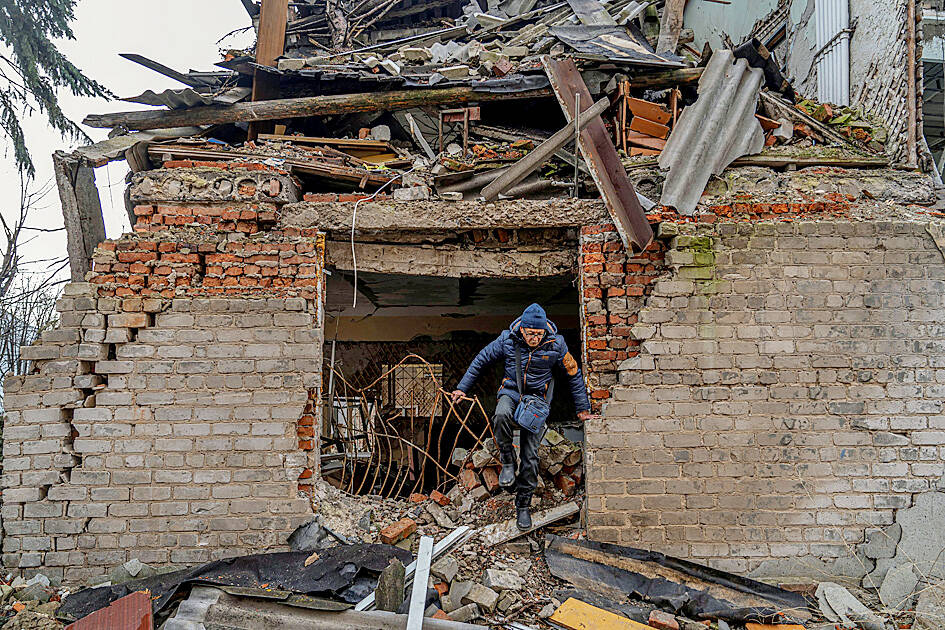
Photo: Reuters
Ukrainian forces withdrew from certain parts of Velyka Novosilka to avoid encirclement, the 110th Separate Mechanized Brigade said in a statement on its official Telegram channel on Sunday.
The brigade is active in that patch of the front line.
Analysts have long predicted that it is only a matter of time until Russian forces capture the settlement, which lies only 15km from the neighboring Dnipropetrovsk region.
The brigade said although they have approximate parity with Russian forces in terms of artillery and drones, the Russians have a huge advantage in manpower.
“Our units, using the weather conditions, skillfully withdrew from areas where there was a threat of encirclement. This does not mean that we have completely left the city, the fighting in Velyka Novosilka continues. All actions are aimed at minimizing our own losses and maximum damage to the enemy,” the statement said.
The brigade said the withdrawal would make it topographically difficult for Russians to advance by making the river an obstacle for further advance.
“The enemy ... will have no peace, any movement is cut off by shells and drones,” the statement said.
Russia captured the Donetsk cities of Avdiivka and Vuhledar last year after long and grueling battles. Those cities were largely leveled by Russian artillery, glide bombs and drones before they fell.
Russian forces have also been trying for months to capture the key Donetsk strongholds of Pokrovsk and Chasiv Yar.
Elsewhere, Ukrainian NGOs catering to the needs of war veterans and their families have claimed a suspension of US funding is forcing them to halt their work, days after newly sworn in US Secretary of State Marco Rubio announced he would pause foreign aid grants for 90 days.
Ukrainian President Volodymyr Zelenskiy later claimed that military aid to Ukraine would continue, but did not clarify whether humanitarian aid had been paused. Kyiv relies on the US for 40 percent of its military needs.
According to news reports, Ukrainian NGOs receiving funding from Washington this weekend began receiving “stop work” orders, requiring them to pause all projects and related travel.
Veteran Hub, an NGO that provides legal and psychological support to war veterans and their families, was forced to halt operations of two of its three largest service units as a result, the organization said on its official Facebook page.
It said the suspension has led it to ask for public donations for the first time.
“Since 2018, we have refrained from public fundraising because we believe that donations are primarily needed for the military. Today, we are forced to publicly ask for support for the first time,” the organization said.
With the administration of US President Donald Trump questioning the future of US aid to Ukraine, stressing the need to quickly broker a peace deal, Moscow and Kyiv are seeking battlefield successes to strengthen their negotiating positions ahead of any prospective talks.
For the past year, Russian forces have been waging an intense campaign to punch holes in Ukraine’s defenses in the eastern Donetsk region. The sustained and costly offensive has compelled Kyiv to give up a series of towns, villages and hamlets.

ROCKY RELATIONS: The figures on residents come as Chinese tourist numbers drop following Beijing’s warnings to avoid traveling to Japan The number of Chinese residents in Japan has continued to rise, even as ties between the two countries have become increasingly fractious, data released on Friday showed. As of the end of December last year, the number of Chinese residents had increased by 6.5 percent from the previous year to 930,428. Chinese people accounted for 22.6 percent of all foreign residents in Japan, making them by far the largest group, Japanese Ministry of Justice data showed. Beijing has criticized Tokyo in increasingly strident terms since Japanese Prime Minister Sanae Takaichi last year suggested that a military conflict around Taiwan could

A pro-Iran hacking group claimed to breach FBI Director Kash Patel’s personal e-mail inbox and posted some of the contents online. The e-mails provided by the hacking group include travel details, correspondence with leasing agents in Washington and global entry, and loyalty account numbers. The e-mail address the hackers claim to have compromised has been previously tied to Patel’s personal details, and the leaked e-mails contain photos of Patel and others, in addition to correspondence with family members and colleagues. “The FBI is aware of malicious actors targeting Director Patel’s personal email information,” the agency said in a statement on

RIVALRY: ‘We know that these are merely symbolic investigations initiated by China, which is in fact the world’s most profligate disrupter of supply chains,’ a US official said China has started a pair of investigations into US trade practices, retaliating against similar probes by US President Donald Trump’s administration as the superpowers stake out positions before an expected presidential summit in May. The move, announced by the Chinese Ministry of Commerce on Friday, is a direct mirror of steps Trump took to revive his tariff agenda after the US Supreme Court last month struck down some of his duties. “China expresses its strong dissatisfaction and firm opposition to these actions,” a ministry spokesperson said in a statement, referring to the so-called Section 301 investigations initiated on March 11.

When a hiker fell from a 55m waterfall in wild New Zealand bush, rescuers were forced to evacuate the badly hurt woman without her dog, which could not be found. After strangers raised thousands of dollars for a search, border collie Molly was flown to safety by a helicopter pilot who was determined to reunite the pet and the owner. A week earlier, an emergency rescue helicopter found the woman with bruises and lacerations after a fall at a rocky spot at the waterfall on the South Island’s West Coast. She was airlifted on March 24, but they were forced to


 RSS
RSS