


Brazil’s government on Saturday expressed outrage after dozens of immigrants deported from the US arrived by plane in handcuffs, calling it a “flagrant disregard” for their rights.
The Brazilian Ministry of Foreign Affairs said it would demand an explanation from Washington over the “degrading treatment of passengers on the flight.”
The spat comes as Latin America grapples with US President Donald Trump’s return to power bringing a hardline anti-immigration agenda, promising crackdowns on irregular migration and mass deportations.
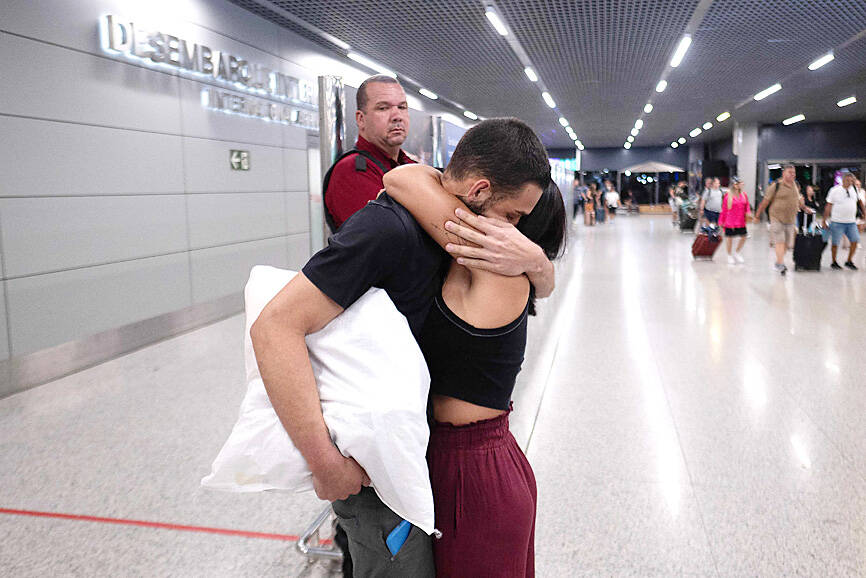
Photo: AFP
When the plane landed in the northern city of Manaus, Brazilian authorities ordered US officials to “immediately remove the handcuffs,” the Brazilian Ministry of Justice and Public Security said in a statement.
Brazilian Minister of Justice and Public Security Ricardo Lewandowski told Brazilian President Luiz Inacio Lula da Silva of “the flagrant disregard for the fundamental rights of Brazilian citizens,” the statement said.
Brazil would request “explanations from the US government about the degrading treatment of passengers” on the Friday night flight, the foreign ministry wrote on X.
The government said 88 Brazilians were aboard the aircraft.
Edgar Da Silva Moura, a 31-year-old computer technician, was on the flight, after seven months in detention in the US.
“On the plane they didn’t give us water, we were tied hands and feet, they wouldn’t even let us go to the bathroom,” he said. “It was very hot, some people fainted.”
Luis Antonio Rodrigues Santos, a 21-year-old freelancer, recounted the “nightmare” of people with “respiratory problems” during “four hours without air-conditioning” due to technical issues on the plane.
“Things have already changed [with Trump]; immigrants are treated as criminals,” he said.
The flight was originally destined for the southeastern city of Belo Horizonte, but encountered a technical issue forcing it to land in Manaus.
A government source said the deportation flight was not directly linked to any immigration orders issued by Trump upon taking office on Monday last week, but rather stemmed from a 2017 bilateral agreement.
Brazilian Minister of Human Rights and Citizenship Macae Evaristo told journalists that “children with autism ... who went through very serious experiences” were also on the flight.
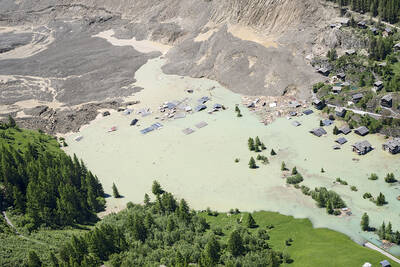
The collapse of the Swiss Birch glacier serves as a chilling warning of the escalating dangers faced by communities worldwide living under the shadow of fragile ice, particularly in Asia, experts said. Footage of the collapse on Wednesday showed a huge cloud of ice and rubble hurtling down the mountainside into the hamlet of Blatten. Swiss Development Cooperation disaster risk reduction adviser Ali Neumann said that while the role of climate change in the case of Blatten “still needs to be investigated,” the wider impacts were clear on the cryosphere — the part of the world covered by frozen water. “Climate change and

Poland is set to hold a presidential runoff election today between two candidates offering starkly different visions for the country’s future. The winner would succeed Polish President Andrzej Duda, a conservative who is finishing his second and final term. The outcome would determine whether Poland embraces a nationalist populist trajectory or pivots more fully toward liberal, pro-European policies. An exit poll by Ipsos would be released when polls close today at 9pm local time, with a margin of error of plus or minus 2 percentage points. Final results are expected tomorrow. Whoever wins can be expected to either help or hinder the

DENIAL: Musk said that the ‘New York Times was lying their ass off,’ after it reported he used so much drugs that he developed bladder problems Elon Musk on Saturday denied a report that he used ketamine and other drugs extensively last year on the US presidential campaign trail. The New York Times on Friday reported that the billionaire adviser to US President Donald Trump used so much ketamine, a powerful anesthetic, that he developed bladder problems. The newspaper said the world’s richest person also took ecstasy and mushrooms, and traveled with a pill box last year, adding that it was not known whether Musk also took drugs while heading the so-called US Department of Government Efficiency (DOGE) after Trump took power in January. In a

It turns out that looming collision between our Milky Way and Andromeda galaxies might not happen after all. Astronomers on Monday said that the probability of the two spiral galaxies colliding is less than previously thought, with a 50-50 chance within the next 10 billion years. That is essentially a coin flip, but still better odds than previous estimates and farther out in time. “As it stands, proclamations of the impending demise of our galaxy seem greatly exaggerated,” the Finnish-led team wrote in a study appearing in Nature Astronomy. While good news for the Milky Way galaxy, the latest forecast might be moot


 RSS
RSS