


SpaceX launched its Starship rocket on its latest test flight on Thursday, but the spacecraft was destroyed following a thrilling booster catch back at the pad.
Elon Musk’s company said Starship broke apart — what it called a “rapid unscheduled disassembly.”
The spacecraft’s six engines appeared to shut down one by one during ascent, with contact lost just eight-and-a-half minutes into the flight.
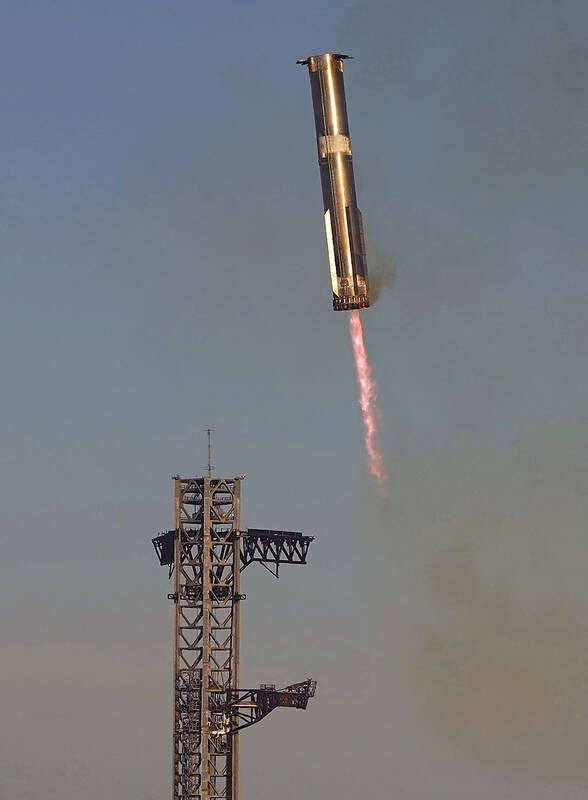
Photo: AP
The spacecraft — a new and upgraded model making its debut — was supposed to soar across the Gulf of Mexico from Texas on a near loop around the world similar to previous test flights. SpaceX had packed it with 10 dummy satellites for practice at releasing them.
A minute before the loss, SpaceX used the launch tower’s giant mechanical arms to catch the returning booster, a feat achieved only once before. The descending booster hovered over the launch pad before being gripped by the pair of arms dubbed chopsticks.
The thrill of the catch quickly turned into disappointment for not only the company, but the crowds gathered along the southern tip of Texas.
“It was great to see a booster come down, but we are obviously bummed out about ship,” SpaceX spokesman Dan Huot said.
“It’s a flight test. It’s an experimental vehicle,” he stressed.
The last data received from the spacecraft indicated an altitude of 146km and a velocity of 21,317kph.
Musk said a preliminary analysis suggests leaking fuel might have built up pressure in a cavity above the engine firewall.
Fire suppression will be added to the area, with increased venting and double-checking for leaks, he wrote on X.
The 123m rocket had thundered away in late afternoon from Boca Chica Beach near the Mexican border. The late hour ensured a daylight entry halfway around the world in the Indian Ocean, but the shiny retro-looking spacecraft never got that far.
SpaceX had made improvements to the spacecraft for the latest demo and added a fleet of satellite mockups. The test satellites were the same size as SpaceX’s Starlink Internet satellites and, like the spacecraft, were meant to be destroyed upon entry.
Musk plans to launch actual Starlinks on Starships before moving on to other satellites and, eventually, crews. It was the seventh test flight for the world’s biggest and most powerful rocket.
NASA has reserved a pair of Starships to land astronauts on the moon later this decade. Musk’s goal is Mars.
Hours earlier in Florida, another billionaire’s rocket company — Jeff Bezos’ Blue Origin — launched the newest supersized rocket, New Glenn. The rocket reached orbit on its first flight, successfully placing an experimental satellite thousands of kilometers above Earth. However, the first-stage booster was destroyed, missing its targeted landing on a floating platform in the Atlantic.


HIGH HOPES: The power source is expected to have a future, as it is not dependent on the weather or light, and could be useful for places with large desalination facilities A Japanese water plant is harnessing the natural process of osmosis to generate renewable energy that could one day become a common power source. The possibility of generating power from osmosis — when water molecules pass from a less salty solution to a more salty one — has long been known. However, actually generating energy from that has proved more complicated, in part due the difficulty of designing the membrane through which the molecules pass. Engineers in Fukuoka, Japan, and their private partners think they might have cracked it, and have opened what is only the world’s second osmotic power plant. It generates

When a hiker fell from a 55m waterfall in wild New Zealand bush, rescuers were forced to evacuate the badly hurt woman without her dog, which could not be found. After strangers raised thousands of dollars for a search, border collie Molly was flown to safety by a helicopter pilot who was determined to reunite the pet and the owner. A week earlier, an emergency rescue helicopter found the woman with bruises and lacerations after a fall at a rocky spot at the waterfall on the South Island’s West Coast. She was airlifted on March 24, but they were forced to

Showcasing phallus-shaped portable shrines and pink penis candies, Japan’s annual fertility festival yesterday teemed with tourists, couples and families elated by its open display of sex. The spring Kanamara Matsuri near Tokyo features colorfully dressed worshipers carrying a trio of giant phallic-shaped objects as they parade through the street with glee. The festival, as legend has it, honors a local blacksmith in the Edo Period (1603-1868) who forged an iron dildo to break the teeth of a sharp-toothed demon inhabiting a woman’s vagina that had been castrating young men on their wedding nights. A 1m black steel phallus sits in the courtyard of

JAN. 1 CLAUSE: As military service is voluntary, applications for permission to stay abroad for over three months for men up to age 45 must, in principle, be granted A little-noticed clause in sweeping changes to Germany’s military service policy has triggered an uproar after it emerged that the law requires men aged up to 45 to get permission from the armed forces before any significant stay abroad, even in peacetime. The legislation, which went into effect on Jan. 1 aims to bolster the military and demands all 18-year-old men fill out a questionnaire to gauge their suitability to serve in the armed forces, but stops short of conscription. If the “modernized” model fails to pull in enough recruits, parliament will be compelled to discuss the reintroduction of compulsory service, German


 RSS
RSS