


Cuba has freed 127 prisoners, including opposition leader Jose Daniel Ferrer, in a landmark deal with departing US President Joe Biden that has led to emotional reunions across the communist island.
Ferrer, 54, is the most high-profile of the prisoners that Cuba began freeing on Wednesday after Biden agreed to remove the country from Washington’s list of terrorism sponsors — part of an eleventh-hour bid to cement his legacy before handing power on Monday to US president-elect Donald Trump.
“Thank God we have him home,” Nelva Ortega said of her husband, Ferrer, who has been in and out of prison for the past two decades.
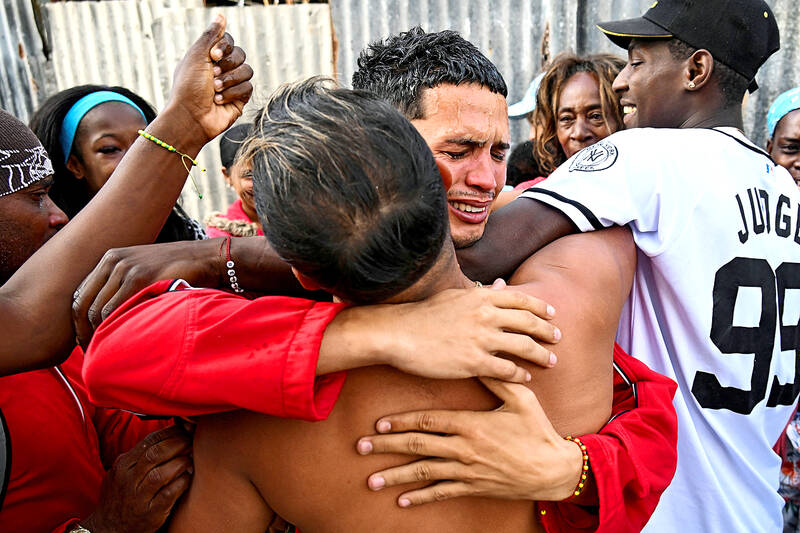
Photo: AFP
His latest stint lasted three-and-a-half years.
Shortly after his release on Thursday, Ferrer urged Cubans on a Miami-based radio program to “not be afraid” to stand up to a government he said was “increasingly scared” and “increasingly weak.”
In return for being removed from the US terror list that includes North Korea, Iran and Syria, cash-strapped Cuba promised to release 553 people — many of whom the Biden administration said were “political prisoners.”
Most were arrested for taking part in mass July 2021 demonstrations against the government over recurring power outages, food shortages and price hikes.
Cuban Supreme Court Vice President Maricela Sosa said that “between Wednesday and Thursday 127 [detainees] have been granted early release.”
Reporters on Thursday saw four prisoners emerge from the San Miguel del Padron prison on the outskirts of the capital, Havana.
Marlon Brando Diaz, who was serving an 18-year sentence for his participation in the 2021 protests, said tearfully that he was thankful for “a new chance in life.”
“It’s a new start,” he said, as he hugged emotional family members.
The deal with Washington paves the way for increased US investment in the Caribbean island, which has been under a trade embargo for more than six decades.
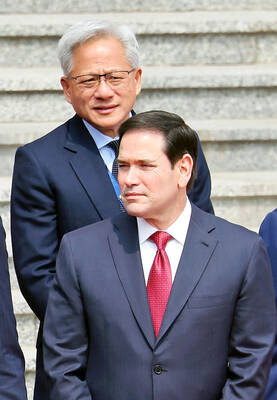
However, in a sign that the thaw might be short-lived, Trump’s pick for secretary of state, Florida Senator Marco Rubio, suggested Biden’s decision could be reversed.
The son of Cuban immigrants, Rubio is vociferously critical of that country’s government and said Trump’s incoming administration was not bound by Biden’s policies.
“There is zero doubt in my mind that they [the Cuban government] meet all the qualifications for being a state sponsor of terrorism,” he said at his US Senate confirmation hearing on Wednesday.
The trickle of prisoner releases caused anguish for families still waiting for news of their loved ones.
Authorities have not released a list or a timetable of those to be freed.
Analysts said Cuba could be stalling to ensure Trump upholds the deal when he returns to the White House next week, with the remaining prisoners serving as a bargaining chip.
If so, “it’s a pretty risky move,” said Michael Bustamante, chair of Cuban studies at the University of Miami. “The Trump administration might not take kindly to this game at all.”

Kouri Richins, a Utah mother who published a children’s book about grief after the death of her husband is to serve a life sentence for his murder without the possibility of parole, a judge ruled on Wednesday. Richins was convicted in March of aggravated murder for lacing a cocktail given to her husband, Eric Richins, with five times the lethal dose of fentanyl at their home near Park City in 2022. A jury also found her guilty of four other felonies, including insurance fraud, forgery and attempted murder for trying to poison her husband weeks earlier on Feb. 14, 2022, with a
‘PERSONAL MISTAKES’: Eileen Wang has agreed to plead guilty to the felony, which comes with a maximum sentence of 10 years in federal prison A southern California mayor has agreed to plead guilty to acting as an illegal agent for the Chinese government and has resigned from her city position, officials said on Monday. Eileen Wang (王愛琳), mayor of Arcadia, was charged last month with one count of acting in the US as an illegal agent of a foreign government. She was accused of doing the bidding of Chinese officials, such as sharing articles favorable to Beijing, without prior notification to the US government as required by law. The 58-year-old was elected in November 2022 to a five-person city council, from which the mayor is selected
DELA ROSA CASE: The whereabouts of the senator, who is wanted by the ICC, was unclear, while President Marcos faces a political test over the senate situation Philippine authorities yesterday were seeking confirmation of reports that a top politician wanted by the International Criminal Court (ICC) had fled, a day after gunfire rang out at the Philippine Senate where he had taken refuge fearing his arrest. Senator Ronald “Bato” dela Rosa, the former national police chief and top enforcer of former Philippine president Rodrigo Duterte’s “war on drugs,” has been under Senate protection and is wanted for crimes against humanity, the same charges Duterte is accused of. “Several sources confirmed that the senator, Senator Bato, is no longer in the Senate premises, but we are still getting confirmation,” Presidential
HELP DENIED? The US Department of State said that the Cuban leadership refuses to allow the US to provide aid to Cubans, ‘who are in desperate need of assistance’ US Secretary of State Marco Rubio on Wednesday said that Cuba’s leadership must change, as Washington renewed an offer of US$100 million in aid if the communist nation agrees to cooperate. Cuba has been suffering severe economic tumult led by an energy shortage that plunged 65 percent of the country into darkness on Tuesday. Cuba’s leaders have blamed US sanctions, but Rubio, a Cuban American and critic of the government established by Fidel Castro, said the system was to blame, including corruption by the military. “It’s a broken, nonfunctional economy, and it’s impossible to change it. I wish it were different,” he told


 RSS
RSS