


The governor of the Northern Mariana Islands said a US$800m US military upgrade plan that includes a new airfield in the Pacific territory “has to happen” amid concern over China’s recent missile tests in the region.
Tinian, home to about 3,500 people, is one of the three main islands of the Commonwealth of the Northern Mariana Islands, an unincorporated US territory.
During World War II, the US launched a nuclear bomb against Japan from Tinian, and now a major rehabilitation of a deserted airfield and other military upgrades are underway on the island.
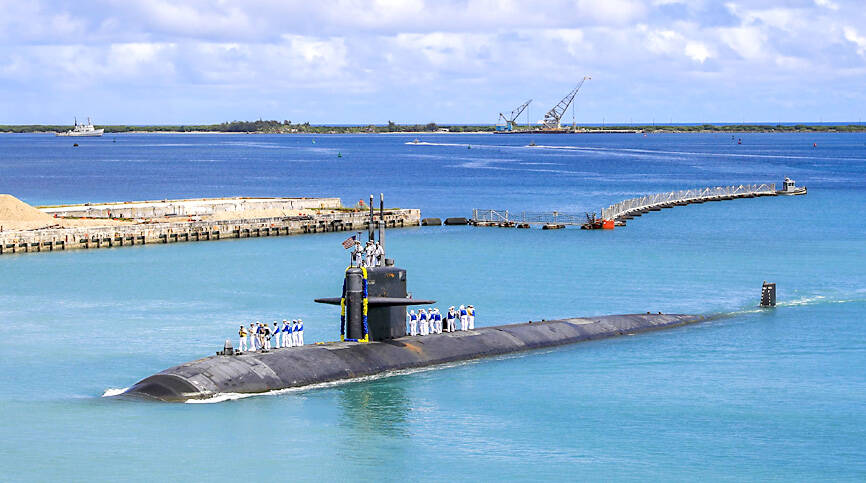
Photo: AP
The development is part of a broader strategy by Washington to beef up its Indo-Pacific security presence amid growing tensions in the region.
“The world is changing in the Indo-Pacific and we need to acknowledge that. We need to face reality,” Northern Mariana Islands Governor Arnold Palacio said, adding that the defense base development on Tinian “has to happen.”
“Do I wish that we don’t have to have military bases? I think everybody in this world would like to see peace, but the best deterrent is to have a good defense and to be prepared,” he added.
Palacios cited concerns over China’s recent missile test over the Pacific Ocean and deployment of forces around the waters of Taiwan.
“That’s the first chain of violence. We’re the second chain of violence. If something happens, we will be impacted,” he said.
About 2,414km south of Tokyo, Tinian has an area of 101km2.
During World War II, it served as a base for B-29 Superfortress bombers that took part in the bombing of Tokyo in March 1945 and the nuclear bombings of Hiroshima and Nagasaki in August 1945.
Tinian is known in the region for its pristine beaches, cattle ranches and hot peppers, which grow abundantly throughout the island. It is dotted with historical sites that attract tourists interested in the World War II.
Over the next few years, the US Department of Defense plans to invest close to US$800m in Tinian to build up defense operations. Work began in 2022 and the first phase of the project, which includes the updated runway, is due to be completed next year.
The US air force is restoring more than 1.85m2 of degraded pavement to create “a rejuvenated runway,” said lieutenant commander Michelle Tucker, spokesperson for the Joint Task Force-Micronesia. The taskforce is a newly formed command overseeing military operations in the Pacific.
Tucker said US air force engineers are conducting “rehabilitation work” on Tinian to allow the US to “rapidly deploy and sustain forces in diverse environments.”
Neighboring island Guam is at the core of the US military’s Indo-Pacific strategy and home to air force, naval and marine bases. Tucker said the Northern Marianas Islands are part of the US and “critical to US defense and power projection across the region.”
Given Tinian’s strategic location, the island is considered a backup site to “meet mission requirements” for the US military to support bases in Guam or other Pacific locations, Tucker said.
“The construction work on Tinian is part of a broader initiative to expand facilities and general port and airport options throughout the Indo-Pacific region,” he added.
The US is also exploring possibilities for waterfront and wharf improvements at Tinian harbor berths “to accommodate various navy vessels,” he said.
Palacios said defense development on Tinian is needed in the current environment.
“We hope that things will get dialed down and everybody finally figures out that we need to all get along in the region. We cannot afford to be afraid,” he said.
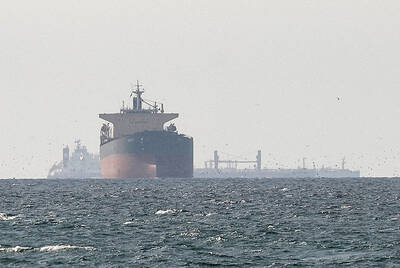
A ship that appears to be taking on the identity of a scrapped gas carrier exited the Strait of Hormuz on Friday, showing how strategies to get through the waterway are evolving as the Middle East war progresses. The vessel identifying as liquefied natural gas (LNG) carrier Jamal left the Strait on Friday morning, ship-tracking data show. However, the same tanker was also recorded as having beached at an Indian demolition yard in October last year, where it is being broken up, according to market participants and port agent’s reports. The ship claiming to be Jamal is likely a zombie vessel that
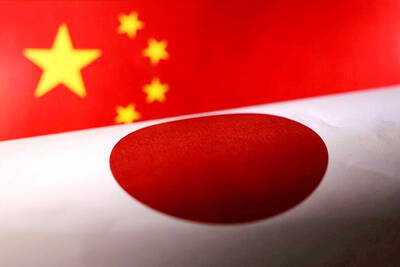
Japan is to downgrade its description of ties with China from “one of its most important” in an annual diplomatic report, according to a draft reviewed by Reuters, as relations with Beijing worsen. This year’s Diplomatic Bluebook, which Japanese Prime Minister Sanae Takaichi’s government is expected to approve next month, would instead describe China as an important neighbor and the relationship as “strategic” and “mutually beneficial.” The draft cites a series of confrontations with Beijing over the past year, including export controls on rare earths, radar lock-ons targeting Japanese military aircraft and increased pressure around Taiwan. The shift in tone underscores a deterioration

LAW CONSTRAINTS: The US has been pressing allies to send warships to open the Strait, but Tokyo’s military actions are limited under its postwar pacifist constitution Japan could consider deploying its military for minesweeping in the Strait of Hormuz if a ceasefire is reached in the war on Iran, Japanese Minister of Foreign Affairs Toshimitsu Motegi said yesterday. “If there were to be a complete ceasefire, hypothetically speaking, then things like minesweeping could come up,” Motegi said. “This is purely hypothetical, but if a ceasefire were established and naval mines were creating an obstacle, then I think that would be something to consider.” Japan’s military actions are limited under its postwar pacifist constitution, but 2015 security legislation allows Tokyo to use its Self-Defense Forces overseas if an attack,

German Chancellor Friedrich Merz’s conservative Christian Democratic Union (CDU) yesterday faced a regional election battle in Rhineland-Palatinate, now held by the center-left Social Democratic Party (SPD). Merz’s CDU has enjoyed a narrow poll lead over the SPD — their coalition partners at the national level — who have ruled the mid-sized state for 35 years. Polling third is the far-right Alternative for Germany (AfD), which spells a greater threat to the two centrist parties in several state elections in September in the country’s ex-communist east. The picturesque state of Rhineland-Palatinate, bordering France, Belgium and Luxembourg and with a population of about 4 million,


 RSS
RSS