


Australia plans to require social media platforms to act to prevent online harm to users such as bullying, predatory behavior and algorithms pushing destructive content, the government said yesterday.
“The Digital Duty of Care will place the onus on digital platforms to proactively keep Australians safe and better prevent online harms,” Australian Minister for Communications Michelle Rowland said in a statement.
The proposed changes to the Online Safety Act were announced before the government next week introduces to Parliament world-first legislation that would ban children younger than 16 from platforms including X, Instagram, Facebook and TikTok.
Photo: Reuters
Critics have argued that removing children from social media would reduce incentives for platforms to provide safer online environments.
Social media have been blamed for an increase in children taking their own lives and developing eating disorders due to bulling and exposures to negative body images.
Rowland said that making tech companies legally responsible for keeping Australians safe was an approach already adopted by Britain and the EU.
Digital businesses would be required to take “reasonable steps” to prevent foreseeable harms on their platforms and services, she said.
The duty of care framework would be underpinned by risk assessment and risk mitigation, and informed by safety-by-design principles, the minister said.
Legislating a duty of care would mean services cannot “set and forget,” she said.
Instead, their obligations would mean they need to continually identify and mitigate potential risks, as technology and service offerings change and evolve, she said.
The categories of harm in the legislation include harm to young people and mental well-being, promotion of harmful practices and illegal activity.
The government has not said when the duty of care legislation would be introduced to Parliament or outlined the punishment for breaches.
The Digital Industry Group Inc, an advocate for the digital industry in Australia better known as DIGI, welcomed government efforts to “future-proof” the Online Safety Act.
“DIGI’s members together represent some of the safest sections of the Internet and their work to keep people safe on their services never stops,” DIGI managing director Sunita Bose said in a statement.
“While we wait for further details about this announcement, DIGI’s members will continue to deliver safety-by-design on their services and work constructively with the government to keep Australians safe online,” Bose added.
Swinburne University digital media expert Belinda Barnet described the duty of care as a “great idea.”
“It’s quite pioneering to expect that platforms that host Australian users would have a duty of care responsibility in terms of the content they show and the experiences they offer,” Barnet said.
“It’s making the platforms take responsibility and that just simply doesn’t happen at the moment. There’s an assumption that they’re a neutral third party. They’re not responsible for the impact of that content,” she said.

A humanoid robot that won a half-marathon race for robots in Beijing on Sunday ran faster than the human world record in a show of China’s technological leaps. The winner from Honor, a Chinese smartphone maker, completed the 21km race in 50 minutes and 26 seconds, said a WeChat post by the Beijing Economic-Technological Development Area, also known as Beijing E-Town, where the race began. That was faster than the human world record holder, Ugandan Jacob Kiplimo, who finished the same distance in about 57 minutes in March at the Lisbon road race. The performance by the robot marked a significant step forward
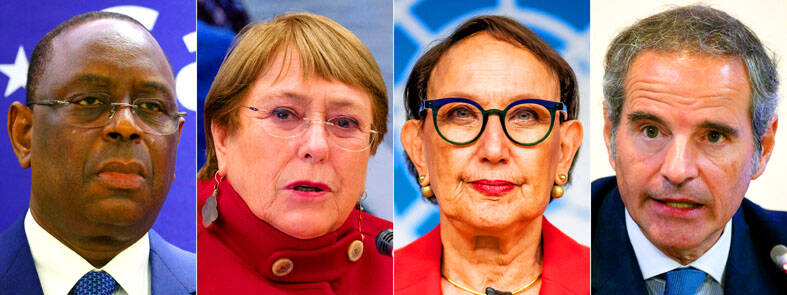
Four contenders are squaring up to succeed Antonio Guterres as secretary-general of the UN, which faces unprecedented global instability, wars and its own crushing budget crisis. Chile’s Michelle Bachelet, Argentina’s Rafael Grossi, Costa Rica’s Rebeca Grynspan and Senegal’s Macky Sall are each to face grillings by 193 member states and non-governmental organizations for three hours today and tomorrow. It is only the second time the UN has held a public question-and-answer, a format created in 2016 to boost transparency. Ultimately the five permanent members of the UN’s top body, the Security Council, hold the power, wielding vetoes over who leads the

South Korea’s air force yesterday apologized for a 2021 midair collision involving two fighter jets, a day after auditors said the pilots were taking selfies and filming during the flight and held them responsible for the accident. “We sincerely apologize to the public for the concern caused by the accident that occurred in 2021,” an air force spokesman told a news conference, adding that one of the pilots involved had been suspended from flying duties, received severe disciplinary action and has since left the military. The apology followed a report released on Wednesday by the South Korean Board of Audit and Inspection,

An earthquake registering a preliminary magnitude of 7.7 off northern Japan on Monday prompted a short-lived tsunami alert and the advisory of a higher risk of a possible mega-quake for coastal areas there. The Cabinet Office and the Japan Meteorological Agency said there was a 1% chance for a mega-quake, compared to a 0.1% chance during normal times, in the next week or so following the powerful quake near the Chishima and Japan trenches. Officials said the advisory was not a quake prediction but urged residents in 182 towns along the northeastern coasts to raise their preparedness while continuing their daily lives. Prime


 RSS
RSS