


Hundreds of people have heckled Spanish King Felipe VI and Queen Letizia, as well as the Spanish prime minister and the regional leader of Valencia — throwing mud and shouting “murderers” — as the group attempted an official visit to one of the municipalities hardest hit by the deadly floods.
The scenes playing out in Paiporta on Sunday laid bare the mounting sense of abandonment among the devastated areas and the lingering anger over why an alert urging residents not to leave home on Tuesday last week was sent after the flood waters began surging.
Much of the fury appeared to be directed at the elected officials, as calls rang out for the resignation of Pedro Sanchez, the country’s prime minister, and Carlos Mazon, Valencia’s regional leader.
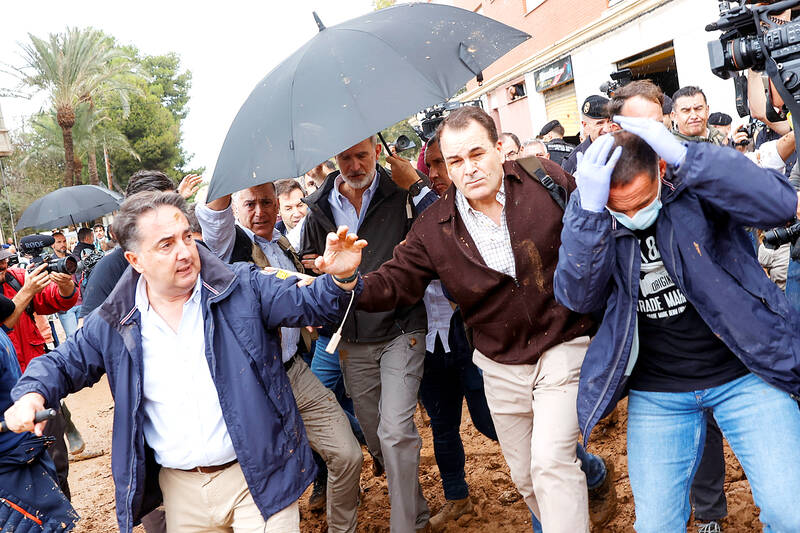
Photo: Reuters
Sanchez was swiftly evacuated as bodyguards used umbrellas to protect the group from the barrage of mud.
“What were they expecting?” one local person asked the newspaper El Pais. “People are very angry. Pedro Sanchez should have been here on day one with a shovel.”
Felipe insisted on continuing the visit, at one point meeting a man who wept on his shoulder. He was also confronted by a young man who told him that “you’ve abandoned us,” asking why residents had been left on their own to grapple with the aftermath of the deadly floods. “You’re four days too late,” he told the king.
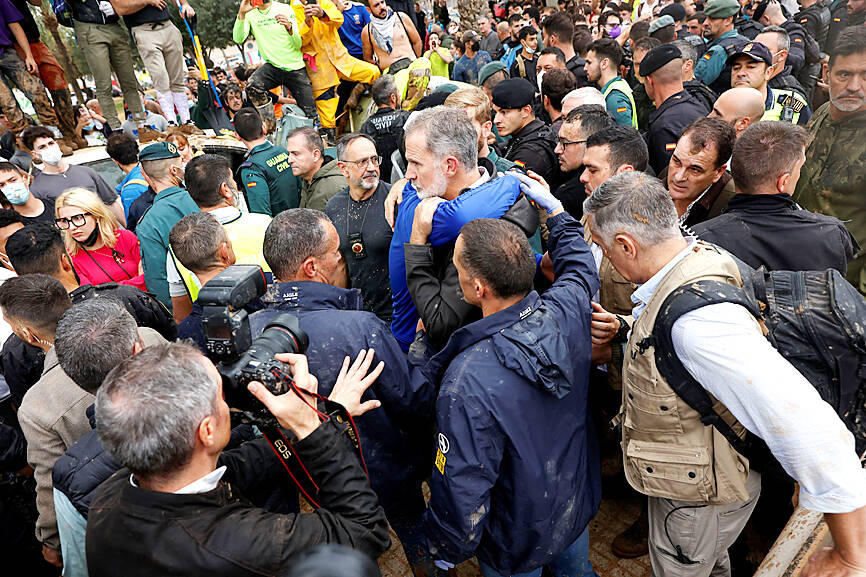
Photo: Reuters
The man also challenged the king on why the civil protection service, which is overseen by the regional government, had sent the alert hours after the state-run weather agency had warned of deteriorating conditions.
“They knew it, they knew it, and yet they did nothing,” he shouted at the monarch. “It’s a disgrace.”
Hours after the visit, King Felipe appeared to address the incident.
Speaking to officials in Valencia in a video posted online, he said: “One has to understand the anger and frustration of many people given all that they have gone through, as well as the difficulty in understanding how all the mechanisms work when it comes to the emergency operations.”
Spain’s royal palace later said that the king’s plans to visit a second hard-hit town in the region had been postponed.
The public rage came as the death toll from the floods climbed to 217. As the meteorological agency on Sunday again issued a red alert, forecasting further heavy rain in the area, mayors from the affected municipalities pleaded with officials to send help.
“We’re very angry and we’re devastated,” said Guillermo Lujan, the mayor of Aldaia. “We have a town in ruins. We need to start over and I’m begging for help. Please help us.”
The town’s 33,000 residents were among many in the region grappling with the aftermath of the ferocious floods that are the deadliest in Spain’s modern history. The number of people missing remains unknown.
Lujan said his town was in desperate need of heavy machinery to clear out the vehicles and debris piled up along the streets.
In flooded towns such as Alfafar and Sedavi, mayors said they felt abandoned by officials as people scrambled to shovel mud from their homes and clear streets. In some areas, people were still trying to secure an electricity supply or stable phone service.
On Friday, the catastrophic images from these municipalities led to a show of solidarity, as thousands of volunteers from less-affected areas trekked to the hardest hit areas carrying shovels, brooms and food supplies.
On Saturday, thousands more turned up at Valencia’s City of Arts and Sciences, which had been hastily converted into the nerve center of the clean-up operation.
Sanchez said 10,000 troops and police would be deployed to help with what he said is “the worst flood our continent has seen so far this century.”
“I’m aware that the response we’re mounting isn’t enough … I know we have to do better and give it our all,” he said.
Scientists say the human-driven climate crisis is increasing the length, frequency and intensity of extreme weather events.
The warming of the Mediterranean, which increases water evaporation, plays a key role in making torrential rains more severe, experts have also said.

Through the noise of rushing papers and whirring belts at a print factory in Kyoto, two creators watch their photo essay come to life in broadsheet form — part of an effort to win new audiences in the age of artificial intelligence (AI). Despite the decline of the publishing industry, self-publication and handmade “zine” magazines are growing in popularity in Japan, reflecting the nation’s enduring love of paper in the digital era. While speaking to Agence France-Presse at the plant, his hands black with ink, one of the creators, Kazuma Obara, said: “I think [paper] is a medium that engages all five
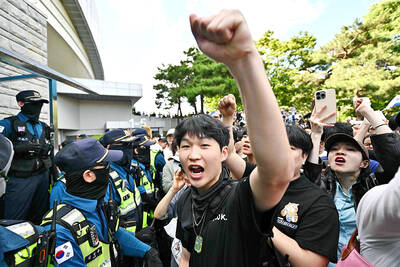
‘ABSURD MISTAKE’: The election commission said that there had been a failure to anticipate turnout after 14 polling stations ran short of ballot papers South Korean riot police yesterday cleared protesters from a Seoul polling station after a 35-hour blockade sparked by a shortage of ballot papers during local elections earlier this week. Wednesday’s election was the first nationwide vote since South Korean President Lee Jae-myung took office following the ouster of Yoon Suk-yeol over his short-lived martial law declaration. Lee’s ruling Democratic Party swept most races, but failed to flip the crucial Seoul mayoral seat. The South Korean National Election Commission apologized, blaming a failure to anticipate turnout after 14 polling stations in Seoul ran short of ballot papers. Some polling stations stayed open until 10pm to

Australian researchers have trained lab-grown brain cells on a silicon computer chip to play the 1990s shooter game Doom and said they are just scratching the surface of what the neurons could be capable of doing. It is the science-fiction work of biotech boffins at Cortical Labs, who researched and developed the technology that harnesses the workings of the brain’s networking system. Each so-called “biological computer” contains about 200,000 living human brain cells, grown from stem cells that were harvested from blood donations. Having mastered the simple computer game Pong, where a paddle is moved up and down to send a ball

France experienced its hottest spring on record, the French weather service said on Tuesday, after an exceptional early heat wave that also broke highs for the season in England and Wales. Meteo-France said the average nationwide temperature over March to May was 13.8°C — about 1.7°C above the norm, and surpassing records set in 2011 and 2020. “The warmest spring since records began in 1900,” it said in a bulletin. All three months were warmer than average, but the onset of an “unprecedented heatwave” late last month pushed the mercury to highs typically seen at the height of the summer. “Our country had never


 RSS
RSS