


Japanese Prime Minister Shigeru Ishiba today vowed to stay in office despite his gamble of snap elections backfiring, with the ruling party's worst result in 15 years.
Ishiba, 67, called yesterday's election days after taking office on Oct. 1, but voters angry at a slush fund scandal punished his Liberal Democratic Party (LDP), which has governed Japan almost non-stop since 1955.
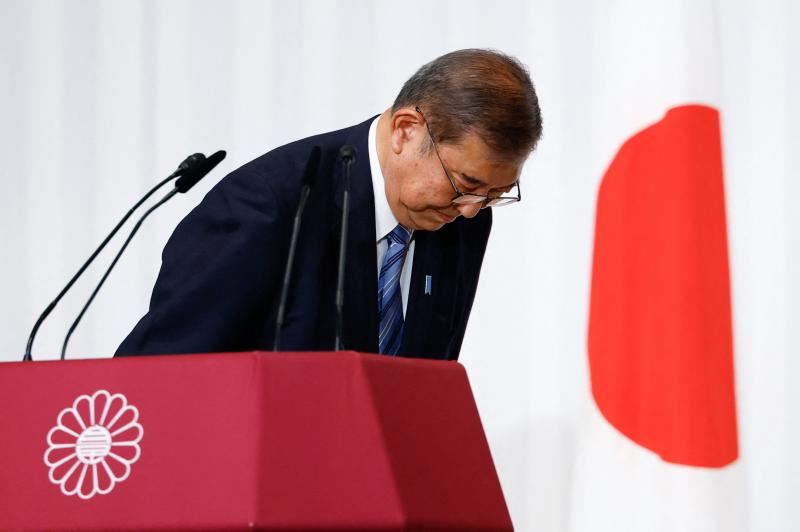
Photo: AFP
With projections suggesting the LDP-led coalition would lose its ruling majority, Ishiba vowed to stay in office, saying he would not allow a "political vacuum."
"I want to fulfill my duty by protecting people's lives, protecting Japan," Ishiba told reporters.
He said the biggest election factor was "people's suspicion, mistrust and anger" over a scandal, which saw LDP figures pocket money from fundraising events and that helped sink his predecessor Fumio Kishida.
"I will enact fundamental reform regarding the issue of money and politics," Ishiba told reporters, repeating that voters had delivered a "severe judgement" on the party.
The yen hit a three-month low, sliding more than 1 percent against the dollar, as exit polls and results reported by national broadcaster NHK and other media showed the worst result for the LDP and its junior coalition partner Komeito in 15 years.
They were projected to fall short of Ishiba's stated goal of winning at least 233 seats — a majority in the 456-member lower house.
The LDP won 191 seats, down from 259 at the last election in 2021, and Komeito 24, according to NHK tallies.
Official results are expected later today.
Ahead of the election, Japanese media had speculated that if this happened, Ishiba could potentially quit, becoming the nation's shortest-serving prime minister in the post-war period.
Today the LDP's election committee chief, former Japanese premier Junichiro Koizumi's son Shinjiro Koizumi, resigned.
The most likely next step is that Ishiba will now seek to head a minority government, with the divided opposition seen as probably incapable of forming a coalition of their own, analysts said.
Ishiba said he was not considering a broader coalition "at this point."
"Lawmakers aligned with [former Japanese prime minister Shinzo] Abe were cold-shouldered under Ishiba, so they could potentially pounce on the opportunity to take their revenge," said Yu Uchiyama, political science professor at the University of Tokyo.
"But at the same time, with the number of LDP seats reduced so much, they might take the high road and support Ishiba for now, thinking it's not the time for infighting," he said.
A big winner was former Japanese premier Yoshihiko Noda's opposition Constitutional Democratic Party (CDP), which increased its projected seat tally to 148 from 96 at the last election.
Ishiba had promised to not actively support LDP politicians caught up in the funding scandal.
However, the opposition jumped on media reports that the party has provided 20 million yen (US$132,000) each to district offices headed by these figures, who were still standing in the election.
"Voters chose which party would be the best fit to push for political reforms," Noda said late yesterday, adding that the "LDP-Komeito administration cannot continue."
Mirroring elections elsewhere, fringe parties did well, with Reiwa Shinsengumi, founded by a former actor, tripling its seats to nine after promising to abolish sales tax and boost pensions.
The anti-immigration and traditionalist Conservative Party of Japan, established last year by nationalist writer Naoki Hyakuta, won its first three seats.
The number of women lawmakers reached a record high at 73, according to NHK, but still representing less than 16 percent of the legislature.
"As long as our own lives don't improve, I think everyone has given up on the idea that we can expect anything from politicians," restaurant worker Masakazu Ikeuchi, 44, said in rainy Tokyo.
"I think the outcome was a result of people across Japan wanting to change the current situation," said fellow voter Takako Sasaki, 44.
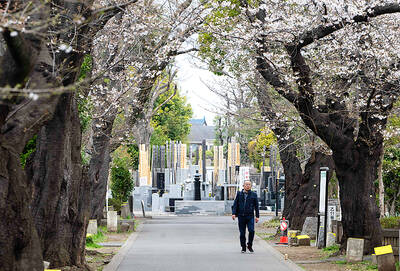
ROCKY RELATIONS: The figures on residents come as Chinese tourist numbers drop following Beijing’s warnings to avoid traveling to Japan The number of Chinese residents in Japan has continued to rise, even as ties between the two countries have become increasingly fractious, data released on Friday showed. As of the end of December last year, the number of Chinese residents had increased by 6.5 percent from the previous year to 930,428. Chinese people accounted for 22.6 percent of all foreign residents in Japan, making them by far the largest group, Japanese Ministry of Justice data showed. Beijing has criticized Tokyo in increasingly strident terms since Japanese Prime Minister Sanae Takaichi last year suggested that a military conflict around Taiwan could

A pro-Iran hacking group claimed to breach FBI Director Kash Patel’s personal e-mail inbox and posted some of the contents online. The e-mails provided by the hacking group include travel details, correspondence with leasing agents in Washington and global entry, and loyalty account numbers. The e-mail address the hackers claim to have compromised has been previously tied to Patel’s personal details, and the leaked e-mails contain photos of Patel and others, in addition to correspondence with family members and colleagues. “The FBI is aware of malicious actors targeting Director Patel’s personal email information,” the agency said in a statement on
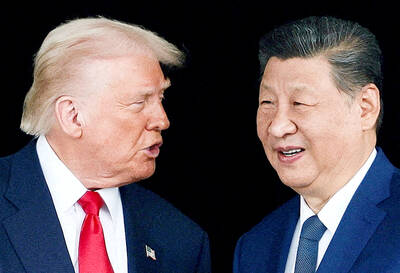
RIVALRY: ‘We know that these are merely symbolic investigations initiated by China, which is in fact the world’s most profligate disrupter of supply chains,’ a US official said China has started a pair of investigations into US trade practices, retaliating against similar probes by US President Donald Trump’s administration as the superpowers stake out positions before an expected presidential summit in May. The move, announced by the Chinese Ministry of Commerce on Friday, is a direct mirror of steps Trump took to revive his tariff agenda after the US Supreme Court last month struck down some of his duties. “China expresses its strong dissatisfaction and firm opposition to these actions,” a ministry spokesperson said in a statement, referring to the so-called Section 301 investigations initiated on March 11.

When a hiker fell from a 55m waterfall in wild New Zealand bush, rescuers were forced to evacuate the badly hurt woman without her dog, which could not be found. After strangers raised thousands of dollars for a search, border collie Molly was flown to safety by a helicopter pilot who was determined to reunite the pet and the owner. A week earlier, an emergency rescue helicopter found the woman with bruises and lacerations after a fall at a rocky spot at the waterfall on the South Island’s West Coast. She was airlifted on March 24, but they were forced to


 RSS
RSS