


Ten Vietnamese fishers were violently robbed in the South China Sea, state media reported yesterday, with an official saying the attackers came from Chinese-flagged vessels.
The men were reportedly beaten with iron bars and robbed of thousands of dollars of fish and equipment on Sunday off the Paracel Islands (Xisha Islands, 西沙群島), which Taiwan claims, as do Vietnam, China, Brunei, Malaysia and the Philippines.
Vietnamese media did not identify the nationalities of the attackers, but Phung Ba Vuong, an official in central Quang Ngai province, told reporters: “They were Chinese, [the boats had] Chinese flags.”

Photo: AFP
Four of the 10-man Vietnamese crew were rushed to hospital on Monday after arriving at Quang Ngai port, state-run Tien Phong reported.
The men were attacked by about 40 people for three hours, the newspaper said.
“Wearing checkered clothes, they cruelly beat us with iron bars,” captain Nguyen Thanh Bien was quoted as saying, adding that he fell unconscious for about an hour after the attack.
Footage on Tien Phong’s Web site showed the fishers being taken from their boat on stretchers.
One had a broken leg and two had broken arms, the report said.
Nguyen Thanh Bien told authorities that about US$20,000 of equipment and fish had been stolen in the attack.
Phung Ba Vuong — who chairs the people’s committee of Binh Chau, the commune where the fishers live — said on Facebook that he “strongly opposed the barbarous acts by China.”
Neither the Vietnamese Ministry of Foreign Affairs nor the Chinese Ministry of Foreign Affairs immediately replied to a request for comment.
In a separate incident on Sunday, Tien Phong reported that another Vietnamese fishing boat in the Paracel Islands was robbed of up to US$12,200 of equipment and fish.
The incident comes several weeks after Chinese People’s Liberation Army Lieutenant General He Lei (何雷) said that China “will resolutely crush any foreign hostile encroachment on China’s territorial, sovereign and maritime rights and interests.”
He made the statement on the sidelines of a defense forum in Beijing following a series of high-profile confrontations with Philippine ships in the waters.

SPEAKING OUT: After Siranudh Scott’s allegations surfaced, celebrities and public figures took to social media to share their own experiences of sexual misconduct and abuse A high-profile alleged sexual abuse case within a wealthy Thai beer brewing family has prompted a wave of painful accounts from survivors of unconnected abuse in the conservative nation. Siranudh Scott, a member of the billionaire Thai family that founded the ubiquitous Singha beer brand, posted an emotional video this month accusing his elder brother Sunit of repeatedly abusing him when he was a teenager. Sunit, who is in his 30s, later denied the allegations in a video posted online, but Singha parent Boonrawd dismissed him from his executive role with the company on Tuesday last week. “I felt I needed to speak

‘CROSSING THE LINE’: China’s embassy in Seoul criticized US Forces Korea Commander General Xavier Brunson, asking if his ‘hostile’ remarks were authorized by Washington South Korea and the US are in talks over recent public remarks by the commander of US Forces Korea, Seoul’s presidential office said yesterday, after the comments drew sharp criticism from China. In a recent podcast interview, US Forces Korea Commander General Xavier Brunson described South Korea as “the dagger in the heart of Asia” from China’s east coast, prompting the Chinese embassy in Seoul to say that he had “truly crossed the line.” The interview came amid growing speculation that Washington might seek to expand the role of US Forces Korea in countering the growing regional influence of China, a key
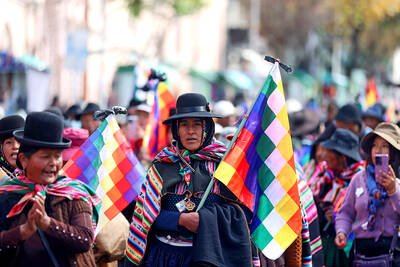
SEEKING ORDER: Rodrigo Paz said that ‘anyone who wants to destroy the nation will have to deal with this president and the full force of the constitution’ Bolivian President Rodrigo Paz on Wednesday said that the nation was at a “breaking point” after nearly a month of protests that have caused shortages of food, fuel and medicine. Paz, who took office six months ago amid the worst economic crisis there in four decades, is battling a groundswell of fury over his policies. The political capital, La Paz, has been besieged by low-income workers and members of the indigenous majority calling for his resignation. “The country needs order and is reaching breaking point,” the 58-year-old said at a public event in La Paz, renewing his appeal for dialogue. On Tuesday, the Bolivian

Forecasters in Europe yesterday warned of exceptional heat as record temperatures driven by a “heat dome” push temperatures well above seasonal norms across the continent. The surge follows a record-breaking Monday, with France logging its hottest day in the month of May on record, its weather agency said, and the UK also posting unprecedented highs. A so-called “heat dome” of warm air from northern Africa trapped under a high-pressure system over western Europe is behind the high temperatures not usually seen until high summer. Restrictions on outdoor work were imposed in parts of Italy, beaches in southwest France filled earlier than usual and


 RSS
RSS