


Alberto Fujimori, whose decade-long presidency began with triumphs righting Peru’s economy and defeating a brutal insurgency only to end in a disgrace of autocratic excess that later sent him to prison, has died. He was 86.
His death on Wednesday in the capital, Lima, was announced by his daughter, Keiko Fujimori, in a post on X.
Alberto Fujimori, who governed with an increasingly authoritarian hand from 1990 to 2000, was pardoned in December last year from his convictions for corruption and responsibility for the murder of 25 people.
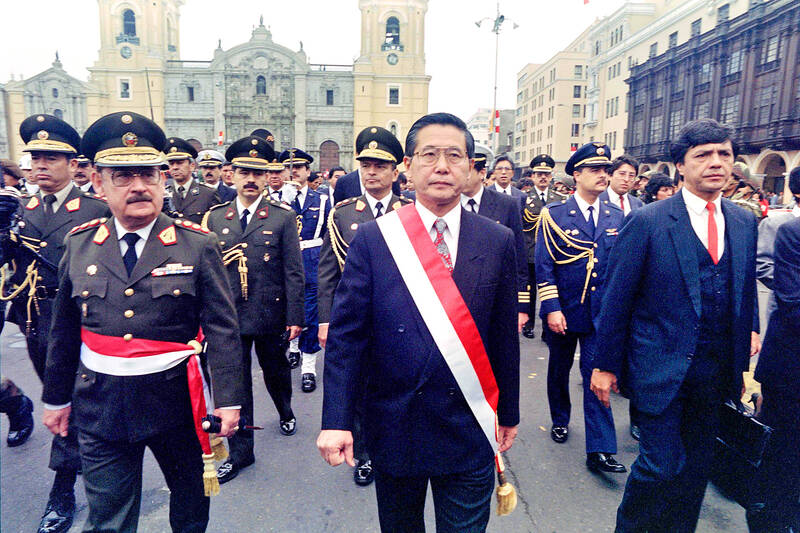
Photo: AFP
His daughter in July said that he was planning to run for Peru’s presidency for the fourth time in 2026.
The former university president and mathematics professor was the consummate political outsider when he emerged from obscurity to win Peru’s 1990 election over writer Mario Vargas Llosa. Over a tumultuous political career, he repeatedly made risky, go-for-broke decisions that alternately earned him adoration and reproach.
He took over a country ravaged by runaway inflation and guerrilla violence, mending the economy with bold actions including mass privatizations of state industries. Defeating fanatical Shining Path rebels took a little longer, but also won him broad-based support.
However, his presidency collapsed just as dramatically.
After briefly shutting down the Peruvian Congress and elbowing himself into a controversial third term, he fled the country in disgrace in 2000 when leaked videotapes showed his spy chief, Vladimiro Montesinos, bribing lawmakers. The president went to Japan, the land of his parents, and famously faxed in his resignation.
He stunned supporters and foes alike five years later when he landed in neighboring Chile, where he was arrested and then extradited to Peru. He had hoped to run for Peru’s presidency in 2006, but instead wound up in court facing charges of abuse of power.
The high-stakes political gambler would lose miserably. He became the first former president in the world to be tried and convicted in his own country for human rights violations. He was not found to have personally ordered the 25 death-squad killings for which he was convicted, but he was deemed responsible because the crimes were committed in his government’s name.
His 25-year sentence did not stop Alberto Fujimori from seeking political revindication, which he planned from a prison built in a police academy on the outskirts of Lima.
His congresswoman daughter Keiko tried in 2011 to restore the family dynasty by running for the presidency, but was narrowly defeated in a runoff. She ran again in 2016 and 2021, when she lost by just 44,000 votes after a campaign in which she promised to free her father.
“After a long battle with cancer, our father, Alberto Fujimori, has just departed to meet the Lord,” she said on X on Wednesday. “We ask those who loved him to accompany us with a prayer for the eternal rest of his soul.”
He is survived by his four children. The oldest, Keiko, became first lady in 1996 when his father divorced his mother, Susana Higuchi, in a bitter battle in which she accused Alberto Fujimori of having her tortured. The youngest child, Kenji, was elected a congressman.

Kouri Richins, a Utah mother who published a children’s book about grief after the death of her husband is to serve a life sentence for his murder without the possibility of parole, a judge ruled on Wednesday. Richins was convicted in March of aggravated murder for lacing a cocktail given to her husband, Eric Richins, with five times the lethal dose of fentanyl at their home near Park City in 2022. A jury also found her guilty of four other felonies, including insurance fraud, forgery and attempted murder for trying to poison her husband weeks earlier on Feb. 14, 2022, with a
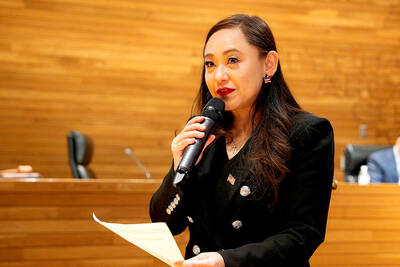
‘PERSONAL MISTAKES’: Eileen Wang has agreed to plead guilty to the felony, which comes with a maximum sentence of 10 years in federal prison A southern California mayor has agreed to plead guilty to acting as an illegal agent for the Chinese government and has resigned from her city position, officials said on Monday. Eileen Wang (王愛琳), mayor of Arcadia, was charged last month with one count of acting in the US as an illegal agent of a foreign government. She was accused of doing the bidding of Chinese officials, such as sharing articles favorable to Beijing, without prior notification to the US government as required by law. The 58-year-old was elected in November 2022 to a five-person city council, from which the mayor is selected

DELA ROSA CASE: The whereabouts of the senator, who is wanted by the ICC, was unclear, while President Marcos faces a political test over the senate situation Philippine authorities yesterday were seeking confirmation of reports that a top politician wanted by the International Criminal Court (ICC) had fled, a day after gunfire rang out at the Philippine Senate where he had taken refuge fearing his arrest. Senator Ronald “Bato” dela Rosa, the former national police chief and top enforcer of former Philippine president Rodrigo Duterte’s “war on drugs,” has been under Senate protection and is wanted for crimes against humanity, the same charges Duterte is accused of. “Several sources confirmed that the senator, Senator Bato, is no longer in the Senate premises, but we are still getting confirmation,” Presidential

HELP DENIED? The US Department of State said that the Cuban leadership refuses to allow the US to provide aid to Cubans, ‘who are in desperate need of assistance’ US Secretary of State Marco Rubio on Wednesday said that Cuba’s leadership must change, as Washington renewed an offer of US$100 million in aid if the communist nation agrees to cooperate. Cuba has been suffering severe economic tumult led by an energy shortage that plunged 65 percent of the country into darkness on Tuesday. Cuba’s leaders have blamed US sanctions, but Rubio, a Cuban American and critic of the government established by Fidel Castro, said the system was to blame, including corruption by the military. “It’s a broken, nonfunctional economy, and it’s impossible to change it. I wish it were different,” he told


 RSS
RSS