


A difficult operation to remove a small amount of radioactive debris from Japan’s stricken Fukushima Dai-ichi nuclear power plant began yesterday, after technical issues suspended an earlier attempt.
Tokyo Electric Power Co (TEPCO) in a statement said that its “pilot extraction operation” had started.
It would take about two weeks, the company said.
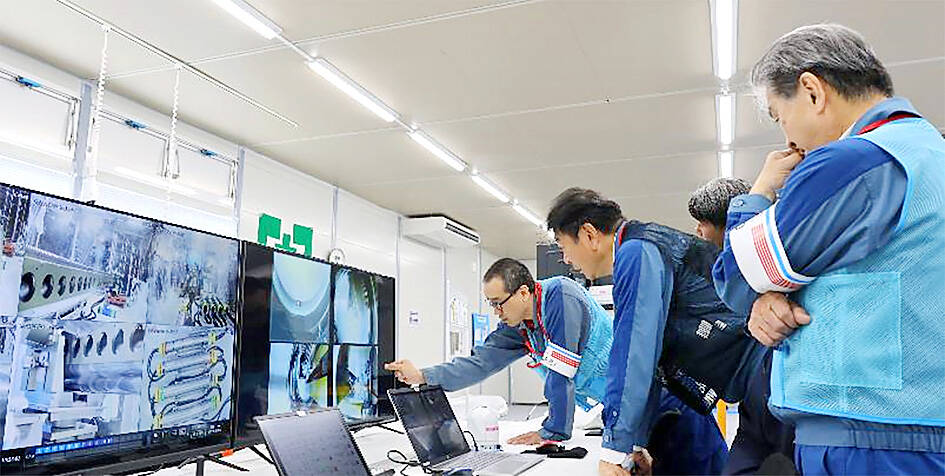
Photo: Tokyo Electric Power Co via AP
The tiny sample would be studied for clues about conditions inside the reactors — a crucial step toward decommissioning the nuclear power plant.
About 880 tonnes of extremely hazardous material remain 13 years after a tsunami caused by a magnitude 9.0 earthquake triggered one of the world’s worst nuclear accidents.
Removing the debris from the reactors is regarded as the most daunting challenge in the decades-long decommissioning project.
“The government would like to urge TEPCO to respond with an even higher sense of urgency as we enter the most difficult work phase, which will be the basis for decommissioning the plant,” Japanese Chief Cabinet Secretary Yoshimasa Hayashi told reporters yesterday.
TEPCO originally planned to start its first trial removal on Aug. 22, aiming to collect just 3g for analysis — if the extraction process was successful — but the company had to stop the work at a preliminary stage after detecting a problem involving the installation of the necessary equipment.
Three of the plant’s six reactors were operating when the tsunami hit on March 11, 2011, sending them into meltdown.
The debris within has radiation levels so high that TEPCO had to develop specialized robots able to function inside.
TEPCO deployed two mini-drones and a “snake-shaped robot” into one of the three nuclear reactors in February, as part of the preparations for the removal task.
Separately, last year Japan began releasing treated wastewater from the plant into the Pacific Ocean, sparking a diplomatic row with China and Russia. Both nations have banned Japanese seafood imports, although Tokyo insists the discharge is safe, a view backed by the UN atomic agency.
Meanwhile, in a TEPCO initiative to promote food from the Fukushima area, swanky London department store Harrods on Saturday began selling peaches that were grown in the region.
Fukushima peaches are renowned for their juicy, sweet taste — but they are not cheap, with one box of three reportedly going for £80 (US$105).

‘CROSSING THE LINE’: China’s embassy in Seoul criticized US Forces Korea Commander General Xavier Brunson, asking if his ‘hostile’ remarks were authorized by Washington South Korea and the US are in talks over recent public remarks by the commander of US Forces Korea, Seoul’s presidential office said yesterday, after the comments drew sharp criticism from China. In a recent podcast interview, US Forces Korea Commander General Xavier Brunson described South Korea as “the dagger in the heart of Asia” from China’s east coast, prompting the Chinese embassy in Seoul to say that he had “truly crossed the line.” The interview came amid growing speculation that Washington might seek to expand the role of US Forces Korea in countering the growing regional influence of China, a key

Through the noise of rushing papers and whirring belts at a print factory in Kyoto, two creators watch their photo essay come to life in broadsheet form — part of an effort to win new audiences in the age of artificial intelligence (AI). Despite the decline of the publishing industry, self-publication and handmade “zine” magazines are growing in popularity in Japan, reflecting the nation’s enduring love of paper in the digital era. While speaking to Agence France-Presse at the plant, his hands black with ink, one of the creators, Kazuma Obara, said: “I think [paper] is a medium that engages all five

Australian researchers have trained lab-grown brain cells on a silicon computer chip to play the 1990s shooter game Doom and said they are just scratching the surface of what the neurons could be capable of doing. It is the science-fiction work of biotech boffins at Cortical Labs, who researched and developed the technology that harnesses the workings of the brain’s networking system. Each so-called “biological computer” contains about 200,000 living human brain cells, grown from stem cells that were harvested from blood donations. Having mastered the simple computer game Pong, where a paddle is moved up and down to send a ball

A surprising gut feeling may help pigeons find their way home. Animals use various techniques to navigate, including following the stars and remembering key landmarks. Birds, fish and turtles orient themselves using Earth’s magnetic field as a compass, but it is not yet clear how exactly they do this. Pigeons are a well-known group of frequent flyers that can traverse hundreds of kilometers in a single day. For thousands of years, humans have used them to carry news, notes and military messages. Scientists have long tried to untangle how pigeons travel without getting lost. Some think the birds detect magnetic cues using light-sensitive


 RSS
RSS