


The UN on Tuesday voiced concern over a “climate of fear” in post-election Venezuela as lawmakers mulled a package of laws that critics say target opponents of Venezuelan President Nicolas Maduro.
Electoral officials loyal to Maduro declared him the victor of a July 28 vote whose contested results have plunged the country into a political crisis with 25 killed, dozens injured and thousands arrested after protests broke out following the poll.
UN High Commissioner for Human Rights Volker Turk said in a statement that he was troubled by “the high and continuing number of arbitrary detentions, as well as disproportionate use of force” reported since the election “and the resulting climate of fear.”
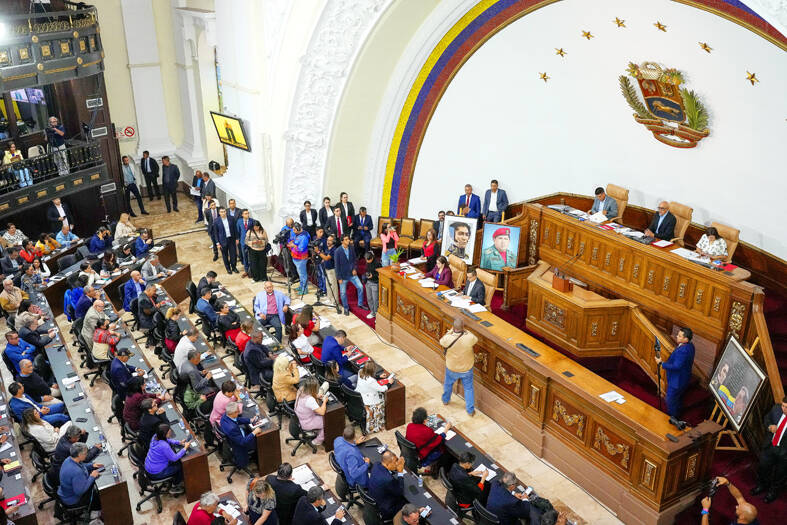
Photo: AP
The Venezuelan National Electoral Council (CNE) had declared Maduro the president-elect for a third, six-year term, giving him 52 percent of ballots cast. It has yet to provide a detailed breakdown.
A preliminary report published on Tuesday by a panel of UN election experts said that the CNE “fell short of the basic transparency and integrity measures” by withholding polling station-level results.
The opposition says its own tally of polling station-level results showed Edmundo Gonzalez Urrutia, a 74-year-old retired diplomat, had won by a wide margin.
The US, the EU and several Latin American countries have also rejected Maduro’s claim of victory.
On Tuesday, the Venezuelan Ministry of Foreign Affairs said that it “categorically rejects” the UN report.
Gonzalez Urrutia and opposition leader Maria Corina Machado, who was barred from running by state institutions, are in hiding after the president accused them of seeking to foment a “coup d’etat” and incite “civil war.”
On Tuesday, the country’s national assembly started considering a package of laws that would tighten regulations on the registration and funding of non-governmental organizations (NGO).
This came after Venezuelan National Assembly President Jorge Rodriguez called NGOs a “facade for the financing of terrorist actions.”
Rodriguez also indicated that he would seek to ban any future election observation missions from foreign countries. Other measures seek to increase government oversight over social media and to punish “fascism” — a term often used by Maduro in relation to the opposition and other detractors.
The president has said that people are using social media to attack him and to promote “hate,” “fascism” and “division.”
Last week, he banned social media site X for 10 days after C chief executive officer Elon Musk said that Maduro had engaged in “major election fraud.”
The president has also promoted a boycott against WhatsApp.
Turk expressed his concern about the legislative project and urged legislators to refrain from adopting laws “that undermine civic and democratic space in the country.”
The Inter-American Commission on Human Rights also urged parliamentarians not to pass the NGO law, which it said would “arbitrarily restrain the right to association [and] freedom of expression.”
After about an hour of debate on Tuesday, the session was suspended until today.
The UN human rights office said that more than 2,400 people have been arrested since July 29 and Turk called for the “immediate release of everyone who has been arbitrarily detained.”

‘CROSSING THE LINE’: China’s embassy in Seoul criticized US Forces Korea Commander General Xavier Brunson, asking if his ‘hostile’ remarks were authorized by Washington South Korea and the US are in talks over recent public remarks by the commander of US Forces Korea, Seoul’s presidential office said yesterday, after the comments drew sharp criticism from China. In a recent podcast interview, US Forces Korea Commander General Xavier Brunson described South Korea as “the dagger in the heart of Asia” from China’s east coast, prompting the Chinese embassy in Seoul to say that he had “truly crossed the line.” The interview came amid growing speculation that Washington might seek to expand the role of US Forces Korea in countering the growing regional influence of China, a key

Through the noise of rushing papers and whirring belts at a print factory in Kyoto, two creators watch their photo essay come to life in broadsheet form — part of an effort to win new audiences in the age of artificial intelligence (AI). Despite the decline of the publishing industry, self-publication and handmade “zine” magazines are growing in popularity in Japan, reflecting the nation’s enduring love of paper in the digital era. While speaking to Agence France-Presse at the plant, his hands black with ink, one of the creators, Kazuma Obara, said: “I think [paper] is a medium that engages all five

Australian researchers have trained lab-grown brain cells on a silicon computer chip to play the 1990s shooter game Doom and said they are just scratching the surface of what the neurons could be capable of doing. It is the science-fiction work of biotech boffins at Cortical Labs, who researched and developed the technology that harnesses the workings of the brain’s networking system. Each so-called “biological computer” contains about 200,000 living human brain cells, grown from stem cells that were harvested from blood donations. Having mastered the simple computer game Pong, where a paddle is moved up and down to send a ball

France experienced its hottest spring on record, the French weather service said on Tuesday, after an exceptional early heat wave that also broke highs for the season in England and Wales. Meteo-France said the average nationwide temperature over March to May was 13.8°C — about 1.7°C above the norm, and surpassing records set in 2011 and 2020. “The warmest spring since records began in 1900,” it said in a bulletin. All three months were warmer than average, but the onset of an “unprecedented heatwave” late last month pushed the mercury to highs typically seen at the height of the summer. “Our country had never


 RSS
RSS