


The US on Monday confirmed that it would resume sales of offensive weapons to Saudi Arabia, as concerns over human rights in the kingdom’s Yemen war give way to US hopes for it to play a role in resolving the conflict in Gaza.
More than three years after imposing limits on human rights grounds over Saudi Arabian strikes in Yemen, the US Department of State said that it would return to weapons sales “in regular order, with appropriate congressional notification and consultation.”
“Saudi Arabia has remained a close strategic partner of the United States, and we look forward to enhancing that partnership,” US Department of State spokesman Vedant Patel told reporters.
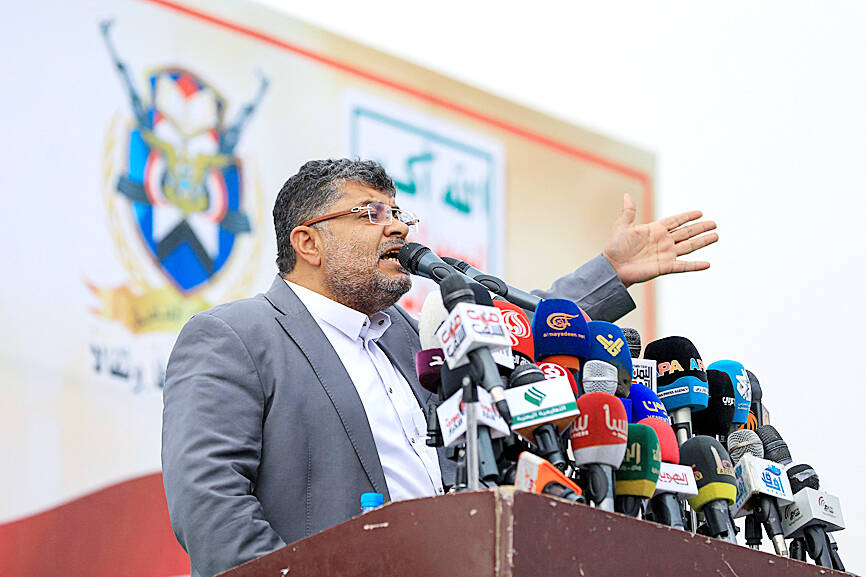
Photo: AFP
US President Joe Biden took office in 2021 pledging a new approach to Saudi Arabia that emphasized human rights and immediately announced that the administration would only send “defensive” weaponry to the longtime US arms customer.
The step came after thousands of civilians — including children — were estimated to have been killed in Saudi Arabian-led airstrikes against Iranian-backed Houthi rebels, who have taken over much of Yemen.
However, geopolitical considerations have changed markedly since then. The UN, with US support, brokered a truce in Yemen in early 2022 that has largely held.
Since the truce, “there has not been a single Saudi airstrike into Yemen and cross-border fire from Yemen into Saudi Arabia has largely stopped,” Patel said. “The Saudis since that time have met their end of the deal, and we are prepared to meet ours.”
It is now the US, the UK and recently Israel that have been striking Houthi targets in Yemen, with Saudi Arabia content to watch from the sidelines.
The Houthis have been firing missiles at commercial ships in the vital Red Sea in professed solidarity with Palestinians, who have been in the crosshairs of Israel since the attack by Hamas on Oct. 7 last year.
In a bid to find a long-term solution, US Secretary of State Antony Blinken has repeatedly traveled to Saudi Arabia to discuss a package of US incentives if the kingdom recognizes Israel.
Saudi Arabia has sought US security guarantees, a continued flow of weapons and potentially a civilian nuclear deal if it normalizes with Israel.
Israeli Prime Minister Benjamin Netanyahu has made normalization with Arab states a top goal and no prize would be as big as Saudi Arabia, guardian of Islam’s two holiest sites, but Saudi Arabia says it cannot act without progress on a Palestinian state, an idea pushed by the Biden administration as it seeks a diplomatic way out of the Gaza conflict, but bitterly opposed by Netanyahu and his far-right allies.
US Representative Joaquin Castro, a progressive member of Biden’s Democratic Party, said that Saudi Arabia still had a “troubling track record” on human rights.
“I supported the Biden administration’s initial decision to pause offensive arms sales to Saudi Arabia, and I hope to see compelling evidence that Saudi Arabia has changed its conduct,” Castro said.
Before Oct. 7 last year, Gulf Arab states had been moving closer to Israel, in large part out of shared hostility to Iran.
Saudi Arabia cooperated with the US, Jordan and the United Arab Emirates, in repelling an Iranian missile and drone barrage against Israel in April.
The US is again hoping for support from Arab partners as Iran threatens another reprisal against Israel over the killing in Tehran of Hamas political leader Ismail Haniyeh.

PHISHING: The con might appear convincing, as the scam e-mails can coincide with genuine messages from Apple saying you have run out of storage For a while you have been getting messages from Apple saying “your iCloud storage is full.” They say you have exceeded your storage plan, so documents are no longer being backed up, and photos you take are not being uploaded. You have been resisting Apple’s efforts to get you to pay a minimum of £0.99 (US$1.33) a month for more storage, but it seems that you cannot keep putting off the inevitable: You have received an e-mail which says your iCloud account has been blocked, and your photos and videos would be deleted very soon. To keep them you need

The Israeli military has demolished entire villages as part of its invasion of south Lebanon, rigging homes with explosives and razing them to the ground in massive remote detonations. The Guardian reviewed three videos posted by the Israeli military and on social media, which showed Israel carrying out mass detonations in the villages of Taybeh, Naqoura and Deir Seryan along the Israel-Lebanon border. Lebanese media has reported more mass detonations in other border villages, but satellite imagery was not readily available to verify these claims. The demolitions came after Israeli Minister of Defense Israel Katz called for the destruction of

A US YouTuber who caused outrage for filming himself kissing a statue commemorating Korean wartime sex slaves has been sentenced to six months in prison, a court in Seoul said yesterday. Johnny Somali, 25, gained notoriety several years ago for recording himself doing a series of provocative stunts in South Korea and Japan, and streaming them on platforms such as YouTube and Twitch. South Korean authorities indicted Somali — whose real name is Ramsey Khalid Ismael — in 2024 on public order violations and obstruction of business, and banned him from leaving the country. “The court has sentenced him to six months in

The death toll from a shooting in western Afghanistan rose to 11 on Saturday, after gunmen targeted civilians at a picnic spot in Herat, the provincial authority said. Bullet marks were visible on a wall of the Sayed Mohammad Agha Shia shrine, while bloodstains marked a blanket abandoned at the scene. “Eleven people have been recorded dead and eight others wounded from Friday’s incident, with the condition of two of the wounded reported as critical,” Herat’s information office said in a statement. The update raises a toll of seven killed provided on Friday by the Afghan Ministry of Interior Affairs


 RSS
RSS