


There has been one figure of stability in the past 14 years of political turmoil in the UK — Larry the Downing Street cat.
With a general election on July 4, the aging tabby could be in line for his sixth prime minister.
He has already had five Conservative prime ministers serve under him, but if polls are correct, he will soon get his first from the Labour Party.
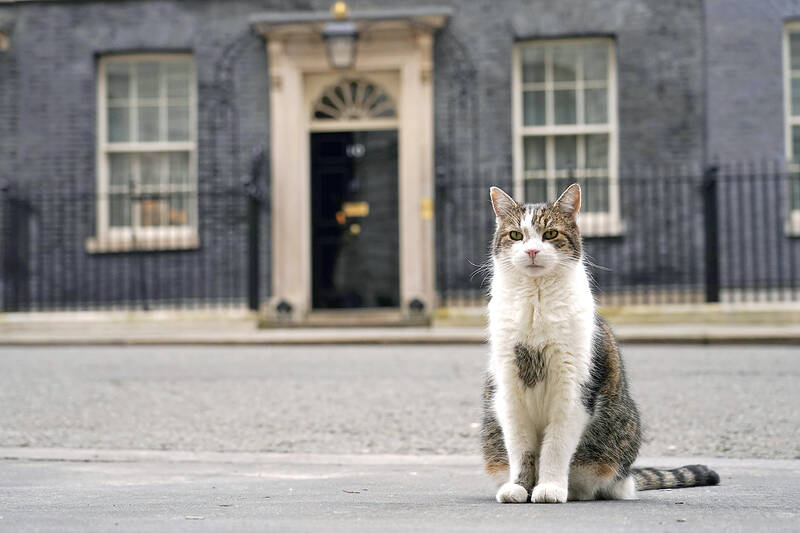
Photo: AP
British Prime Minister Rishi Sunak’s departure would see him take his fox-red labrador retriever Nova, too. Not that Larry would mind.
According to Sunak’s wife, Akshata Murty, the pair have had some “heated exchanges.”
However, Larry has always prevailed.
Labour leader Keir Starmer recently told the BBC that his family has a cat, Jojo, that his children spoil more than him.
They also have a hamster, Bear, he told the Metro newspaper.
It remains to be seen if either would move with him if he wins.
Larry has been fiercely protective of his territory, frequently fighting to be top cat with his counterpart at the British Foreign and Commonwealth Office, Palmerston.
His rival eventually retired to the countryside.
Urban foxes and unsuspecting pigeons have also been chased away, although one feathered interloper narrowly avoided his clutches as the media looked on.
Larry made his first appearance in Downing Street on Feb. 15, 2011, after being adopted from the Battersea shelter in south London.
He was recruited under then-British prime minister David Cameron to get rid of mice and even given an official title: “Chief Mouser.”
However, his performance in that department left much to be desired, despite a few early successes.
Cameron himself tried to quash rumors that he and Larry did not get along, while reporters on the politics beat have said he is friendly with journalists.
“He’s interested,” BBC political correspondent Helen Catt said in a recent item on Larry. “He tends to come up and have a look when you’re there with the camera crew, he likes to see what the press are up to.”
That has its downsides, she added.
“When you’re in Downing Street and you’re doing lives, you’re always very aware that if he pops out behind you, a lot of people really aren’t going to be listening to what you’re saying anymore,” she said.

FRUSTRATIONS: One in seven youths in China and Indonesia are unemployed, and many in the region are stuck in low-productivity jobs, the World Bank said Young people across Asia are struggling to find good jobs, with many stuck in low-productivity work that the World Bank said could strain social stability as frustrations fuel a global wave of youth-led protests. The bank highlighted a persistent gap between younger and more experienced workers across several Asian economies in a regional economic update released yesterday, noting that one in seven young people in China and Indonesia are unemployed. The share of people now vulnerable to falling into poverty is now larger than the middle class in most countries, it said. “The employment rate is generally high, but the young struggle to

ENERGY SHIFT: A report by Ember suggests it is possible for the world to wean off polluting sources of power, such as coal and gas, even as demand for electricity surges Worldwide solar and wind power generation has outpaced electricity demand this year, and for the first time on record, renewable energies combined generated more power than coal, a new analysis said. Global solar generation grew by a record 31 percent in the first half of the year, while wind generation grew 7.7 percent, according to the report by the energy think tank Ember, which was released after midnight yesterday. Solar and wind generation combined grew by more than 400 terawatt hours, which was more than the increase in overall global demand during the same period, it said. The findings suggest it is
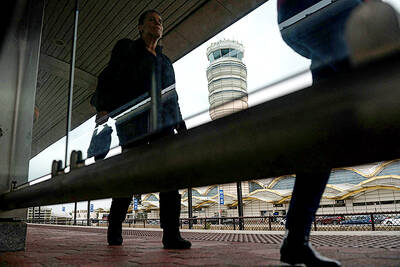
IN THE AIR: With no compromise on the budget in sight, more air traffic controllers are calling in sick, which has led to an estimated 13,000 flight delays, the FAA said Concerns over flight delays and missed paychecks due to the US government shutdown escalated on Wednesday, as senators rejected yet another bid to end the standoff. Democrats voted for a sixth time to block a Republican stopgap funding measure to reopen government departments, keeping much of the federal workforce home or working without pay. With the shutdown in its eighth day, lines at airports were expected to grow amid increased absenteeism among security and safety staff at some of the country’s busiest hubs. Air traffic controllers — seen as “essential” public servants — are kept at work during government shutdowns, but higher numbers

Elvis Nghobo tried to get into four different professional schools in Cameroon, but could not make it. Frustrated, the 34-year-old turned to selling food at a market in Yaounde, the country’s seat of power. Nghobo blames his woes on what he calls a corrupt education system that favors children of the elite. As the central African country prepares for Sunday’s presidential election, he said he would not be heading out to vote. He called the results a foregone conclusion for 92-year-old Paul Biya, the world’s oldest president, who has ruled for Nghobo’s entire life. “He is already too old to govern, and it’s boring


 RSS
RSS