


North Korean defector Park Sang-hak considers the propaganda balloons he floats into his homeland to be part of a tradition of psychological warfare, and vows to keep going until North Korean leader Kim Jong-un’s regime falls.
Park, the son of a North Korean double agent who escaped his country in 1999, has been sending balloons loaded with anti-regime propaganda leaflets, US dollar bills and USB drives filled with K-pop across the border for nearly 20 years.
His mission is to “enlighten the North Korean public,” but the 56-year-old has found himself in the spotlight in the past few weeks after Pyongyang singled him out as “scum” and sent more than 1,000 balloons carrying trash into South Korea in retaliation.
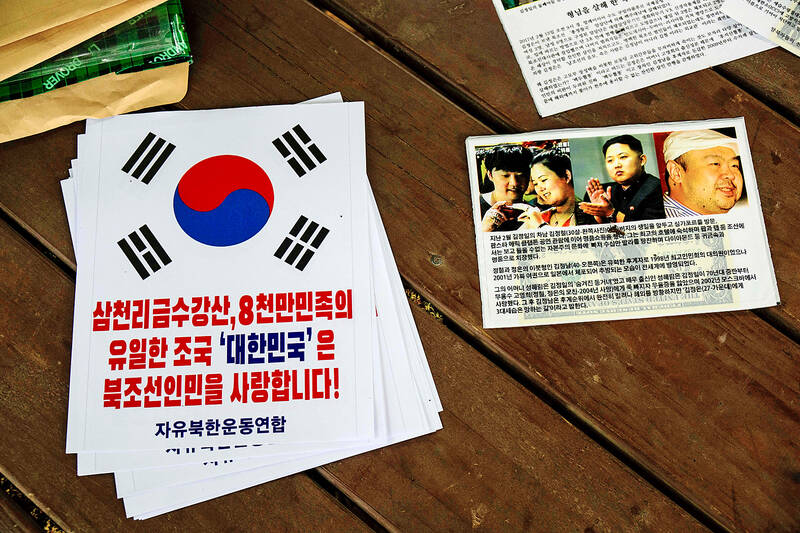
Photo: AFP
Another wave of trash-bearing balloons forced a three-hour halt to flights in and out of Seoul’s Incheon airport early yesterday morning.
This is an “unacceptable” subversion of the rules of the game, Park said, adding that never in the decades of leaflet warfare between the two Koreas has either side sent garbage across the border.
“Kim Jong-un stands out as the first person ordering balloons of trash,” he said, calling it a “despicable and atrocious act” and demanding that Kim apologize.
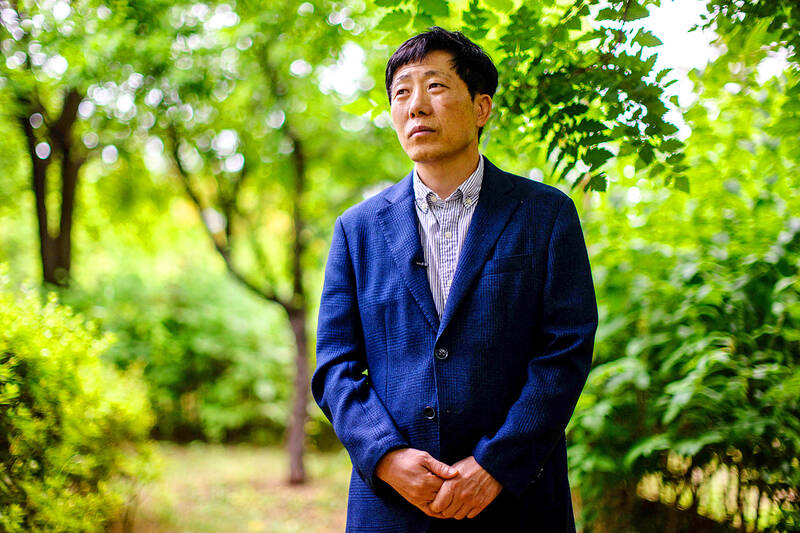
Photo: AFP
Park has first-hand experience of the power of a propaganda leaflet.
He vividly remembers a leaflet he found decades ago in the North, which purported to show two successful defectors in the South.
“One picture shows this defector with pretty South Korean women in swimming suits, with the text saying he had received 100 million won (US$71,900) in government aid,” Park said.
It changed Park’s life, showing him that defection was not only for elite diplomats or border soldiers, but was possible for anyone who dared to cross the river into China.
“It was the most important information for me,” he said.
A few years later, he, his mother and two siblings crossed the river themselves.
The leaflet seen by Park was made by the South Korean government. He later met one of the defectors in the photograph and asked him whether it was real.
“He told me it was staged by Seoul’s National Intelligence Service,” Park said.
Seoul and Pyongyang used to produce their own propaganda leaflets and run loudspeaker broadcasts near the border. South Korea produced radio shows specifically to be beamed into the North.
However, the two countries called off their dueling campaigns in 2003, during a period of warmer ties, prompting Park to start his own activities.
Park sent his first balloon northward in 2006. At first, he used balloons bought from a toy shop, but through a process of trial and error he improved his method.
Now he says he can send fully packed balloons — each weighing 7kg to 8kg — “with my eyes closed,” although for operational security reasons, he declined to reveal the details of his launches.
The balloons hold special waterproof leaflets that are designed to safely carry a single dollar bill, a key part of his campaign’s success, Park said.
North Koreans learn there are dollar bills dropping from the sky, he said, prompting them to find and open the balloons’ packages when they see them, and that leads them to read the leaflets.
One missive — all are written by Park and his staff — details the killing of Kim’s half-brother, Kim Jong-nam, in Kuala Lumpur International Airport in 2017, including a photograph of his slumping body.
Pyongyang’s reaction to his balloons proves they have an effect on the North Korean public, Park said.
It is hard to imagine how little information the North’s 26 million people have access to with the Internet and media controlled by the regime, Park said.
This is why the leaflets matter and why they work, he said.
“I have received calls from around 800 defectors thanking me for my mission, telling me that they had seen my leaflets in the North,” he said, adding that he would not stop his campaign.
His critics say his actions risk escalating the tense security situation between the two Koreas, but Park dismisses the accusations, saying his campaign is peaceful.
His ultimate aim is for the Kim regime to fall, which he hopes can happen due to domestic change, not an outside intervention.
“These leaflets will deliver truth to the North Korean people, who will then use them to rise up against the Kim regime and topple it,” he said. “My leaflets are of truth, money and love.”

Through the noise of rushing papers and whirring belts at a print factory in Kyoto, two creators watch their photo essay come to life in broadsheet form — part of an effort to win new audiences in the age of artificial intelligence (AI). Despite the decline of the publishing industry, self-publication and handmade “zine” magazines are growing in popularity in Japan, reflecting the nation’s enduring love of paper in the digital era. While speaking to Agence France-Presse at the plant, his hands black with ink, one of the creators, Kazuma Obara, said: “I think [paper] is a medium that engages all five
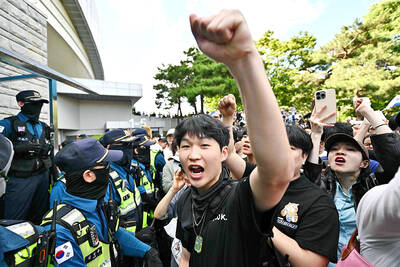
‘ABSURD MISTAKE’: The election commission said that there had been a failure to anticipate turnout after 14 polling stations ran short of ballot papers South Korean riot police yesterday cleared protesters from a Seoul polling station after a 35-hour blockade sparked by a shortage of ballot papers during local elections earlier this week. Wednesday’s election was the first nationwide vote since South Korean President Lee Jae-myung took office following the ouster of Yoon Suk-yeol over his short-lived martial law declaration. Lee’s ruling Democratic Party swept most races, but failed to flip the crucial Seoul mayoral seat. The South Korean National Election Commission apologized, blaming a failure to anticipate turnout after 14 polling stations in Seoul ran short of ballot papers. Some polling stations stayed open until 10pm to

Australian researchers have trained lab-grown brain cells on a silicon computer chip to play the 1990s shooter game Doom and said they are just scratching the surface of what the neurons could be capable of doing. It is the science-fiction work of biotech boffins at Cortical Labs, who researched and developed the technology that harnesses the workings of the brain’s networking system. Each so-called “biological computer” contains about 200,000 living human brain cells, grown from stem cells that were harvested from blood donations. Having mastered the simple computer game Pong, where a paddle is moved up and down to send a ball

France experienced its hottest spring on record, the French weather service said on Tuesday, after an exceptional early heat wave that also broke highs for the season in England and Wales. Meteo-France said the average nationwide temperature over March to May was 13.8°C — about 1.7°C above the norm, and surpassing records set in 2011 and 2020. “The warmest spring since records began in 1900,” it said in a bulletin. All three months were warmer than average, but the onset of an “unprecedented heatwave” late last month pushed the mercury to highs typically seen at the height of the summer. “Our country had never


 RSS
RSS