


To get to his doctor’s appointment, Paulo Roberto Heineck limps across a floating walkway — the only access to a neighboring town after floods in southern Brazil washed away multiple bridges one month ago.
“Everything is more difficult now, but we must keep going,” said the 54-year-old father-of-three, his calf bandaged after a recent operation.
Brazil’s army has temporarily installed five pontoon bridges in the Taquari Valley, an agricultural region that was among the worst-affected by historic floods that have left nearly 170 dead and dozens missing.
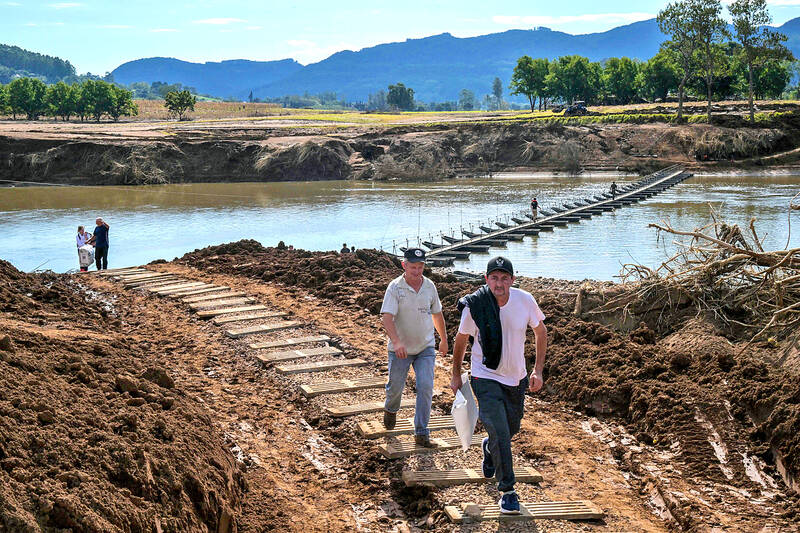
Photo: AFP
The narrow walkways balancing on canoe-shaped floats are typically used by the military in times of conflict after the bombing of bridges.
At least six bridges were washed away by floodwaters in the region, preventing people from crossing between towns by car to go to work, school or a medical appointment.
However, the new walkways are precarious and ongoing bad weather has already led to them being swept away, forcing authorities to install new ones.
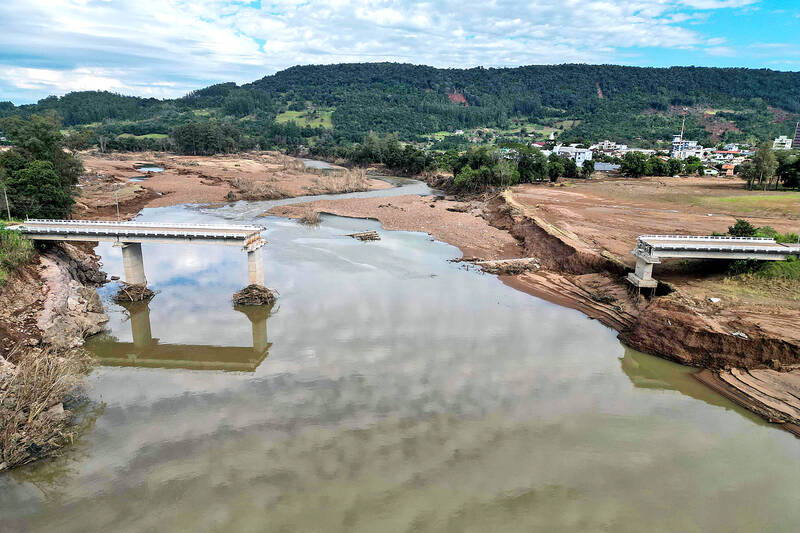
Photo: AFP
“The population needed to resume its routine in the shortest possible time,” said Brazilian Colonel Rafael Farias, 46, next to the walkway over the Forqueta River, in the town of Marques de Souza.
People must pass in single file, wearing bright-orange life jackets handed to them by soldiers stationed on both sides of the riverbank.
Juliani Steffer, a 36-year-old clothing saleswoman, arrives out of breath in Marques de Souza after crossing from the town of Travesseiro carrying a bag full of goods.
“People have lost a lot of clothes. Since they can’t come to my store by car, I go to their homes,” Steffer added.
There is no lighting, so crossings are stopped at dusk, forcing people to rush to avoid being stuck on the wrong side.
The footbridge connecting Travesseiro to Marques de Souza has already had to be removed twice due to strong currents.
About 20km away, two other walkways were built over the Taquari River, connecting Arroio do Meio town to Lajeado, the main city in the region, which has 90,000 residents.
Their success was immediate, with thousands parking their cars on either side of the river to take the pontoon bridge.
However, new torrential rains washed away part of the walkways and the authorities were working to reassemble them on Wednesday, the army told reporters.
Meanwhile, the military and volunteers made five boats available to cross the river, with a combined capacity of 25 people.
The walkway “is essential because Arroio do Meio cannot live without Lajeado and Lajeado cannot live without Arroio do Meio,” said Marta Rosani da Silva, a street cleaner preparing to cross the walkway with her six-year-old son, on the eve of a new storm.
“Of course it would be better” to have a bridge that allows cars to pass, the 41-year-old said. “Where it previously took one hour to get to work, it now takes three.”
The federal government has promised to rebuild the bridges.
Meanwhile, locals are trying to drum up donations through private initiatives and social networks to speed up rebuilding.
In the case of the Travesseiro bridge, the cost is estimated at 10 million reais (US$2 million).
“The authorities promised 4 [million reais]. We are missing 6 [million reais],” said Katia Cristina Lammers, 44, the owner of a food business who is leading fundraising efforts in Travesseiro.

‘CROSSING THE LINE’: China’s embassy in Seoul criticized US Forces Korea Commander General Xavier Brunson, asking if his ‘hostile’ remarks were authorized by Washington South Korea and the US are in talks over recent public remarks by the commander of US Forces Korea, Seoul’s presidential office said yesterday, after the comments drew sharp criticism from China. In a recent podcast interview, US Forces Korea Commander General Xavier Brunson described South Korea as “the dagger in the heart of Asia” from China’s east coast, prompting the Chinese embassy in Seoul to say that he had “truly crossed the line.” The interview came amid growing speculation that Washington might seek to expand the role of US Forces Korea in countering the growing regional influence of China, a key

Through the noise of rushing papers and whirring belts at a print factory in Kyoto, two creators watch their photo essay come to life in broadsheet form — part of an effort to win new audiences in the age of artificial intelligence (AI). Despite the decline of the publishing industry, self-publication and handmade “zine” magazines are growing in popularity in Japan, reflecting the nation’s enduring love of paper in the digital era. While speaking to Agence France-Presse at the plant, his hands black with ink, one of the creators, Kazuma Obara, said: “I think [paper] is a medium that engages all five

Australian researchers have trained lab-grown brain cells on a silicon computer chip to play the 1990s shooter game Doom and said they are just scratching the surface of what the neurons could be capable of doing. It is the science-fiction work of biotech boffins at Cortical Labs, who researched and developed the technology that harnesses the workings of the brain’s networking system. Each so-called “biological computer” contains about 200,000 living human brain cells, grown from stem cells that were harvested from blood donations. Having mastered the simple computer game Pong, where a paddle is moved up and down to send a ball

France experienced its hottest spring on record, the French weather service said on Tuesday, after an exceptional early heat wave that also broke highs for the season in England and Wales. Meteo-France said the average nationwide temperature over March to May was 13.8°C — about 1.7°C above the norm, and surpassing records set in 2011 and 2020. “The warmest spring since records began in 1900,” it said in a bulletin. All three months were warmer than average, but the onset of an “unprecedented heatwave” late last month pushed the mercury to highs typically seen at the height of the summer. “Our country had never


 RSS
RSS