


Far from the violence ravaging Haiti, a market on the border with the Dominican Republic has maintained a welcome degree of normal everyday life.
At the Dajabon border gate, a wave of Haitians press forward, eager to shop at the twice-weekly market about 200km from Haiti’s capital, Port-au-Prince.
They are drawn by the market’s offerings — food, clothing, toys and even used appliances — items not always readily available in Haiti.
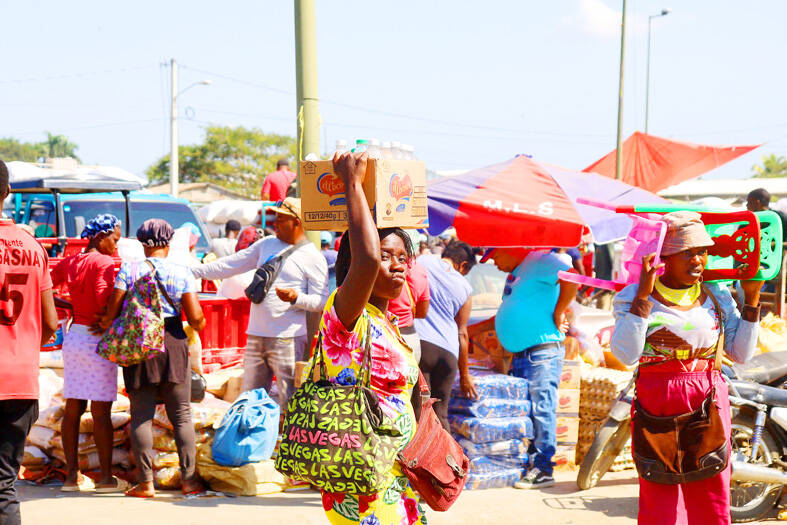
Photo: AFP
However, with gang violence bad and growing ever worse in Haiti, the Dominican government has reinforced the usual military presence at the border and placed soldiers on alert.
While the market continues to function, the authorities and merchants fear business might suffer as the gangs that control large swaths of Haiti make travel in the country risky, with people subject to being robbed or attacked.
“The market has seen a decline” in the past month, with customers “afraid to buy a large volume of merchandise” lest they be robbed on their way home, said Noel Fernandez, the president of a merchants’ association.
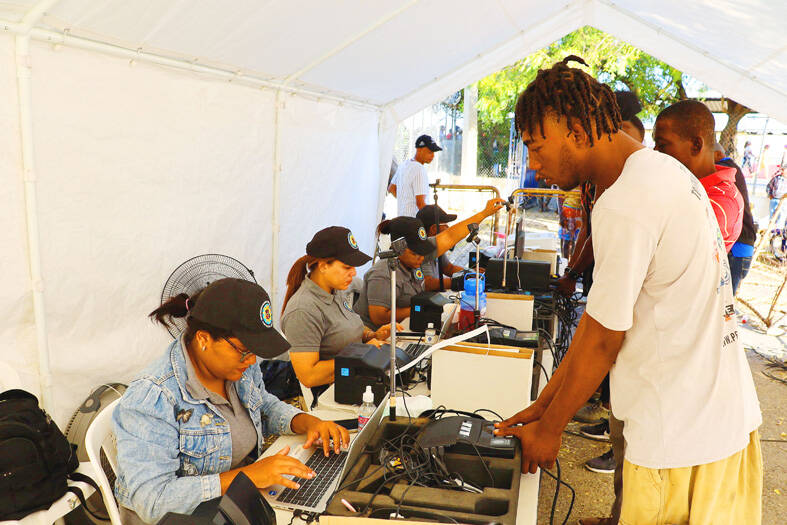
Photo: AFP
“The gangs there take the stuff, but thanks to God, although we’re not at 100 percent, the market is open,” said the 36-year-old, a merchant in the area for much of his life.
The Haitian gangs have waged violent opposition to the government of Haitian Prime Minister Ariel Henry.
The government of the far more stable Dominican Republic next door has been building a 174km wall along the border with Haiti since 2022 in an effort to control migration from its neighbor.
In Dajabon, hundreds of Haitians pass through the border gates on Mondays and Fridays, when passage to the binational market is free.
As part of their security measures, Dominican authorities established separate corridors for men and women to enter. Guards use a biometric system to verify visitors’ identities.
The additional security measures were implemented because of “the issue our neighboring country is currently experiencing,” said Morlin Fabian Tolentino, commander of a specialized border security unit.
Dominican merchants said they feel safe and have suffered “no inconvenience.”
“The security is good” because of the “rigorous” border controls, 42-year-old merchant Juan Osoria said.
People in Dajabon “are more concerned with trade” than any security challenge, said Mayor Santiago Riveron, even while confirming a drop in demand at the market as the Haitian crisis has grown worse.
Still, Haitians continue to walk through the colorful market, eyeing merchandise and pushing wheelbarrows or carrying baskets they hope to load with goods.
Dominicans operating market stalls are happy to see that.
“Thank God it is happening,” said 45-year-old Arcadio Ramirez, a fruit vendor. “It lets us make a living.”

‘IN A DIFFERENT PLACE’: The envoy first visited Shanghai, where he attended a Chinese basketball playoff match, and is to meet top officials in Beijing tomorrow US Secretary of State Antony Blinken yesterday arrived in China on his second visit in a year as the US ramps up pressure on its rival over its support for Russia while also seeking to manage tensions with Beijing. The US diplomat tomorrow is to meet China’s top brass in Beijing, where he is also expected to plead for restraint as Taiwan inaugurates president-elect William Lai (賴清德), and to raise US concerns on Chinese trade practices. However, Blinken is also seeking to stabilize ties, with tensions between the world’s two largest economies easing since his previous visit in June last year. At the

UNSETTLING IMAGES: The scene took place in front of TV crews covering the Trump trial, with a CNN anchor calling it an ‘emotional and unbelievably disturbing moment’ A man who doused himself in an accelerant and set himself on fire outside the courthouse where former US president Donald Trump is on trial has died, police said yesterday. The New York City Police Department (NYPD) said the man was declared dead by staff at an area hospital. The man was in Collect Pond Park at about 1:30pm on Friday when he took out pamphlets espousing conspiracy theories, tossed them around, then doused himself in an accelerant and set himself on fire, officials and witnesses said. A large number of police officers were nearby when it happened. Some officers and bystanders rushed

Beijing is continuing to commit genocide and crimes against humanity against Uyghurs and other Muslim minorities in its western Xinjiang province, U.S. Secretary of State Antony Blinken said in a report published on Monday, ahead of his planned visit to China this week. The State Department’s annual human rights report, which documents abuses recorded all over the world during the previous calendar year, repeated language from previous years on the treatment of Muslims in Xinjiang, but the publication raises the issue ahead of delicate talks, including on the war in Ukraine and global trade, between the top U.S. diplomat and Chinese

RIVER TRAGEDY: Local fishers and residents helped rescue people after the vessel capsized, while motorbike taxis evacuated some of the injured At least 58 people going to a funeral died after their overloaded river boat capsized in the Central African Republic’s (CAR) capital, Bangui, the head of civil protection said on Saturday. “We were able to extract 58 lifeless bodies,” Thomas Djimasse told Radio Guira. “We don’t know the total number of people who are underwater. According to witnesses and videos on social media, the wooden boat was carrying more than 300 people — some standing and others perched on wooden structures — when it sank on the Mpoko River on Friday. The vessel was heading to the funeral of a village chief in


 RSS
RSS