


Farmers and their supporters in Poland on Wednesday clashed with police amid protests against food imports from Ukraine that they say threaten their livelihoods.
Police used tear gas and detained more than a dozen people to prevent the protesters from getting through to the Sejm, the Polish parliament.
Some protesters threw stones at police and tried to push through barriers around parliament, injuring several officers, police said.
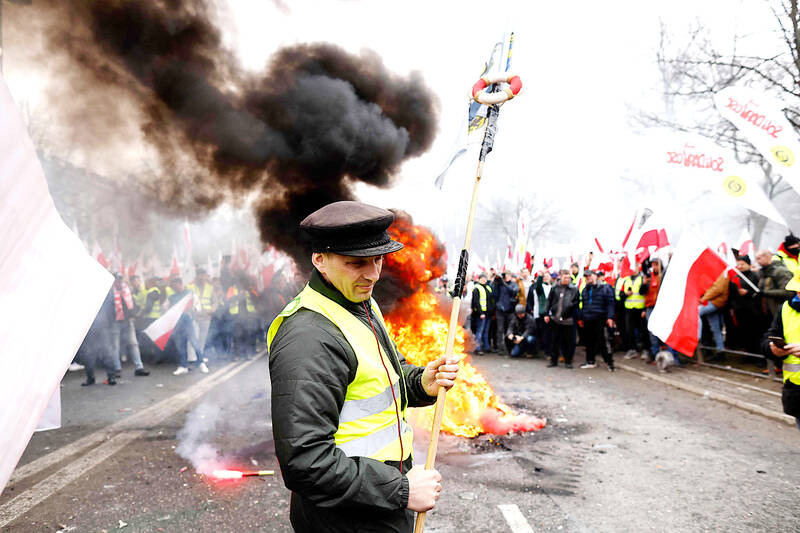
Photo: AFP
Farmers are angry over EU climate policies and food imports from Ukraine that they say threaten their livelihoods.
Such protests have occurred across the 27-member EU in the past few weeks, but this one was decidedly angrier than earlier demonstrations in the central European nation.
Police wrote on X that its officers “are not a party to the ongoing dispute,” and warned that behavior threatening their safety “cannot be taken lightly and requires a firm and decisive response.”
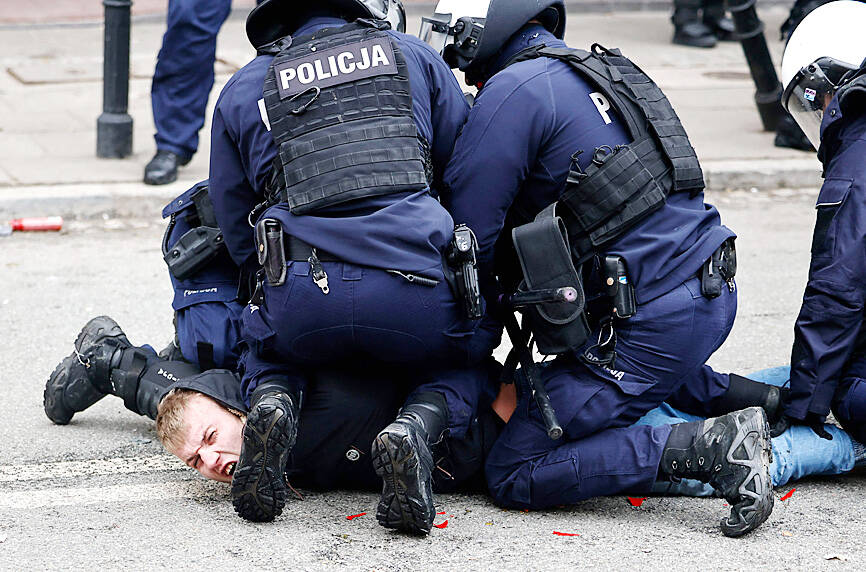
Photo: AFP
Polish Deputy Minister of Agriculture Michal Kolodziejczak said he did not believe that “real, normal farmers caused a riot in front of the Sejm today,” and that it was necessary to isolate “provocateurs and troublemakers.”
He did not say who he thought was behind the violence.
Farmers on tractors blocked highways leading into Warsaw while thousands of people gathered in front of the prime minister’s office before marching to the parliament.
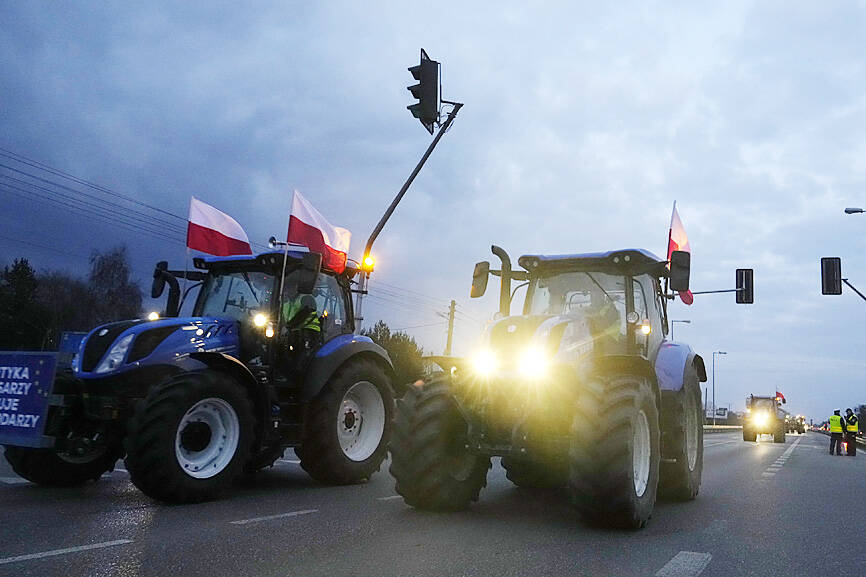
Photo: AP
Some trampled an EU flag and burned a mock coffin bearing the word “farmer.”
Farmers were joined by miners, foresters, hunters and others. They blew horns and set off firecrackers and smoke bombs, despite police warnings that the use of pyrotechnics was banned.
Some protesters burned tires.
The protesters are demanding a withdrawal from the EU’s Green Deal, a plan meant to fight climate change and protect biodiversity, including with plans requiring farmers to reduce use of chemicals to boost their crops.
The protests have led politicians to water down some provisions.
The protesters also want the border with Ukraine closed to stop the imports of Ukrainian food products, which farmers say drive down market prices and put Poland’s agricultural sector in jeopardy.
The protest increased pressure on the government of Polish Prime Minister Donald Tusk, a former European Council president.
Tusk has sought to meet the farmers’ demands, calling their frustrations justified.
He has said he plans to propose amendments to the Green Deal.
Authorities have said they are concerned that Russia is trying to leverage legitimate concerns to create divisions between Warsaw and Kyiv.
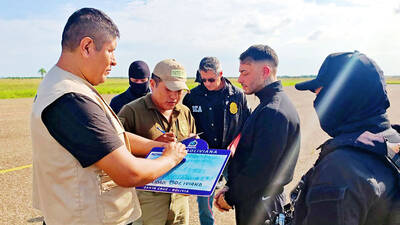
KINGPIN: Marset allegedly laundered the proceeds of his drug enterprise by purchasing and sponsoring professional soccer teams and even put himself in the starting lineups Notorious Latin American narco trafficker Sebastian Marset, who eluded police for years, was handed over to US authorities after his arrest on Friday in Bolivia. Marset, a Uruguayan national who was on the US most-wanted list, was passed to agents of the US Drug Enforcement Administration at Santa Cruz airport in Bolivia, then put on a US airplane, Bolivian state television showed. “The arrest and deportation were carried out pursuant to a court order issued by the US justice system,” Bolivian Minister of Government Marco Antonio Oviedo told reporters. The alleged kingpin was arrested in an upscale neighborhood of Santa
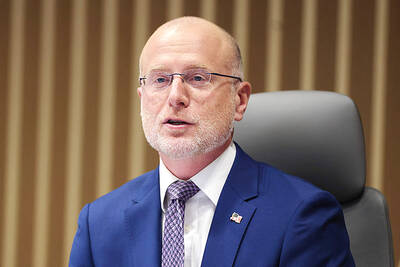
FAKE NEWS? ‘When the government demands the press become a state mouthpiece under the threat of punishment, something has gone very wrong,’ a civic group said The top US broadcast regulator on Saturday threatened media outlets over negative coverage of the Middle East war, after US President Donald Trump slammed critical headlines from the “Fake News Media.” The US president since his first term has derided mainstream media as “fake news” and has sued major outlets over what he sees as unfair coverage. Brendan Carr, head of the US Federal Communications Commission — which oversees the nation’s radio, television and Internet media — said broadcasters risked losing their licenses over news coverage. “The law is clear. Broadcasters must operate in the public interest, and they will
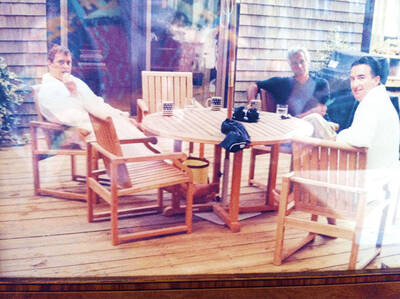
SCANDAL: Other images discovered earlier show Andrew bent over a female and lying across the laps of a number of women, while Mandelson is pictured in his underpants A photograph of former British prince Andrew and veteran politician Peter Mandelson sitting in bathrobes alongside late sex offender Jeffrey Epstein was unearthed on Friday in previously published documents. The image is believed to be the first known photograph of the two men with Epstein. They are currently engulfed in scandal in the UK over their ties to their mutual friend. The undated photograph, first reported by ITV News, shows King Charles III’s disgraced brother and former British ambassador to the US sitting barefoot outside on a wooden deck. They appear to have mugs with a US flag on them

NASA on Thursday said that the long-delayed launch of Artemis 2, the first crewed flyby mission to the moon in more than 50 years, could come as soon as April 1. “We are on track for a launch as early as April 1, and we are working toward that date,” Lori Glaze, a senior NASA official, told a news conference, after technical difficulties delayed a launch originally expected last month. “It’s a test flight, and it is not without risk, but our team and our hardware are ready,” she said. “Just keep in mind we still have work” to do. The US space


 RSS
RSS