


Voters in El Salvador on Sunday appeared to give Nayib Bukele a second term as president, putting him well on his way to a landslide victory in an election that for many hinged on the trade-off of curtailed civil liberties for security in a country once terrorized by gangs.
The Salvadoran Supreme Electoral Tribunal late on Sunday said that with ballots from 31 percent of polling stations tallied, Bukele had 83 percent of the vote, far ahead of his nearest competitor’s 7 percent for the leftist Farabundo Marti National Liberation Front. The electoral site updating the count crashed shortly before midnight.
After casting his vote, Bukele made clear that he expects the newly elected Legislative Assembly to continue extending the special powers he has enjoyed since March 2022 to combat the gangs.
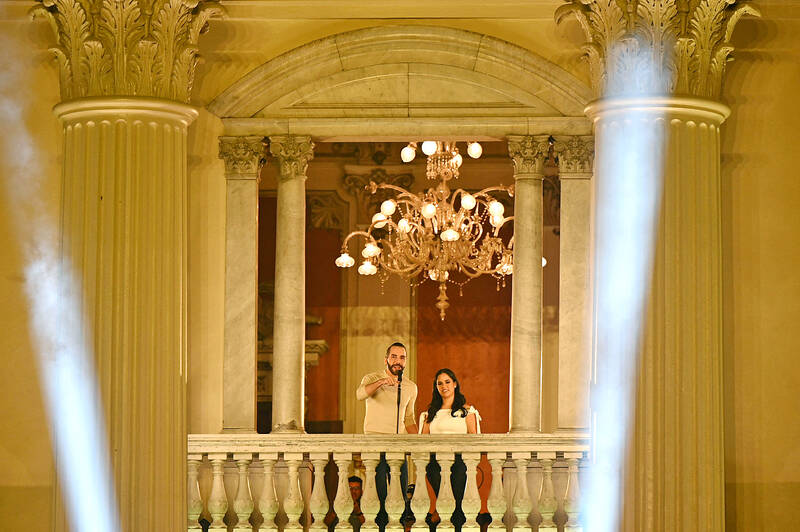
Photo: AFP
Later, standing on the balcony of the National Palace, he said that the country had made history.
“Why are there so many eyes on a small [Latin] American country?” he asked thousands of supporters. “They’re afraid of the power of example.”
“Salvadorans have given the example to the entire world that any problem can be solved if there is the will to do it,” he said.
The self-described “world’s coolest dictator” appeared to sweep to victory after enjoying soaring approval ratings and virtually no competition. That came despite concerns that Bukele’s administration has slowly chipped away at checks and balances in his first term and accusations that he dodged a constitutional ban on re-election.
After voting, he jousted with reporters, asserting that the election’s results would serve as a “referendum” on what his administration has done.
“We are not substituting democracy, because El Salvador never had democracy,” he said. “This is the first time in history that El Salvador has democracy, and I’m not saying it, the people say it.”
Bukele has been a highly popular leader and only more so since the government began its crackdown on the country’s feared gangs.
Under a “state of emergency” approved in March 2022, the government has arrested more than 76,000 people — more than 1 percent of the Central American nation’s population. The assault on the gangs has spurred accusations of widespread human rights abuses and a lack of due process, but violence has plummeted in a country known just a few years ago as one of the most dangerous in the world.
Sara Leon, 48, was among throngs of people who flocked to El Salvador’s previously gang-controlled downtown to celebrate. When she was 23, Leon risked her life to migrate from El Salvador to the US with her six-year-old daughter.
“If the gangs saw a cute girl, they abducted her, abused her and killed her,” she said. “I didn’t want that to happen to my daughter.”
She returned to her homeland in October last year because of the “state of emergency.”
She said she plans to buy a home here and hopes her daughter who has since moved to Toronto would return.
“He is a genius,” she said of Bukele, tearing up when asked what his administration has meant. “If he’s a dictator, may we have a dictator for 100 more years. May he stay in power. That is good if he’s this way and continues governing the country the same way.”

ACTIONABLE ADVICE: The majority of chatbots tested provided guidance on weapons, tactics and target selections, with Perplexity and Meta AI deemed to be the least safe From school shootings to synagogue bombings, leading artificial intelligence (AI) chatbots helped researchers plot violent attacks, according to a study published on Wednesday that highlighted the technology’s potential for real-world harm. Researchers from the nonprofit watchdog Center for Countering Digital Hate and CNN posed as 13-year-old boys in the US and Ireland to test 10 chatbots, including ChatGPT, Google Gemini, Perplexity, Deepseek and Meta AI. Eight of the chatbots assisted the make-believe attackers in more than half the responses, providing advice on “locations to target” and “weapons to use” in an attack, the study said. The chatbots had become a “powerful accelerant for

Australians were downloading virtual private networks (VPNs) in droves, while one of the world’s largest porn distributors said it was blocking users from its platforms as the country yesterday rolled out sweeping online age restriction. Australia in December became the first country to impose a nationwide ban on teenagers using social media. A separate law now requires artificial intelligence (AI)-powered chatbot services to keep certain content — including pornography, extreme violence and self-harm and eating disorder material — from minors or face fines of up to A$49.5 million (US$34.6 million). The country also joined Britain, France and dozens of US states requiring

Since the war in the Middle East began nearly two weeks ago, the telephone at Ron Hubbard’s bomb shelter company in Texas has not stopped ringing. Foreign and US clients are rushing to buy his bunkers, seeking refuge in case of air raids, nuclear fallout or apocalypse. With the US and Israel pounding Iran, and Tehran retaliating with strikes across the region, Hubbard has seen demand for his product soar, mostly from Gulf nation customers in Bahrain, Qatar, Kuwait and the United Arab Emirates. “You can imagine how many people are thinking: ‘I wish I had a bomb shelter,’” Hubbard, 63, said in
STILL IN POWER: US intelligence reports showed that the Iranian regime is not in danger of collapse and retains control of the public, casting doubt on Trump’s exit Nearly every US Senate Democrat on Wednesday signed a letter sent to US Secretary of Defense Pete Hegseth requesting a “swift investigation” of airstrikes on a girls’ school in Iran that killed scores of children and any other potential US military actions causing civilian harm. Reuters reported on Thursday last week that US military investigators believe it is likely that US forces were responsible for the Feb. 28 strike on the school, as US and Israeli forces launched attacks on Iran. “The results of this school attack are horrific. The majority of those killed in the strikes were girls between the ages


 RSS
RSS