


Centuries ago, people in what is now northeastern Romania donned bear skins and danced to fend off evil spirits. That custom is today known as the Dancing Bears Festival, drawing crowds of tourists every December.
Hundreds of people of all ages, clad in bear costumes, dance every year around Christmas to the deafening beat of drums and roam villages and towns.
The highlight of this year’s festival was to be held yesterday, with bear-clad dancers descending on the town of Comanesti, in eastern Romania, for the finale.
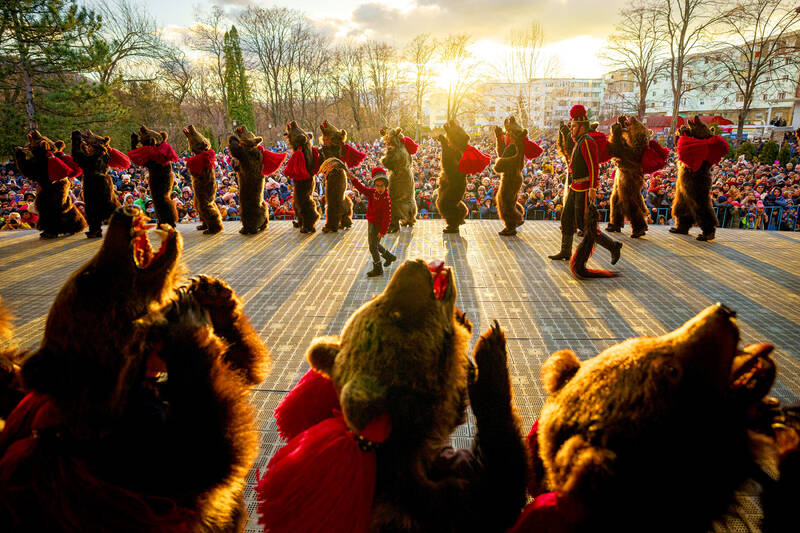
Photo: AP
Visitors come from as far as Japan to see the spectacle, featuring lines of people in costumes with gaping bear jaws and claws marching and dancing. Giant red pompom decorations are usually added to the furs.
Some of the “bears” jokingly growl or pretend to attack the spectators.
Locals say the custom dates back to the pre-Christianity era when people believed that wild animals staved off misfortune or danger.
Dancing “bears” visited people’s homes and knocked on their doors to wish them good luck and a Happy New Year.
“The bear runs through our veins, it is the spirit animal for those in our area,” said Costel Dascalu, who started participating in the festival when he was eight.
At the time, Romania was still under communist rule and the festival was relatively low-key.
“I want to keep the tradition alive,” the 46-year-old added.
When the holiday season approaches, “our breath smells like bears, and we get goose bumps when we hear the sound of drums,” he joked.
Residents are happy that the tradition has lived on after many Romanians left the region in the 1990s to look for better jobs in Western Europe.
Brown bears are widely present in Romania’s traditions and culture, and the animals can often be seen by mountain roads and in forests. Excessive bear hunting prompted the authorities to issue a ban in 2016.
Participants in the festival say most of the bear skins they use as costumes have been preserved for generations and treated with great care.
Wearing a full-sized bear fur is not easy: Including the head and claws, the costume could weigh up to 50kg.
The most expensive bear skins can cost 2,000 euros (US$2,211), local media reported.

When a hiker fell from a 55m waterfall in wild New Zealand bush, rescuers were forced to evacuate the badly hurt woman without her dog, which could not be found. After strangers raised thousands of dollars for a search, border collie Molly was flown to safety by a helicopter pilot who was determined to reunite the pet and the owner. A week earlier, an emergency rescue helicopter found the woman with bruises and lacerations after a fall at a rocky spot at the waterfall on the South Island’s West Coast. She was airlifted on March 24, but they were forced to

CONFIDENCE BOOSTER: ’After parkour ... you dare to do a lot of things that you think only young people can do,’ a 67-year-old parkour enthusiast said In a corner of suburban Singapore, Betty Boon vaults a guardrail, crawls underneath a slide, executes forward shoulder rolls and scales a steep slope, finishing the course to applause. “Good job,” the 69-year-old’s coach cheers. This is “geriatric parkour,” where about 20 retirees learned to tackle a series of relatively demanding exercises, building their agility and enjoying a sense of camaraderie. Boon, an upbeat grandmother, said learning parkour has aided her confidence and independence as she ages. “When you’re weak, you will be dependent on someone,” she said after sweating it out with her parkour classmates in suburban Toa Payoh,

HIGH HOPES: The power source is expected to have a future, as it is not dependent on the weather or light, and could be useful for places with large desalination facilities A Japanese water plant is harnessing the natural process of osmosis to generate renewable energy that could one day become a common power source. The possibility of generating power from osmosis — when water molecules pass from a less salty solution to a more salty one — has long been known. However, actually generating energy from that has proved more complicated, in part due the difficulty of designing the membrane through which the molecules pass. Engineers in Fukuoka, Japan, and their private partners think they might have cracked it, and have opened what is only the world’s second osmotic power plant. It generates

Chinese dissident artist Gao Zhen (高兟), famous for making provocative satirical sculptures of former Chinese leader Mao Zedong (毛澤東), was tried on Monday over accusations of “defaming national heroes and martyrs,” his wife and a rights group said. Gao, 69, who was detained in 2024 during a visit from the US, faces a maximum three-year prison sentence, said his wife, Zhao Yaliang (趙雅良), and Shane Yi, a researcher at the Chinese Human Rights Defenders group which operates outside the nation. The closed-door, one-day trial took place at Sanhe City People’s Court in Hebei Province neighboring the capital, Beijing, and ended without a


 RSS
RSS