


Yemen’s warring parties have committed to a new ceasefire and agreed to engage in a UN-led peace process to end the war, UN Special Envoy for Yemen Hans Grundberg said on Saturday.
The announcement by Grundberg marks the latest step to end the nine-year war that has killed hundreds of thousands of people and triggered one of the world’s worst humanitarian crises.
It follows recent meetings by Grundberg in Saudi Arabia and Oman with Rashad al-Alimi, chairman of the Yemeni Presidential Leadership Council, which is backed by Saudi Arabia, and Mohammed Abdul Salam, the chief negotiator of the Iran-backed Houthi rebels.
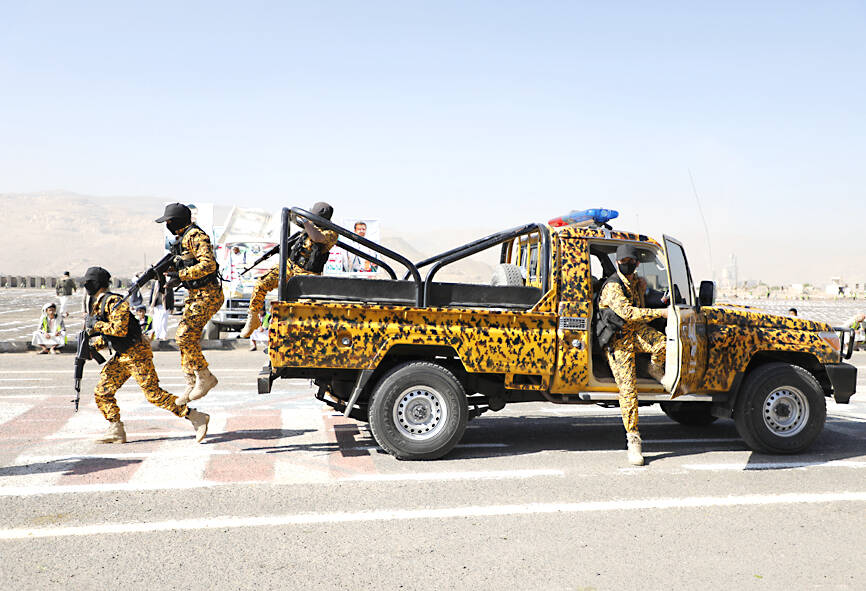
Photo: EPA-EFE
A statement by Grundberg’s office quoted him as saying he “welcomes the parties’ commitment to a set of measures to implement a nation-wide ceasefire ... and [to] engage in preparations for the resumption of an inclusive political process.”
The envoy “will now engage with the parties to establish a road map under UN auspices that includes these commitments and supports their implementation,” the statement added.
Yemen has been gripped by conflict since the Iran-backed Houthi rebels took control of the capital, Sanaa, in 2014, triggering a Saudi-led military intervention in support of the beleaguered government the following year.
A UN-brokered ceasefire that took effect in April last year brought a sharp reduction in hostilities. The truce expired in October last year, although fighting largely remains on hold.
Grundberg would now “engage with the parties to establish a roadmap under UN auspices” to end the war, the statement said.
The road map also includes commitments to pay civil servants’ salaries, open routes into the rebel-blockaded city of Taez and other parts of Yemen and resume oil exports, it said.
“Yemenis are watching and waiting for this new opportunity to provide for tangible results and progress toward lasting peace,” Grundberg said. “The parties have taken a significant step. Their commitments are, first and foremost, an obligation to the Yemeni people.”
The agreement comes amid a flurry of attacks by the Houthi rebels on key shipping lanes in the Red Sea in solidarity with Palestinians in the Gaza Strip, where Israel is fighting Hamas militants.
The Houthis have pledged to attack Israel-linked vessels or ships heading to Israeli ports unless an end is brought to the Israel-Hamas war that started on Oct. 7.
They have launched more than 100 drone and missile attacks, targeting 10 merchant vessels involving more than 35 different countries, the Pentagon has said.
The attacks by the rebels are imperilling a transit route that carries up to 12 percent of global trade, prompting the US to set up a multinational naval task force to protect Red Sea shipping.
The Houthi “military actions hinder progress toward a peaceful resolution,” said Mohammed Albasha, a senior Middle East analyst for the US-based Navanti Group.
“The Houthis have transitioned ... to becoming aggressors targeting civilian assets,” he said.
The latest agreement coincides with a push by Saudi Arabia to extricate itself from the conflict, despite slim hopes of lasting peace.
The oil-rich monarchy gave a signal this year by resuming ties with Iran, which backs the Houthis against the Saudi-supported government in a proxy war.
The Saudi-led intervention’s stated aim was to protect civilians from Houthi attacks, restore the government and stop Yemen becoming a safe haven for Iranian-backed forces.

Through the noise of rushing papers and whirring belts at a print factory in Kyoto, two creators watch their photo essay come to life in broadsheet form — part of an effort to win new audiences in the age of artificial intelligence (AI). Despite the decline of the publishing industry, self-publication and handmade “zine” magazines are growing in popularity in Japan, reflecting the nation’s enduring love of paper in the digital era. While speaking to Agence France-Presse at the plant, his hands black with ink, one of the creators, Kazuma Obara, said: “I think [paper] is a medium that engages all five
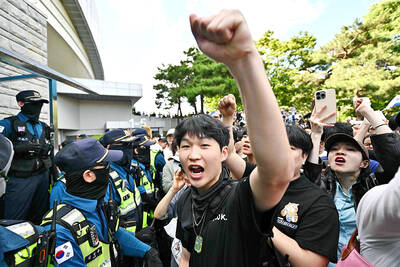
‘ABSURD MISTAKE’: The election commission said that there had been a failure to anticipate turnout after 14 polling stations ran short of ballot papers South Korean riot police yesterday cleared protesters from a Seoul polling station after a 35-hour blockade sparked by a shortage of ballot papers during local elections earlier this week. Wednesday’s election was the first nationwide vote since South Korean President Lee Jae-myung took office following the ouster of Yoon Suk-yeol over his short-lived martial law declaration. Lee’s ruling Democratic Party swept most races, but failed to flip the crucial Seoul mayoral seat. The South Korean National Election Commission apologized, blaming a failure to anticipate turnout after 14 polling stations in Seoul ran short of ballot papers. Some polling stations stayed open until 10pm to

Australian researchers have trained lab-grown brain cells on a silicon computer chip to play the 1990s shooter game Doom and said they are just scratching the surface of what the neurons could be capable of doing. It is the science-fiction work of biotech boffins at Cortical Labs, who researched and developed the technology that harnesses the workings of the brain’s networking system. Each so-called “biological computer” contains about 200,000 living human brain cells, grown from stem cells that were harvested from blood donations. Having mastered the simple computer game Pong, where a paddle is moved up and down to send a ball

France experienced its hottest spring on record, the French weather service said on Tuesday, after an exceptional early heat wave that also broke highs for the season in England and Wales. Meteo-France said the average nationwide temperature over March to May was 13.8°C — about 1.7°C above the norm, and surpassing records set in 2011 and 2020. “The warmest spring since records began in 1900,” it said in a bulletin. All three months were warmer than average, but the onset of an “unprecedented heatwave” late last month pushed the mercury to highs typically seen at the height of the summer. “Our country had never


 RSS
RSS