


Ballistic missiles fired by Yemen’s Houthi rebels on Sunday struck three commercial ships in the Red Sea, while a US warship shot down three drones in self-defense during the hours-long assault, the US military said. The Iranian-backed Houthis claimed two of the attacks.
The strikes marked an escalation in a series of maritime attacks in the Middle East linked to the Israel-Hamas war, as multiple vessels found themselves in the crosshairs of a single Houthi assault for the first time in the conflict.
The US vowed to “consider all appropriate responses” in the wake of the attack, specifically calling out Iran, after tensions have been high for years now over Tehran’s rapidly advancing nuclear program.
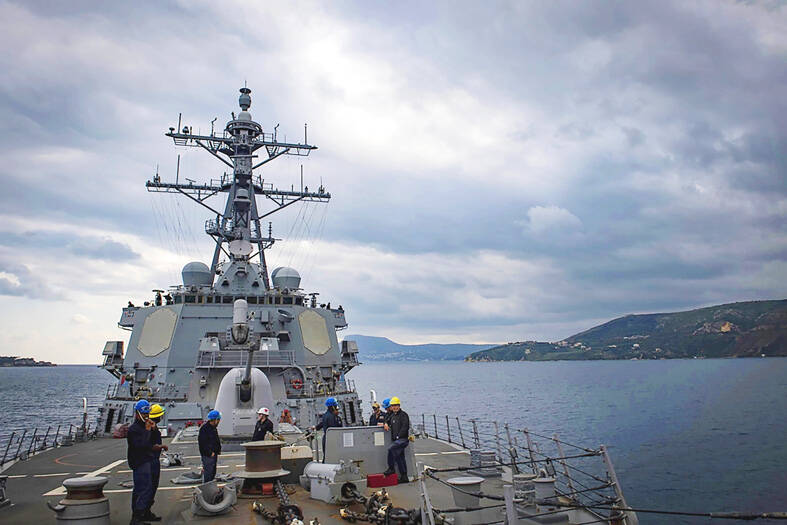
Photo: AP /Mass Communication Specialist 1st Class Ryan U. Kledzik / US Navy
“These attacks represent a direct threat to international commerce and maritime security,” the US military’s Central Command said in a statement. “They have jeopardized the lives of international crews representing multiple countries around the world.”
“We also have every reason to believe that these attacks, while launched by the Houthis in Yemen, are fully enabled by Iran,” it added.
The attack began at about 9:15am in Yemen’s Houthi-controlled capital, Sana’a, Central Command said.
The USS Carney, a Navy destroyer, detected a ballistic missile fired from Houthi-controlled areas of Yemen at the Bahamas-flagged bulk carrier Unity Explorer. The missile hit near the ship, the US said.
Shortly afterward, the Carney shot down a drone headed its way, although it was not clear if the destroyer was the target, Central Command said.
About 30 minutes later, the Unity Explorer was hit by a missile. While responding to its distress call, the Carney shot down another incoming drone.
Central Command said the Unity Explorer sustained minor damage from the missile.
Two other commercial ships, the Panamanian-flagged bulk carriers Number 9 and Sophie II, were both struck by missiles. The Number 9 reported some damage, but no casualties, and the Sophie II reported no significant damage, Central Command said.
While sailing to assist the Sophie II at about 4:30pm, the Carney shot down another drone heading in its direction. The drones did no damage.
The Carney, an Arleigh Burke-class guided-missile destroyer, has shot down multiple rockets the Houthis have fired toward Israel during that nation’s war against Hamas in the Gaza Strip. It has not been damaged in any of the incidents and no injuries have been reported on board.
The US Department of Defense initially described the assault as simply an attack on the Carney before providing more details.
Houthi military spokesman Brigadier General Yahya Saree claimed two of Sunday’s attacks, saying the first vessel was hit by a missile and the second by a drone while in the Bab el-Mandeb Strait, which links the Red Sea to the Gulf of Aden. Saree did not mention any US warship being involved.
“The Yemeni armed forces continue to prevent Israeli ships from navigating the Red Sea [and Gulf of Aden] until the Israeli aggression against our steadfast brothers in the Gaza Strip stops,” Saree said. “The Yemeni armed forces renew their warning to all Israeli ships or those associated with Israelis that they will become a legitimate target if they violate what is stated in this statement.”

A new online voting system aimed at boosting turnout among the Philippines’ millions of overseas workers ahead of Monday’s mid-term elections has been marked by confusion and fears of disenfranchisement. Thousands of overseas Filipino workers have already cast their ballots in the race dominated by a bitter feud between President Ferdinand Marcos Jr and his impeached vice president, Sara Duterte. While official turnout figures are not yet publicly available, data from the Philippine Commission on Elections (COMELEC) showed that at least 134,000 of the 1.22 million registered overseas voters have signed up for the new online system, which opened on April 13. However,
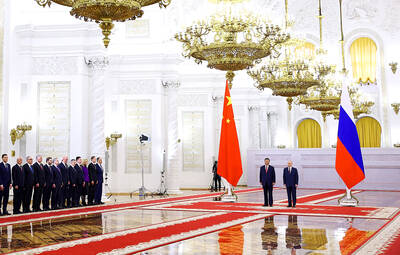
ALLIES: Calling Putin his ‘old friend,’ Xi said Beijing stood alongside Russia ‘in the face of the international counter-current of unilateralism and hegemonic bullying’ Chinese President Xi Jinping (習近平) yesterday was in Moscow for a state visit ahead of the Kremlin’s grand Victory Day celebrations, as Ukraine accused Russia’s army of launching air strikes just hours into a supposed truce. More than 20 foreign leaders were in Russia to attend a vast military parade today marking 80 years since the defeat of Nazi Germany in World War II, taking place three years into Russia’s offensive in Ukraine. Putin ordered troops into Ukraine in February 2022 and has marshaled the memory of Soviet victory against Nazi Germany to justify his campaign and rally society behind the offensive,

CONFLICTING REPORTS: Beijing said it was ‘not familiar with the matter’ when asked if Chinese jets were used in the conflict, after Pakistan’s foreign minister said they were The Pakistan Army yesterday said it shot down 25 Indian drones, a day after the worst violence between the nuclear-armed rivals in two decades. Pakistani Prime Minister Shehbaz Sharif vowed to retaliate after India launched deadly missile strikes on Wednesday morning, escalating days of gunfire along their border. At least 45 deaths were reported from both sides following Wednesday’s violence, including children. Pakistan’s military said in a statement yesterday that it had “so far shot down 25 Israeli-made Harop drones” at multiple location across the country. “Last night, India showed another act of aggression by sending drones to multiple locations,” Pakistan military spokesman Ahmed
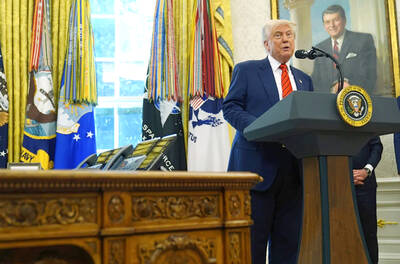
US President Donald Trump on Wednesday said that he would make a decision about how the US government would refer to the body of water commonly known as the Persian Gulf when he visits Arab states next week. Trump told reporters at the White House that he expects his hosts in Saudi Arabia, Qatar and the United Arab Emirates will ask him about the US officially calling the waterway the Arabian Gulf or Gulf of Arabia. “They’re going to ask me about that when I get there, and I’ll have to make a decision,” Trump said. “I don’t want to hurt anybody’s


 RSS
RSS