


State media yesterday said that North Korean leader Kim Jong-un reviewed images taken by his country’s new spy satellite of a US naval base at Pearl Harbor in Hawaii and “major target” sites across South Korea.
Pyongyang said it put a military spy satellite into orbit this week, but Seoul said it was too early to determine if the satellite was functioning as the North claims.
Experts have said putting a working reconnaissance satellite into orbit would improve North Korea’s intelligence-gathering capabilities, particularly over South Korea, and provide crucial data in any military conflict.
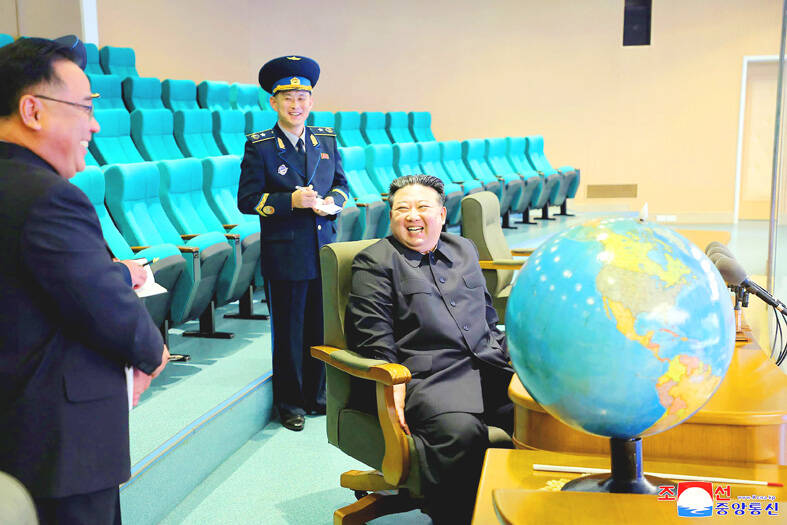
Photo: AFP / KCNA via KNS
Pyongyang previously said, within hours of the Tuesday launch, that Kim was shown photographs of US military bases in Guam taken by the satellite, named Malligyong-1.
Yesterday, the North said that Kim inspected images taken as the satellite passed over Hawaii at about 5am, including those of “a naval base in the Pearl Harbor, the Hickam air-force base in Honolulu,” he North’s official Korean Central News Agency (KCNA) reported.
Kim also reviewed the satellite’s images of the South Korean port city of Busan, which Pyongyang said were taken at about 10am yesterday.
The photos included ones of the US nuclear-powered aircraft carrier USS Carl Vinson, Pyongyang said.
The carrier had arrived at the Busan Naval Base on Tuesday, South Korea’s military said.
Kim also reviewed “major target areas in the enemy region” — referring to the South — including Jinhae, Busan, Ulsan, Pohang, Daegu and Gangneung, KCNA said.
In an earlier report yesterday, KCNA said that Kim had the day before reviewed the satellite’s images of “major target regions” in the South, including its capital and cities hosting US military bases.
The Friday images also included some areas of North Korea, it added.
Among the South Korean cities mentioned, Pyeongtaek — about 60km from Seoul — hosts Camp Humphreys, the largest overseas US military installation in the world.
Pyeongtaek is also home to the Osan Air Base, which houses the South Korean Air Force Operations Command as well as a US Air Force base.
South Korean Minsiter of National Defense Shin Won-sik on Thursday told a local radio station that spy satellites cannot produce photographs on the first day of the launch, questioning the credibility of Pyongyang’s earlier claims, Seoul’s Yonhap news agency reported.
“Even if the satellite enters the orbit [successfully], it takes a considerable amount of time to perform a normal reconnaissance mission,” he told the radio station, Yonhap reported.
Pyongyang is barred by successive rounds of UN resolutions from tests using ballistic technology, and analysts say there is significant technological overlap between space launch capabilities and the development of ballistic missiles.
The North’s satellite launch has since prompted the two Koreas to suspend — the South only partially — a five-year-old military accord established to de-escalate tensions on the Korean Peninsula.
Separately, the top diplomats of South Korea, Japan and the US on Friday “strongly condemned the launch for its destabilizing effect on the region” after a joint phone call, the US State Department said in a statement.
The South Korean National Intelligence Service has said that Pyongyang, after two failed attempts to put a satellite in orbit earlier this year, received help from Moscow for this week’s successful launch.
“If Russia had provided North Korea with a reconnaissance satellite camera this time, I think it would be possible to identify objects with a radius of at least 2m on the ground,” said Ahn Chan-il, a defector-turned-researcher who runs the World Institute for North Korea Studies.
Now that Pyongyang has a spy satellite, the North’s next likely step will be to further develop its “strategic nuclear weapons” using space launch capabilities, he added.

An American scientist convicted of lying to US authorities about payments from China while he was at Harvard University has rebuilt his research lab in Shenzhen, China, to pursue technology the Chinese government has identified as a national priority: embedding electronics into the human brain. Charles Lieber, 67, is among the world’s leading researchers in brain-computer interfaces. The technology has shown promise in treating conditions such as amyotrophic lateral sclerosis and restoring movement in paralyzed people. It also has potential military applications: Scientists at the Chinese People’s Liberation Army have investigated brain interfaces as a way to engineer super soldiers by boosting

Indonesian police have arrested 13 people after shocking images of alleged abuse against small children at a daycare center went viral, sparking outrage across the nation, officials said on Monday. Police on Friday last week raided Little Aresha, a daycare center in Yogyakarta on Java island, following a report from a former employee. CCTV footage circulating on social media showed children, most younger than two, lying on the floor wearing only diapers, their hands and feet bound with rags. The police have confirmed that the footage is authentic. Police said they also found 20 children crammed into a room just 3m by 3m. “So
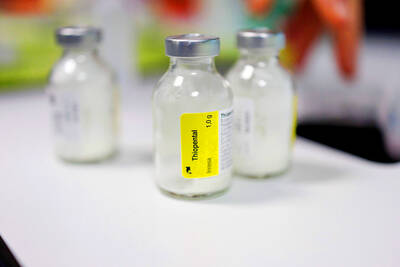
A grieving mother has ended her life at a clinic in Switzerland four years after the death of her only child. Wendy Duffy, 56, a physically healthy woman, died at the Pegasos clinic in Basel after struggling to cope with the death of her 23-year-old son, Marcus. The former care worker, from the West Midlands, England, had previously attempted to take her own life. The case comes as assisted dying would not become law in England and Wales after proposed legislation, branded “hopelessly flawed” by opponents, ran out of time. Ruedi Habegger, the founder of Pegasos, described Duffy’s death as
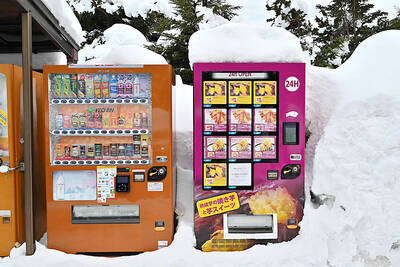
From post offices and parks to stations and even the summit of Mount Fuji, Japan’s vending machines are ubiquitous, but with the rapid pace of inflation cooling demand for their drinks, operators are being forced to rethink the business. Last month beverage giant DyDo Group Holdings announced it would remove about 20,000 vending machines — about 7 percent of their stock nationwide — by January next year, to “reconstruct a profitable network.” Pokka Sapporo Food & Beverage, based in Nagoya, also said last month it would sell its 40,000-machine operation to Osaka-based Lifedrink Co. “The strength of the vending machine


 RSS
RSS