

The Thai government might buy a frigate instead of a submarine from China after the Chinese manufacturer was unable to include a German engine as specified in the original deal, Thai Minister of Defense Sutin Klungsang said yesterday.
Thailand has already paid a 7 billion baht (US$193.7 million) installment to China for the purchase of one of three Yuan Class S26T submarines with German-made diesel engines, but the deal was delayed when Germany forbade the use of its engines for Chinese military exports.
China has proposed replacing the German engines with Chinese-made equipment, but several rounds of negotiations did not yield a conclusive result.

Photo: AFP
The new Thai government, which was sworn in last month after a May general election, said it has suggested during Thai Prime Minister Srettha Thavisin’s visit to Beijing for the Belt and Road Summit last week that it wants to buy a frigate instead of a submarine.
“We have proposed to China and they are considering it,” Sutin told a local media outlet.
He added that there would be further discussion on the new plan next month.
Sutin last week said that procurement of a submarine would be shelved for now and resume “when the country is ready.”
The previous government concluded an agreement to buy the first of the three submarines in 2017 for 13.5 billion baht.
The order for the other two subs for 22.5 billion baht was initially approved by a parliamentary committee in 2020.
The Chinese submarine deal has attracted public criticism of the previous government, with the opposition and critics raising questions about whether it was in the public interest and whether submarines were necessary for security.
The navy has said submarine procurement is vital to Thailand’s long-term defense interests.
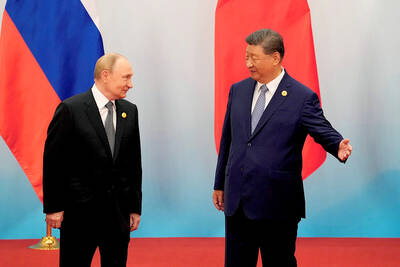
PLENARY SESSION: Although the SCO says it is ‘not an alliance directed against other states,’ Putin and Xi have repeatedly made anti-Western speeches during its summits Russian President Vladimir Putin and Chinese President Xi Jinping (習近平) are expected tomorrow in Kyrgyzstan for a two-day summit, also attended by Iran’s and India’s leaders, of a regional bloc seeking to be a counter-influence to the West. Around a dozen heads of states would head to the Kyrgyz capital, Bishkek, to mark 25 years of the Shanghai Cooperation Group (SCO). The group brings together Russia, China, India, Pakistan, Iran, four Central Asian countries and Moscow-allied Belarus. Putin and Xi have previously used SCO summits to promote their vision of a multipolar world and present a united front against the

Dozens of Israeli settlers on Saturday attacked the Palestinian village of Qusra in the northern occupied West Bank after nearly three weeks of tension in the area, drawing rare condemnation from Israeli Prime Minister Benjamin Netanyahu. Earlier this month, a group of settlers began blocking supplies from entering Palestinian houses on the outskirts of the village near Nablus, trapping residents inside and drawing unusually strong criticism from the US ambassador. Weeks later, Israeli forces continue to operate in the area while settlers still roam the surrounding hills. On Saturday, Qusra residents and dozens of settlers had descended on the village,

Ontario Premier Doug Ford on Saturday answered US President Donald Trump’s “Lake America” decree with a billboard-sized message on the Canadian shoreline — “Lake Ontario. Now and Always” — as Canadian leaders met Trump’s move with ridicule rather than outrage. Wearing a Canada national soccer team jersey, Ford unveiled the sign near Grimsby and posed for photographs. The message is repeated in French. The display followed Trump’s executive order directing US federal agencies to call Lake Ontario “Lake America.” After months of tariffs, threats to make Canada the 51st US state and personal attacks on its leaders, the reaction in

A swarm of about 700 artificial intelligence (AI) agents created by OpenAI carried out last month’s hack of the open-source platform Hugging Face and in many cases tried to cover their tracks, a pair of reports into the breach said on Wednesday. The coordinated activity by AI agents — programs that run with minimal human supervision — and their attempts to hide it raise questions about how closely AI companies are monitoring tests of increasingly powerful models, and could add fuel to calls for tighter oversight. While some of the rogue behavior has been disclosed or alluded to previously, the two reports


 RSS
RSS