


Weather disasters fueled by climate change — from floods to droughts, storms to wildfires — sparked 43.1 million child displacements from 2016 to 2021, the UN Children’s Fund (UNICEF) said on Thursday, slamming the lack of attention paid to victims.
In a sweeping report on the issue, the UN agency detailed the heart-wrenching stories of some of the children affected and coauthor Laura Healy said the data only revealed the “tip of the iceberg,” with many more likely affected.
“We moved our belongings to the highway, where we lived for weeks,” said Sudanese child Khalid Abdul Azim, whose flooded village was only accessible by boat.
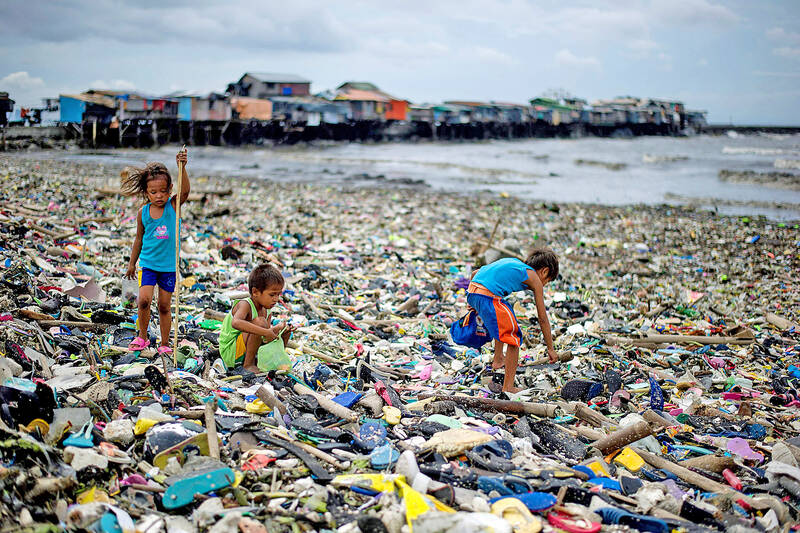
Photo: AFP
In 2017, sisters Mia and Maia Bravo watched flames engulf their trailer in California from the back of the family minivan.
“I was afraid, in shock,” Maia said in the report. “I would stay up all night.”
Statistics on internal displacements caused by climate disasters generally do not account for the age of the victims, but UNICEF worked with the non-governmental organization the Internal Displacement Monitoring Center to unpick the data and reveal the hidden toll on children.
From 2016 to 2021, four types of climate disasters (floods, storms, droughts and wildfires) — the frequency of which has increased due to climate change — led to 43.1 million child displacements in 44 nations, the report says.
Ninety-five percent of those displacements were caused by floods and storms.
“It’s the equivalent of about 20,000 child displacements every day,” Healy said, underscoring how the children affected are then at risk of suffering other traumas, such as being separated from their parents or falling victim to child traffickers.
The data reflect the number of displacements and not the number of children affected, as the same child could be uprooted more than once.
The figures do not allow for a distinction between those evacuated before a weather event and those forced to leave in the wake of a disaster.
The number of displacements due to drought is “radically underreported,” because they are less sudden and thus more difficult to quantify, Healy said.
“This is just the tip of the iceberg based on the available data that we have,” she said. “The reality is with the impacts of climate change, or better tracking of displacement when it comes to slow onset events, that the number of children who are uprooted from their homes is going to be much greater.”
The report offers some partial predictions for specific events.
Floods linked to overflowing rivers could spark 96 million child displacements in the next 30 years, while cyclonic winds could force 10.3 million displacements, it says. Storms surges could lead to 7.2 million displacements.
None of those estimates include preventive evacuations.
“For those who are forced to flee, the fear and impact can be especially devastating, with worry of whether they will return home, resume school, or be forced to move again,” UNICEF executive director Catherine Russell said in a statement. “Moving may have saved their lives, but it’s also very disruptive. As the impacts of climate change escalate, so too will climate-driven movement. We have the tools and knowledge to respond to this escalating challenge for children, but we are acting far too slowly.”
UNICEF called on world leaders to take up the issue at the COP28 climate summit in Dubai, United Arab Emirates, next month.
Even if the intensifying effects of climate change are affecting wide swathes of the planet, the UNICEF report shines the light on particularly vulnerable nations.
China, India and the Philippines are the nations with the largest number of displacements (nearly 23 million in six years) because of their huge populations and their geographic locations — but also because of their preventive evacuation plans.
However, in proportional terms, Africa and small island nations are most at risk — in Dominica, 76 percent of all children were displaced from 2016 to 2021. For Cuba and Saint Martin, that figure was more than 30 percent.

VAGUE: The criteria of the amnesty remain unclear, but it would cover political violence from 1999 to today, and those convicted of murder or drug trafficking would not qualify Venezuelan Acting President Delcy Rodriguez on Friday announced an amnesty bill that could lead to the release of hundreds of prisoners, including opposition leaders, journalists and human rights activists detained for political reasons. The measure had long been sought by the US-backed opposition. It is the latest concession Rodriguez has made since taking the reins of the country on Jan. 3 after the brazen seizure of then-Venezuelan president Nicolas Maduro. Rodriguez told a gathering of justices, magistrates, ministers, military brass and other government leaders that the ruling party-controlled Venezuelan National Assembly would take up the bill with urgency. Rodriguez also announced the shutdown
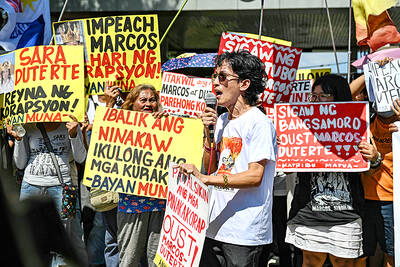
Civil society leaders and members of a left-wing coalition yesterday filed impeachment complaints against Philippine Vice President Sara Duterte, restarting a process sidelined by the Supreme Court last year. Both cases accuse Duterte of misusing public funds during her term as education secretary, while one revives allegations that she threatened to assassinate former ally Philippine President Ferdinand Marcos Jr. The filings come on the same day that a committee in the House of Representatives was to begin hearings into impeachment complaints against Marcos, accused of corruption tied to a spiraling scandal over bogus flood control projects. Under the constitution, an impeachment by the
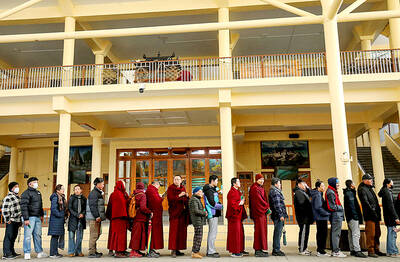
Exiled Tibetans began a unique global election yesterday for a government representing a homeland many have never seen, as part of a democratic exercise voters say carries great weight. From red-robed Buddhist monks in the snowy Himalayas, to political exiles in megacities across South Asia, to refugees in Australia, Europe and North America, voting takes place in 27 countries — but not China. “Elections ... show that the struggle for Tibet’s freedom and independence continues from generation to generation,” said candidate Gyaltsen Chokye, 33, who is based in the Indian hill-town of Dharamsala, headquarters of the government-in-exile, the Central Tibetan Administration (CTA). It

A Virginia man having an affair with the family’s Brazilian au pair on Monday was found guilty of murdering his wife and another man that prosecutors say was lured to the house as a fall guy. Brendan Banfield, a former Internal Revenue Service law enforcement officer, told police he came across Joseph Ryan attacking his wife, Christine Banfield, with a knife on the morning of Feb. 24, 2023. He shot Ryan and then Juliana Magalhaes, the au pair, shot him, too, but officials argued in court that the story was too good to be true, telling jurors that Brendan Banfield set


 RSS
RSS