


A Swiss Academy of Sciences panel is reporting a dramatic acceleration of glacier melt in the Alpine country, which has lost 10 percent of its ice volume in just two years after high summer heat and low snow volumes in winter.
Switzerland — home to the most glaciers of any country in Europe — has seen 4 percent of its total glacier volume disappear this year, the second-biggest decline in a single year on top of a 6 percent drop last year, the biggest thaw since measurements began, the academy’s Commission for Cryosphere observation said.
Experts at the GLAMOS glacier monitoring center have been on the lookout for a possible extreme melt this year amid early warning signs about the nation’s estimated 1,400 glaciers, a number that is now dwindling.
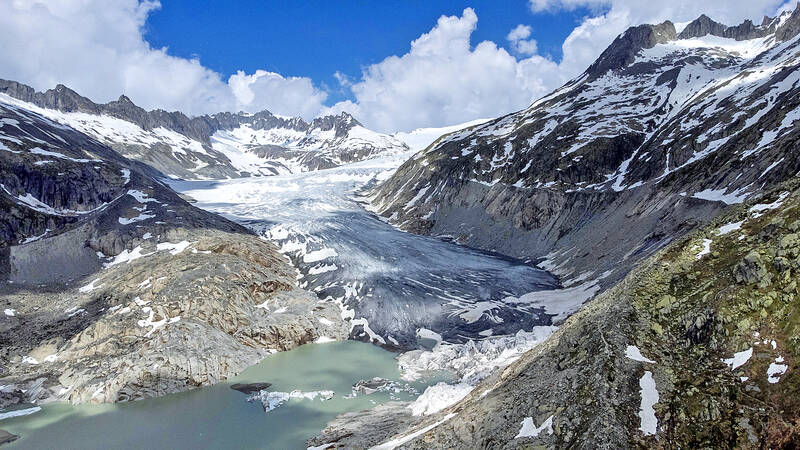
Photo: AP
“The acceleration is dramatic, with as much ice being lost in only two years as was the case between 1960 and 1990,” the academy said. “The two extreme consecutive years have led to glacier tongues collapsing and the disappearance of many smaller glaciers.”
The team said the “massive ice loss” stemmed from a winter with very low volumes of snow — which falls on top of glaciers and protects them from exposure to direct sunlight — and high summer temperatures.
All of Switzerland — where the Alps cut a swath through most of the southern and central parts of the country — was affected, though glaciers in the southern and eastern regions melted almost as fast as in last year’s record thaw.
“Melting of several meters was measured in southern Valais [region] and the Engadin valley at a level above 3,200 meters, an altitude at which glaciers had until recently preserved their equilibrium,” the team said.
The average loss of ice thickness was up to 3m in places such as the Gries Glacier in Valais, the Basodino Glacier in the southern canton, or region, of Ticino, and the Vadret Pers glacier system in eastern Graubunden.
The situation in some parts of the central Bernese Oberland and the Valais was less dramatic — such as for the Aletsch Glacier in Valais and Plaine Morte Glacier in the canton of Bern, because they enjoyed more winter snowfall.
However, even in such areas, “a loss of over 2 meters of the average ice thickness is extremely high,” the team said.
Snow depths measured in the first half of February were generally higher than in the winters of 1964, 1990 or 2007, which were also characterized by low snowfalls, the team said.
However, snow levels sank to a new record low in the second half of February, reaching only about 30 percent of the long-term average.
More than half of automated monitoring stations above 2,000m that have been in place for at least a quarter-century tallied record-low levels of snow at the time.
After that, an “extremely warm June” caused snow to melt two to four weeks earlier than usual, and mid-summer snowfalls melted very quickly, the team said.
Swiss meteorologists last month reported that the 0°C level — or the altitude where water freezes — had risen to its highest level ever recorded, at nearly 5,300m, which means that all the Swiss Alpine peaks faced temperatures above freezing.

Crowds in Bangladesh are flocking to snap photographs with an unlikely social media star — an albino buffalo with flowing blond hair nicknamed “Donald Trump” that is due to be sacrificed within days. Owner Zia Uddin Mridha, 38, said his brother named the 700kg bull over its flowing helmet of hair resembling the signature look of the US president. “My younger brother picked this name because of the buffalo’s extraordinary hair,” he said at his farm in Narayanganj, just outside the capital, Dhaka. Mridha said that a constant stream of curious visitors — social media fans, onlookers and children — have come throughout
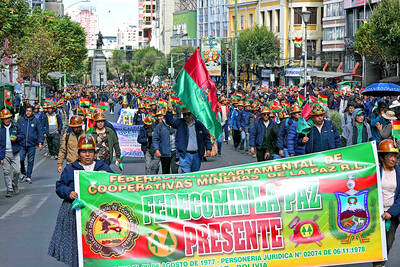
The Bolivian government on Friday struck a deal with protesting miners, but was still grappling with blockades and demonstrations by other workers across La Paz. Other groups are still blocking access roads into the city, which is also the seat of the government. Police on Thursday prevented the miners from entering the main square by using tear gas, while the demonstrators hurled stones and explosives with slingshots. Protests against the policies of Bolivian President Rodrigo Paz have convulsed the Andean nation since early this month, and roadblocks were choking routes into La Paz throughout Friday, the national road authority said. Miners demanded that Paz

The Philippines said it has asked the country’s Supreme Court to allow it to arrest former Philippine president Rodrigo Duterte’s chief drug war enforcer to stand trial in an international tribunal. The International Criminal Court (ICC) last week unsealed an arrest warrant against Philippine Senator Ronald dela Rosa, accusing him along with Duterte and other “coperpetrators” of the “crime against humanity of murder.” Dela Rosa briefly sought refuge in the Philippine Senate last week while asking the Philippine Supreme Court to stop an ongoing attempt by government agents to arrest him. “By his own conduct, he has placed himself outside the protection of

The researchers in Ireland looked at their computer screen, marveling at a medieval book tracked down in a Roman library. They flipped through its digitized pages and found their sought-after treasure: the oldest surviving English poem. “We were extremely surprised. We were speechless. We couldn’t believe our eyes when we first saw that,” said Elisabetta Magnanti, a visiting research fellow at Trinity College Dublin’s school of English. The poem was also within the main body of Latin text, she said, calling it “extraordinary.” Composed in Old English by a Northumbrian agricultural worker in the 7th century, Caedmon’s Hymn appears within some copies of


 RSS
RSS