


North Korea yesterday said that its new submarine has nuclear attack capabilities it has been developing for years, a step leader Kim Jong-un described as crucial in his efforts to build a nuclear-armed navy to counter the US and its Asian allies.
The Korean Central News Agency (KCNA) said the vessel, named Hero Kim Kun-ok, is designed to launch tactical nuclear weapons from underwater, but did not specify the number of missiles it could carry and fire.
South Korean officials were skeptical that the submarine would work as North Korea described and said it likely was not ready for operational duty. Still, the vessel’s development underscored how North Korea continues to potentially extend the range of its nuclear arsenal with systems that are harder to detect in advance.
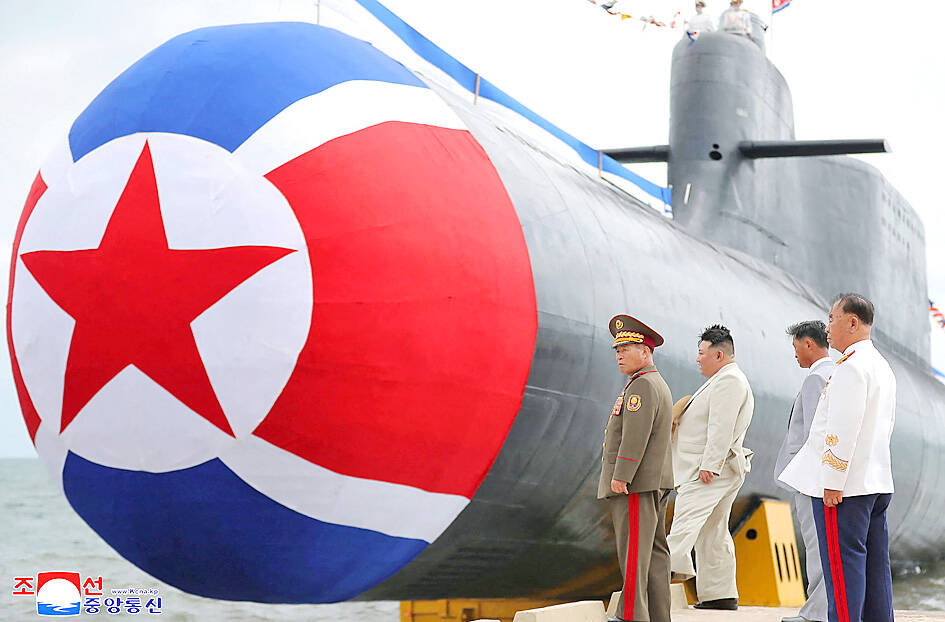
Photo: AFP / KCNA VIA KNS
Based on Kim Jong-un’s comments and photogrpahs by North Korean state media, it is likely the submarine is the same one Kim inspected in 2019 while it was under construction. At the time, experts assessed it as an effort to convert an existing Romeo-class submarine.
The submarine appears to have at least 10 launch tubes — four of them apparently larger than the other six — that are possibly designed for missiles.
“This submarine, though heavily modified, is based on 1950s Soviet-origin technology and will have inherent limitations. Nevertheless, in terms of complicating the targeting challenges that the US and its allies will face, the submarine will serve North Korea’s purposes,” said Ankit Panda, an expert at the Carnegie Endowment for International Peace.
North Korea has tested a variety of missiles designed to be fired from submarines as it pursues the ability to conduct nuclear strikes from underwater. In theory, such capacity would bolster its deterrent by ensuring a survivable capability to retaliate after absorbing a nuclear attack on land.
Ballistic missile submarines would also add a maritime threat to North Korea’s growing collection of solid-fuel weapons fired from land vehicles that are designed to overwhelm missile defenses in South Korea and Japan.
However, it would take considerable time, resources and technological improvements for the heavily sanctioned nation to build a fleet of at least several submarines that could travel quietly and execute attacks reliably, analysts said.
In speeches at the vessel’s launch ceremony on Wednesday and an onboard inspection on Thursday at a military shipyard, Kim Jong-un expressed satisfaction that North Korea has acquired its own nuclear attack submarine to counter the advanced assets of the US, KCNA said.
The US in July docked a nuclear-capable ballistic missile submarine in South Korea for the first time since the 1980s.
Kim Jong-un said the nation is also pursuing a nuclear-propelled submarine, and plans to remodel its existing submarines and surface vessels so they can handle nuclear weapons, describing the building of a nuclear-capable army as an “urgent task.”
South Korea’s military said that North Korea was exaggerating the submarine’s capabilities.
The South Korean Joint Chiefs of Staff said that North Korea would have needed to increase the size of the bridge and other parts of the original vessel to accommodate missile launch systems, but that the appearance of the new submarine suggested that it could “not be operated normally.”
“There are signs of deception or exaggeration,” the South Korean Joint Chiefs of Staff said in a statement, without elaborating.
Kim Jong-un has been emphasizing the need to strengthen the nation’s navy. Some analysts say the focus could be driven by a desire to expand military cooperation with Russia, which has suggested the possibility of combined military exercises.
‘CROSSING THE LINE’: China’s embassy in Seoul criticized US Forces Korea Commander General Xavier Brunson, asking if his ‘hostile’ remarks were authorized by Washington South Korea and the US are in talks over recent public remarks by the commander of US Forces Korea, Seoul’s presidential office said yesterday, after the comments drew sharp criticism from China. In a recent podcast interview, US Forces Korea Commander General Xavier Brunson described South Korea as “the dagger in the heart of Asia” from China’s east coast, prompting the Chinese embassy in Seoul to say that he had “truly crossed the line.” The interview came amid growing speculation that Washington might seek to expand the role of US Forces Korea in countering the growing regional influence of China, a key

Through the noise of rushing papers and whirring belts at a print factory in Kyoto, two creators watch their photo essay come to life in broadsheet form — part of an effort to win new audiences in the age of artificial intelligence (AI). Despite the decline of the publishing industry, self-publication and handmade “zine” magazines are growing in popularity in Japan, reflecting the nation’s enduring love of paper in the digital era. While speaking to Agence France-Presse at the plant, his hands black with ink, one of the creators, Kazuma Obara, said: “I think [paper] is a medium that engages all five

Australian researchers have trained lab-grown brain cells on a silicon computer chip to play the 1990s shooter game Doom and said they are just scratching the surface of what the neurons could be capable of doing. It is the science-fiction work of biotech boffins at Cortical Labs, who researched and developed the technology that harnesses the workings of the brain’s networking system. Each so-called “biological computer” contains about 200,000 living human brain cells, grown from stem cells that were harvested from blood donations. Having mastered the simple computer game Pong, where a paddle is moved up and down to send a ball

A surprising gut feeling may help pigeons find their way home. Animals use various techniques to navigate, including following the stars and remembering key landmarks. Birds, fish and turtles orient themselves using Earth’s magnetic field as a compass, but it is not yet clear how exactly they do this. Pigeons are a well-known group of frequent flyers that can traverse hundreds of kilometers in a single day. For thousands of years, humans have used them to carry news, notes and military messages. Scientists have long tried to untangle how pigeons travel without getting lost. Some think the birds detect magnetic cues using light-sensitive


 RSS
RSS