

When residents of a slum cluster in New Delhi’s Janta Camp area heard that the G20 summit was to be held in the Indian capital, barely 500m from their homes, they expected it would benefit them as well. Instead, they were rendered homeless.
Dharmender Kumar, Khushboo Devi and their three children were among scores of people across Delhi whose houses were demolished over the past few months — action that residents and activists say is part of the beautification work for the summit on Saturday to Sunday.
However, officials from Indian Prime Minister Narendra Modi’s federal government, which has been carrying out the demolitions, said the houses were built illegally on government land and their removal “is a continuous activity.”
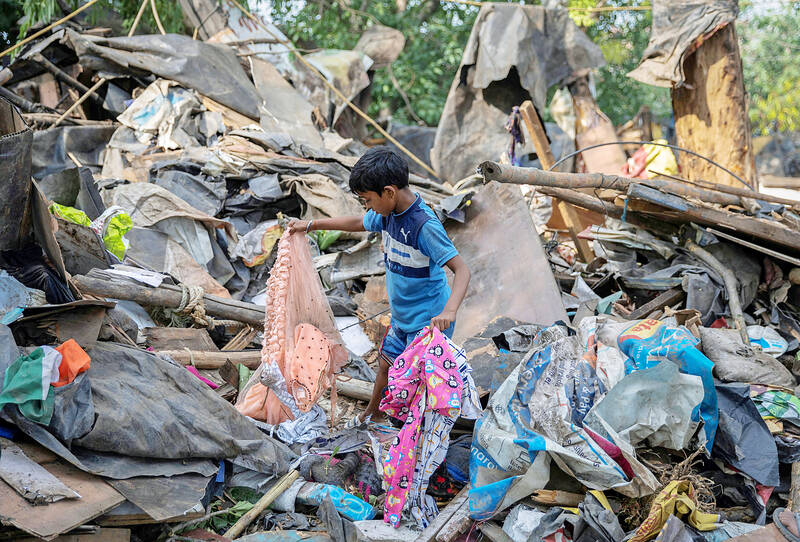
Photo: Reuters
Houses in slums like the one in Janta Camp are built over years, like patchwork. Most of the residents work in nearby areas and have lived within the confines of their small homes for decades.
The demolitions started four months ago. Bulldozers visited Janta Camp on a hot morning in May, and video footage of the demolition shows temporary houses made of tin sheets being razed to the ground, as people who once called them home stand watching, some of them breaking down in tears.
The camp, which sits near Pragati Maidan — the summit’s main venue — is emblematic of much of Delhi’s landscape. Many of the city’s 20 million residents live in largely unplanned districts that have mushroomed into existence over years.
In 2021, then-Indian minister for housing and urban affairs Hardeep Singh Puri told parliament that 13.5 million people reside in unauthorized colonies in Delhi.
“The government is demolishing houses and removing vulnerable people in the name of beautification without any concern about what will happen to them,” said Sunil Kumar Aledia, executive director and founding member of the New-Delhi based Centre for Holistic Development, which works with the homeless.
“If this had to be done, residents should have been warned in time and places found where they could have been rehabilitated,” he added.
India’s Supreme Court last month ruled that squatters cannot claim the right to occupy public land. At best, they can seek time to vacate the public land and apply for rehabilitation, it said.
At least 49 demolition drives were conducted in New Delhi from April 1 to July 27, with nearly 93 hectares of public land being reclaimed, Kaushal Kishore, then-junior minister for housing and urban affairs, told parliament in July.
“No house has been demolished to beautify the city for the G20 summit,” he said.
The demolition of the Janta Camp shanties came as a rude shock for Mohammed Shameem, another resident, who said he thought the “big people” attending the G20 summit would “give something to the poor.”
“The opposite is happening here. Big people will come, sit on our graves and eat,” he said.
For Kumar, who works as a clerk in a Pragati Maidan office, the demolition of his home and the eviction of his family had larger connotations.
“If we relocate from here, my children’s education will also suffer. Here they are able to study because the school is nearby,” he said.
The family, which also includes Khushboo Devi’s father, had been residing in their shanty for 13 years until they were asked to vacate the land “because the area had to be cleaned.”
“If they have to clean, that does not mean they will remove the poor. If the poor are looking so bad, they can make something nice, put a curtain or a sheet so that the poor are not visible,” Devi said.
As the bulldozers departed after reducing their homes to rubble, Kumar and his wife began organising their belongings, which lay strewn by the side of the road.
Afterwards, they piled these into a three-wheeler which transported them to their new accommodation - a single room located 10 km (6 miles) away, for which they paid a monthly rent of 2,500 rupees ($30.21).
Their daughter, meanwhile, carefully lifted a peach-coloured dress that had been thrown to the ground, along with everything else that her parents owned, and dusted it off.
Two months later, in August, the family returned to a part of the Janta Camp area that had been spared by the bulldozers, paying a higher rent of 3,500 rupees for a room.
“It was difficult for my children to go to school everyday from the place we were staying in earlier. I want them to study and do well, we returned for their sake,” Kumar said.
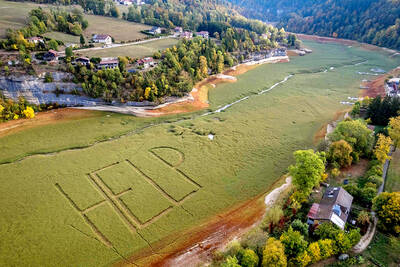
The picturesque Lac des Brenets between France and Switzerland has dried up after a record-breaking hot summer, leaving locals crying out for help to save the lake. Indeed, the words “HELP” and “SOS” have been scratched out in the weeds now flourishing on the exposed lake bed. The drought has ruined pleasure boat tourism, while some question whether the lake will ever return to enduring full health. “It’s absolutely heartbreaking,” said historian David Favre, who lives in Les Brenets. “As children, we used to spend all our summers swimming at the beach, having fun by the water, diving, jumping in and sometimes even

STRAIN ON TIES: The police arrested a 20-year-old man who matched the description of a suspect caught on CCTV leaving a hotel in Naha with the victim’s belongings A US Marine stationed on Japan’s southern island of Okinawa was arrested on suspicion of the murder of a Japanese woman, police said yesterday. The suspect “killed the 39-year-old woman at a hotel in Naha and stole her wallet on Saturday,” a local police spokesman said. US Ambassador George Glass posted on social media that he had spoken with Japan’s foreign ministry and Okinawa’s governor to offer “our sincere condolences and pledging full cooperation as the investigation continues.” Japanese Prime Minister Sanae Takaichi called the crime “exceptionally brutal and vicious” on X. The government has urged the US “to provide maximum cooperation

A US lawmaker has called on Starbucks to close its first stores in Xinjiang, China, calling it a “morally bankrupt decision” to do business in a region where Uighurs face repression. China denies widespread accusations about abuses of the Uighurs, a mainly Muslim people, saying its policies there were aimed at combating terrorism, separatism and religious extremism. Starbucks opened its first two stores this week in Xinjiang’s capital, Urumqi, including one at the city centre’s grand bazaar and a second at its international airport. John Moolenaar, chairman of the Select Committee on China of the House of Representatives, called on Starbucks to “immediately

The winner of this year’s Fat Bear Week has been crowned after a nail-biting final — and it’s the son of a former champion. Backpack, a 20-year-old male beloved by rangers in Alaska for his quiet determination, edged out female fellow finalist Dancing Queen in the annual ursine eating competition at Katmai National Park. More than 2.3 million people voted in the week-long competition that sees bears unwittingly jostle in a series of head-to-head contests to decide which one of them has most impressively piled on the pounds ahead of hibernation. Viewers watch a livestream of the enormous animals as they scoop salmon


 RSS
RSS