


Kenyan President William Ruto yesterday opened the first Africa Climate Summit by urging thousands of delegates in Nairobi to see the climate crisis as a unique opportunity for the continent to attract billions of dollars in investment.
Organizers say they anticipate hundreds of millions of dollars in deals to be announced at the three-day summit, during which they aim to showcase Africa as a destination for climate investment rather than a victim of floods, drought and famine.
African leaders are pushing market-based financing instruments, such as carbon credits, in a bid to mobilize funding that they say has been slow to arrive from rich-world donors.
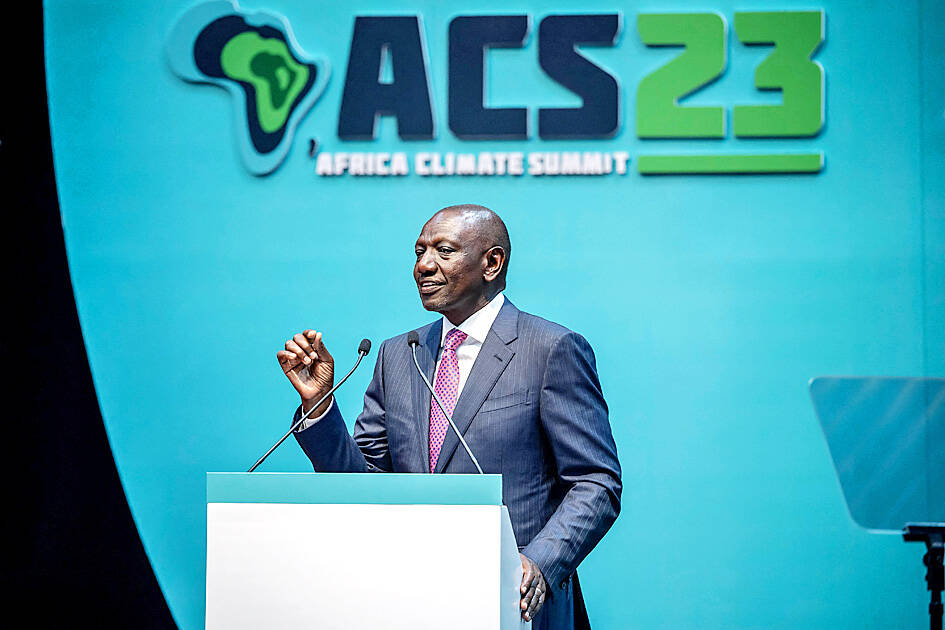
Photo: AFP
“For a very long time we have looked at this as a problem. It is time we flipped and looked it from the other side,” Ruto said.
“We must see in green growth not just a climate imperative, but also a fountain of multibillion-dollar economic opportunities that Africa and the world is primed to capitalize,” he said.
However, many African campaigners have opposed the summit’s approach to climate finance, saying it advances Western priorities at the expense of the continent.
They say carbon credits, which allow polluters to offset emissions by funding green activities, are a pretext for wealthier countries and corporations to continue polluting.
“Africa needs funding from countries that have got rich off our suffering. They owe a climate debt,” said Mohamed Adow, the director of energy at the Power Shift Africa think tank.
About 500 people yesterday marched in dowtown Nairobi to protest the summit’s agenda and demand financial compensation for climate damage from rich countries.
During yesterday’s sessions, environment ministers, business executives and climate campaigners were to discuss how to scale up climate finance and transform food systems.
More than 20 presidents and heads of government are expected to attend the summit from today. They plan to issue a declaration outlining Africa’s position ahead of a UN climate conference later this month and the COP28 UN summit from late November.
Companies and governments have begun announcing investments and financing commitments.
One of the top lenders in the Democratic Republic of the Congo, Rawbank, and global energy trader Vitol announced a US$20 million investment in renewable energy, clean cooking and forest conservation in the nation.
The UK’s Foreign, Commonwealth and Development Office said that £49 million (US$61.9 million) in projects would be announced over the course of the summit.
African countries are also hoping for debt relief from creditors to free up money to invest in renewable energy, conservation and climate adaptation.
A new working paper released by the Debt Relief for Green and Inclusive Recovery Project found that sub-Saharan African countries face annual debt servicing costs that are nearly the same as their climate finance needs.
Even as they push for investments in renewable energy, many African governments also want to develop hydrocarbons resources, particularly natural gas, saying they could accelerate the continent’s development while not contributing significantly to global carbon emissions.
Protesters at the Nairobi march oppose gas development, which they said would worsen climate change and was part of a “neo-colonial scramble” for Africa’s resources.

‘CROSSING THE LINE’: China’s embassy in Seoul criticized US Forces Korea Commander General Xavier Brunson, asking if his ‘hostile’ remarks were authorized by Washington South Korea and the US are in talks over recent public remarks by the commander of US Forces Korea, Seoul’s presidential office said yesterday, after the comments drew sharp criticism from China. In a recent podcast interview, US Forces Korea Commander General Xavier Brunson described South Korea as “the dagger in the heart of Asia” from China’s east coast, prompting the Chinese embassy in Seoul to say that he had “truly crossed the line.” The interview came amid growing speculation that Washington might seek to expand the role of US Forces Korea in countering the growing regional influence of China, a key

Through the noise of rushing papers and whirring belts at a print factory in Kyoto, two creators watch their photo essay come to life in broadsheet form — part of an effort to win new audiences in the age of artificial intelligence (AI). Despite the decline of the publishing industry, self-publication and handmade “zine” magazines are growing in popularity in Japan, reflecting the nation’s enduring love of paper in the digital era. While speaking to Agence France-Presse at the plant, his hands black with ink, one of the creators, Kazuma Obara, said: “I think [paper] is a medium that engages all five

Australian researchers have trained lab-grown brain cells on a silicon computer chip to play the 1990s shooter game Doom and said they are just scratching the surface of what the neurons could be capable of doing. It is the science-fiction work of biotech boffins at Cortical Labs, who researched and developed the technology that harnesses the workings of the brain’s networking system. Each so-called “biological computer” contains about 200,000 living human brain cells, grown from stem cells that were harvested from blood donations. Having mastered the simple computer game Pong, where a paddle is moved up and down to send a ball

A surprising gut feeling may help pigeons find their way home. Animals use various techniques to navigate, including following the stars and remembering key landmarks. Birds, fish and turtles orient themselves using Earth’s magnetic field as a compass, but it is not yet clear how exactly they do this. Pigeons are a well-known group of frequent flyers that can traverse hundreds of kilometers in a single day. For thousands of years, humans have used them to carry news, notes and military messages. Scientists have long tried to untangle how pigeons travel without getting lost. Some think the birds detect magnetic cues using light-sensitive


 RSS
RSS