


An unusually public claim by a Chinese professor that the national youth jobless rate might have hit close to 50 percent in March has stoked a debate about official data and a soft labor market, despite curbs on negative portrayals of the economy.
China’s National Bureau of Statistics said that month’s jobless rate for people aged 16 to 24 was 19.7 percent, less than half of what Peking University associate professor Zhang Dandan (張丹丹) estimated.
If 16 million non-students “lying flat” at home or relying on their parents were included, the rate at that time could have been as high as 46.5 percent, Zhang wrote in an online article in the financial magazine Caixin.
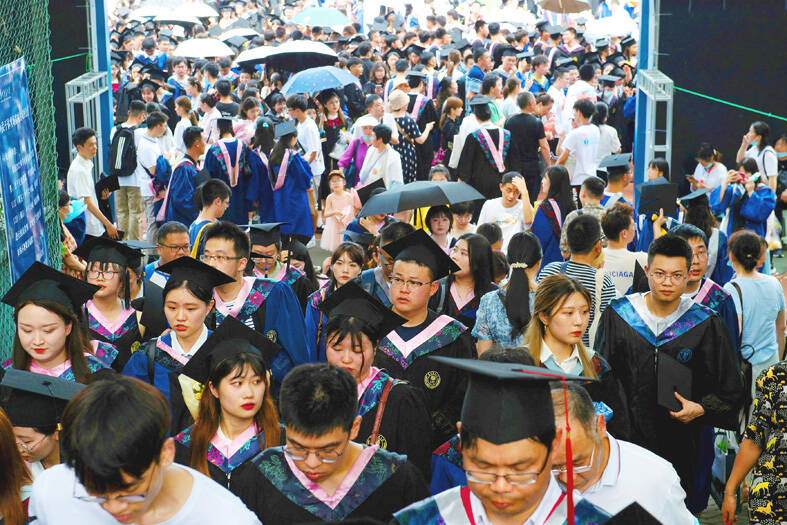
Photo: Reuters
The article by Zhang, associate professor of Economics at the university’s National School of Development, was published on Monday, but has since been removed.
The official youth jobless rate, which only includes people actively seeking work, rose further to a record 21.3 percent last month. Policymakers have struggled to put the economy on a more stable footing since the COVID-19 pandemic.
Zhang’s research focused in part on the impact of the outbreak on the manufacturing hubs of Suzhou and Kunshan in eastern China.
“Employment there only recovered to two-thirds of pre-COVID levels till March, when COVID faded,” she wrote. “Young people remain major workers in the manufacturing sector, so they were hit more badly.”
Additionally, regulations introduced since 2021 in the tutoring, property and online platform sectors have disproportionately hit young employees and the well-educated, she said.
Calls by Reuters to Zhang’s work phone went unanswered and the statistics bureau did not immediately respond to a request for comment.
One user on Sina Weibo yesterday said Zhang’s statistical methodology was flawed, as economists generally do not count people who are not actively seeking work when compiling estimates for joblessness.
However, other social media users focused on how hard it still is to find a job in China.
“The reason why so many graduate students flock to sit postgraduate or civil servant exams instead of looking for jobs is because they just cannot find jobs,” one Weibo user wrote.

Crowds in Bangladesh are flocking to snap photographs with an unlikely social media star — an albino buffalo with flowing blond hair nicknamed “Donald Trump” that is due to be sacrificed within days. Owner Zia Uddin Mridha, 38, said his brother named the 700kg bull over its flowing helmet of hair resembling the signature look of the US president. “My younger brother picked this name because of the buffalo’s extraordinary hair,” he said at his farm in Narayanganj, just outside the capital, Dhaka. Mridha said that a constant stream of curious visitors — social media fans, onlookers and children — have come throughout

It began as a satirical online project. Now millions of young people in India are flocking to it as an outlet for their frustration. A parody political party called the Cockroach Janta Party, with the insect as its symbol, has exploded across India’s social media by turning absurdist humor into protest. Memes and short videos mocking corruption, joblessness and political dysfunction have flooded social media sites, where millions of users are embracing the cockroach — known for its ability to survive harsh conditions — as a tongue-in-cheek symbol of endurance. The online movement’s rise has been unusually rapid. The Cockroach Janta Party (CJP)
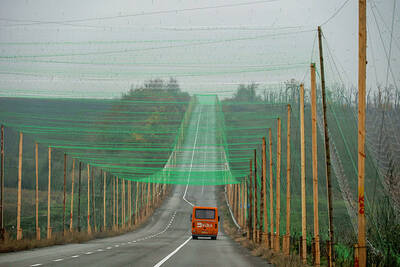
BIGGER ROLE: Beijing has said it maintains an impartial stance on the war in Ukraine, but by training Russian troops, China is far more involved than previously known China’s armed forces secretly trained about 200 Russian military personnel in China late last year, and some have since returned to fight in Ukraine, according to three European intelligence agencies and documents seen by Reuters. While China and Russia have held a number of joint military exercises since Moscow’s full-scale invasion of Ukraine in 2022, Beijing has repeatedly said that it is neutral in the conflict and presents itself as a peace mediator. The covert training sessions, which predominantly focused on the use of drones, were outlined in a dual-language Russian-Chinese agreement signed by senior Russian and Chinese officers in Beijing on
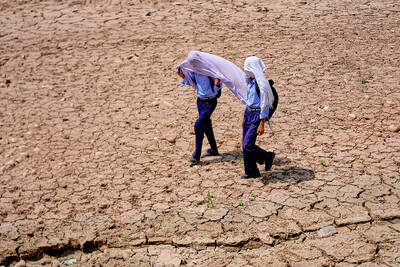
HOTTER: While Indians are accustomed to summer heat, climate change has caused northwestern India to warm faster than other parts of the country, an academic said Roads and markets have emptied during afternoons and some farmers have switched to nighttime work to avoid scorching temperatures as a heat wave grips large parts of India. The India Meteorological Department forecast maximum temperatures for yesterday of about 45°C in the capital, New Delhi, where authorities have opened temporary “cooling zones” to help people cope. The weather department warned that conditions would likely persist across several northern regions in the coming days, with temperatures staying well above seasonal averages. Authorities urged people to stay indoors during the hottest hours and take precautions against heat-related illnesses. India declares a heat wave whenever maximum temperatures


 RSS
RSS