


A disbarred Chinese human rights lawyer has been forced to move 13 times in two months as part of a pattern of harassment against him and three other prominent rights advocates in Beijing that is squeezing the country’s battered civil rights community.
Wang Quanzhang (王全璋) said he is living in a borrowed apartment in the suburbs of Beijing, where the power is frequently cut off.
His colleague Bao Longjun (包龍軍) said he is still living in the apartment he owns, but has been barred from leaving it multiple times by unidentified groups of men who loiter outside his door.
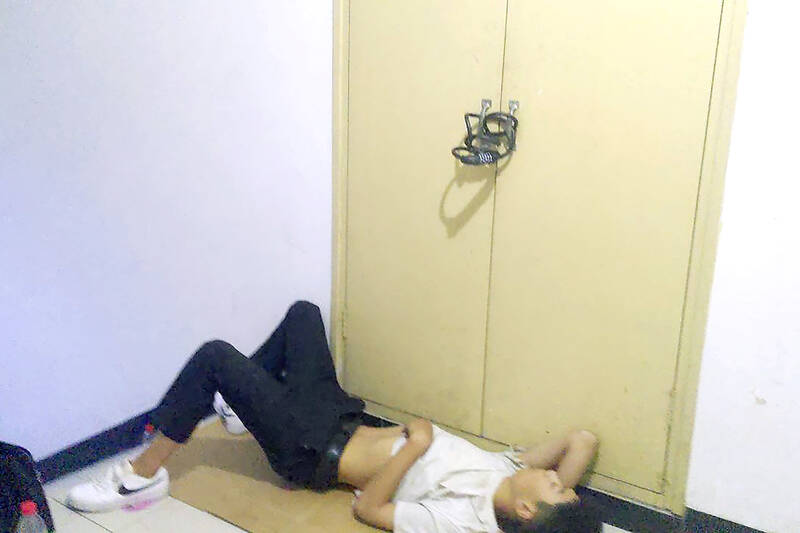
Photo: Wang Quanzhang via AP
Bao said a fourth lawyer was detained along with his wife.
All four are prominent members of a group known as the 709 lawyers, after the date — July 9, 2015 — when a crackdown on independent legal advocacy began, in which hundreds were arrested.
Such advocates are a rare source of help for people facing political charges, or trying to access benefits often denied by unaccountable bureaucracies.
Their work has ranged from defending members of Falun Gong, a religious movement opposed to the Chinese government and which Beijing has banned as an “evil cult,” to helping people lobby for pension increases.
The four men were disbarred after their 2015 arrests, but after being released from prison they continued to do similar work that does not require a law license.
The lawyers’ ordeals coincided with a series of high-profile visits by foreign dignitaries, Human Rights Watch senior China researcher Wang Yaqiu (王亞秋) said in a statement.
French President Emmanuel Macron visited Beijing in early April, followed by German Minister of Foreign Affairs Annalena Baerbock and most recently US Secretary of State Antony Blinken.
The meetings were intended to “signal China is open for business and engagement again. But the petty and inhumane treatment of human rights lawyers and their families show that the authorities only want to double down on repressing the Chinese civil society,” she wrote.
The Beijing Municipal Public Security Bureau did not respond to a request for comment.
In the middle of April, disbarred rights lawyer Yu Wensheng (余文生) and his wife were detained by Beijing police while on their way to the EU Delegation in Beijing, said Bao, who is one of the four advocates.
At about the same time, two other rights lawyers were sentenced to more than 10 years in prison on charges of “subverting state power.”
Groups of men began loitering in front of Bao’s and Wang Quanzhang’s doors, and told them they were not allowed to go outside.
The men did not say who they were or why they were there, the lawyers said, adding that they believe they are informal contractors for the police, a practice widely used by local Chinese governments to apply extralegal pressure to people they view as troublesome.
More pressure came via Wang Quanzhang’s landlord. At about the time that the men appeared, the landlord told Wang Quanzhang that his lease was no longer valid and his family had to move.
Initially, they refused, but after a few days, the apartment’s electricity, water and gas were cut off.
Another disbarred rights lawyer, Li Heping (李和平), and his family left Beijing after similar pressure, said Wang Quanzhang and Sophie Luo (羅勝春), an advocate based in the US.
Bao said the harassment is intended to pressure advocates to leave Beijing, adding that authorities likely hope they will return to their hometowns, where they would become another local government’s problem.
Wang Quanzhang and his wife are still in Beijing, after a month and a half of moving from apartment to hotel to apartment 13 times.
They have been followed to each location by groups of men in plain clothes who loiter nearby, unnerving landlords and neighbors.
At times, hotels have asked him to leave the same day they checked in, Wang Quanzhang said.
The longest they stayed in one place was a hotel that allowed them to stay for nine days. The couple eventually sent their 10-year-old son to live with relatives.
For the past week, they have been living an apartment in suburban Beijing owned by a friend, where the electricity is frequently cut off.
The first time, Wang Quanzhang was able to restore it by flipping a switch in a fuse box outside the apartment, but on other occasions, he found a bicycle lock on the fuse box, or more complex damage that required an electrician to repair, he said.
To cope with blackouts, the couple installed a solar panel to charge their phones, and stockpiled drinking water, rice and instant noodles, Wang Quanzhang said.
“Of course, I hope I can live a peaceful life,” he said. “I’m just living one day at a time.”

‘CROSSING THE LINE’: China’s embassy in Seoul criticized US Forces Korea Commander General Xavier Brunson, asking if his ‘hostile’ remarks were authorized by Washington South Korea and the US are in talks over recent public remarks by the commander of US Forces Korea, Seoul’s presidential office said yesterday, after the comments drew sharp criticism from China. In a recent podcast interview, US Forces Korea Commander General Xavier Brunson described South Korea as “the dagger in the heart of Asia” from China’s east coast, prompting the Chinese embassy in Seoul to say that he had “truly crossed the line.” The interview came amid growing speculation that Washington might seek to expand the role of US Forces Korea in countering the growing regional influence of China, a key

Through the noise of rushing papers and whirring belts at a print factory in Kyoto, two creators watch their photo essay come to life in broadsheet form — part of an effort to win new audiences in the age of artificial intelligence (AI). Despite the decline of the publishing industry, self-publication and handmade “zine” magazines are growing in popularity in Japan, reflecting the nation’s enduring love of paper in the digital era. While speaking to Agence France-Presse at the plant, his hands black with ink, one of the creators, Kazuma Obara, said: “I think [paper] is a medium that engages all five

Australian researchers have trained lab-grown brain cells on a silicon computer chip to play the 1990s shooter game Doom and said they are just scratching the surface of what the neurons could be capable of doing. It is the science-fiction work of biotech boffins at Cortical Labs, who researched and developed the technology that harnesses the workings of the brain’s networking system. Each so-called “biological computer” contains about 200,000 living human brain cells, grown from stem cells that were harvested from blood donations. Having mastered the simple computer game Pong, where a paddle is moved up and down to send a ball

France experienced its hottest spring on record, the French weather service said on Tuesday, after an exceptional early heat wave that also broke highs for the season in England and Wales. Meteo-France said the average nationwide temperature over March to May was 13.8°C — about 1.7°C above the norm, and surpassing records set in 2011 and 2020. “The warmest spring since records began in 1900,” it said in a bulletin. All three months were warmer than average, but the onset of an “unprecedented heatwave” late last month pushed the mercury to highs typically seen at the height of the summer. “Our country had never


 RSS
RSS