


The US Supreme Court on Thursday upheld a law that gives native American families priority in adoptions and foster care placements of indigenous children.
In a 7-2 vote, the court rejected challenges to the US’ Indian Child Welfare Act (ICWA) brought by a non-native American couple seeking to adopt an indigenous child and the state of Texas.
They had said that the ICWA, passed by the US Congress in 1978, was unconstitutional and discriminates on the basis of race.
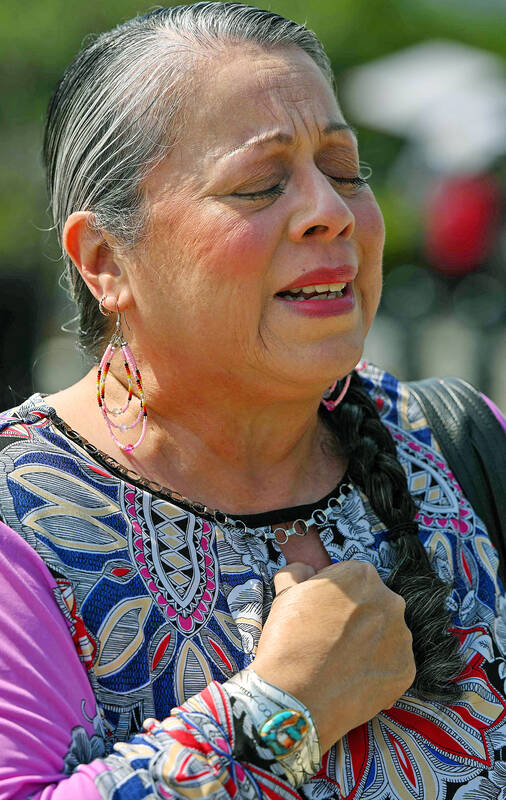
Photo: AFP
“The issues are complicated,” said US Justice Amy Coney Barrett, who authored the majority opinion.
“But the bottom line is that we reject all of petitioners’ challenges to the statute, some on the merits and others for lack of standing,” said Barrett, who is the mother of two adopted children of Haitian origin.
Like in Canada, native American children in the US were for decades removed from their biological parents and placed in boarding schools or with non-indigenous families as part of a policy of forced assimilation.
Congress sought to bring an end to the practice with the passage of the ICWA, which set strict standards for removing native American children from their parents, and required indigenous families to receive priority for foster care placements and adoptions.
Republican-led Texas, as well as families restricted by the ICWA from adopting native American children, filed a legal challenge under the US Constitution’s 14th Amendment, which limits the differentiation between citizens on the basis of race.
Several native American tribes, backed by the administration of US President Joe Biden and rights organization American Civil Liberties Union (ACLU), said that the law was not based on race, but on indigenous groups’ sovereign rights.
Under US law, native American tribes have a special status with their own legal jurisdictions and court systems.
The US Supreme Court intervened in the case after lower courts issued divergent opinions.
Biden welcomed the court ruling.
“Our nation’s painful history looms large over today’s decision,” he said in a statement. “In the not-so-distant past, native children were stolen from the arms of the people who loved them.”
“The Indian Child Welfare Act was passed to protect the future of tribal nations and promote the best interests of native children, and it does just that,” he said.
The ACLU called the ruling a “landmark victory for tribal sovereignty.”
“Tribes have a fundamental right to govern themselves and make decisions on issues that affect their own people — including native children — without interference from federal or state governments,” ACLU’s Racial Justice Program staff attorney Crystal Pardue said.
“Native families have a right to stay together, care for their children and preserve tribal culture by ensuring access to their cultural identity, language and heritage,” Pardue said.
The ACLU said that despite the court ruling, the “work is far from over.”
“Today, states still continue to remove native children from their families and tribes at alarmingly high rates,” the rights group said.

‘CROSSING THE LINE’: China’s embassy in Seoul criticized US Forces Korea Commander General Xavier Brunson, asking if his ‘hostile’ remarks were authorized by Washington South Korea and the US are in talks over recent public remarks by the commander of US Forces Korea, Seoul’s presidential office said yesterday, after the comments drew sharp criticism from China. In a recent podcast interview, US Forces Korea Commander General Xavier Brunson described South Korea as “the dagger in the heart of Asia” from China’s east coast, prompting the Chinese embassy in Seoul to say that he had “truly crossed the line.” The interview came amid growing speculation that Washington might seek to expand the role of US Forces Korea in countering the growing regional influence of China, a key

Through the noise of rushing papers and whirring belts at a print factory in Kyoto, two creators watch their photo essay come to life in broadsheet form — part of an effort to win new audiences in the age of artificial intelligence (AI). Despite the decline of the publishing industry, self-publication and handmade “zine” magazines are growing in popularity in Japan, reflecting the nation’s enduring love of paper in the digital era. While speaking to Agence France-Presse at the plant, his hands black with ink, one of the creators, Kazuma Obara, said: “I think [paper] is a medium that engages all five

Australian researchers have trained lab-grown brain cells on a silicon computer chip to play the 1990s shooter game Doom and said they are just scratching the surface of what the neurons could be capable of doing. It is the science-fiction work of biotech boffins at Cortical Labs, who researched and developed the technology that harnesses the workings of the brain’s networking system. Each so-called “biological computer” contains about 200,000 living human brain cells, grown from stem cells that were harvested from blood donations. Having mastered the simple computer game Pong, where a paddle is moved up and down to send a ball

France experienced its hottest spring on record, the French weather service said on Tuesday, after an exceptional early heat wave that also broke highs for the season in England and Wales. Meteo-France said the average nationwide temperature over March to May was 13.8°C — about 1.7°C above the norm, and surpassing records set in 2011 and 2020. “The warmest spring since records began in 1900,” it said in a bulletin. All three months were warmer than average, but the onset of an “unprecedented heatwave” late last month pushed the mercury to highs typically seen at the height of the summer. “Our country had never


 RSS
RSS